
The Strategic Importance of Advanced Security Intelligence in Modern Operations
The rapid expansion of digital infrastructure has transformed how businesses operate, communicate, and manage risk. From cloud-based platforms and remote work systems to interconnected supply chains and automated industrial processes, modern organisations now depend heavily on digital environments to maintain daily operations. While this transformation has improved efficiency and scalability, it has also created a more complex and volatile threat landscape.
Cybersecurity experts warn that attacks against businesses are becoming more targeted, organised, and financially motivated. Criminal groups are increasingly using advanced techniques to bypass traditional defences, compromise sensitive data, and disrupt essential systems. In response, companies are shifting away from reactive security models and investing more heavily in intelligence-driven strategies designed to detect threats before they escalate.
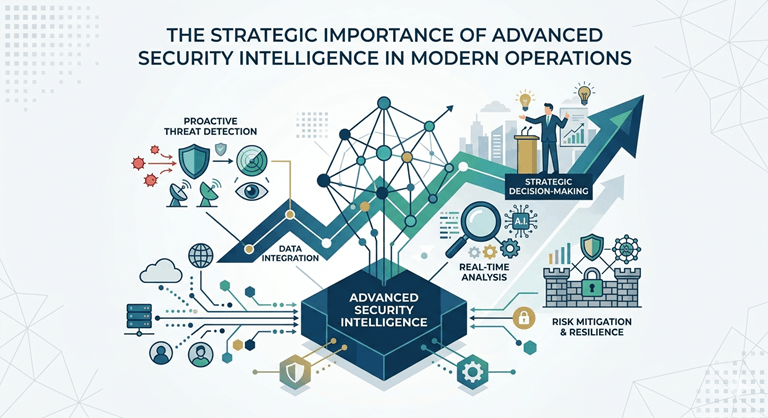
This transition has elevated the importance of advanced security intelligence across industries, including finance, healthcare, logistics, energy, and government services. Security leaders now view intelligence gathering and analysis as essential operational functions rather than supplementary technical tools.
Businesses Are Facing More Sophisticated Threats
The scale and sophistication of cyber threats have increased significantly over the past decade. Attackers are no longer relying solely on broad, opportunistic campaigns. Many operations now involve extensive reconnaissance, credential theft, social engineering, and long-term infiltration strategies aimed at high-value targets.
Ransomware remains one of the most disruptive threats facing organisations worldwide. However, cybersecurity analysts say modern attacks increasingly combine multiple tactics, including data exfiltration, extortion, and attacks on third-party suppliers. Criminal groups often exploit weaknesses within interconnected systems rather than focusing exclusively on individual networks.
The rise of hybrid working has also expanded the number of potential vulnerabilities businesses must manage. Employees accessing corporate systems remotely through multiple devices and cloud applications have created more dispersed digital environments, making visibility and monitoring more challenging.
Intelligence-Led Security Is Reshaping Corporate Strategy
Security intelligence is more than just monitoring tools. The contemporary intelligence tools include network analysis, behavioural data, machine learning and real-time threat feeds to detect suspicious activity in complex digital environments.
The goal is not just to prevent attacks, but to gain insight into the behaviour of attackers, recognise operational risks, and take measures to ensure disruption does not occur, which could impact the business significantly, according to industry experts. There is an intelligence-led aspect to this model, which enables organizations to prioritize threats based on their severity, impact on the business, and the likelihood of exploitation.
Even as the number of cyber incidents and threats is growing, corporate boards are increasingly involved in cybersecurity governance matters. Investors, insurers, and regulators are now increasingly calling on businesses to have measurable resilience measures that are continuously monitored and analysed.
This has affected the allocation of cybersecurity budgets in companies. When it comes to security, rather than just endpoint protection or firewall systems, businesses are looking at investing in security operations centres, forensic analysis, and integrated intelligence platforms that can provide real-time situational awareness.
Particularly, financial institutions, healthcare, and energy companies have been active in enhancing their intelligence capabilities, considering the sensitivity of their operations and the impact of data loss on their systems.
The Role of Digital Investigations in Cybersecurity
With the speed and accuracy of investigation now a key element of modern operations, it is essential to be able to do it quickly. Digital investigations can assist organisations in gaining insight into the extent of the breach and the systems that were breached, as well as the presence of the attacker in a network.
Forensic analysis shouldn’t be limited to after-the-fact investigations, cybersecurity experts say. Forensic tools are increasingly used as part of actual threat monitoring programmes to increase the chances of detection and speed up containment steps.
Across the Middle East, investment in cyber resilience has accelerated as governments and enterprises continue expanding digital infrastructure projects. Organisations seeking specialised expertise in digital forensics and incident response in the UAE are focusing on capabilities that combine rapid investigation, threat containment, and regulatory compliance support within high-risk operational environments.
In particular, sectors that operate with critical infrastructure, financial transactions, and large-scale systems of customer data have seen a rapid growth in demand for advanced incident response services. The speed of response can make the difference between an incident being contained and spreading to become an operational crisis, according to security experts.
Supply Chain Visibility Has Become Essential
In the modern cybersecurity strategy, the shift towards supply chain risk is one of the most important. External technology vendors, software vendors, and cloud-based services have become vital to businesses to support their core business.
An interconnected structure has opened up new opportunities for attackers. In recent years, a number of high-profile incidents have occurred whereby the breach was made by third parties who offered access to larger corporate networks. Smaller businesses are often the first to be attacked by hackers, and are generally less robustly secure before being attacked horizontally to higher-value targets.
Advanced security intelligence is one of the crucial elements in detecting those risks. Intelligence platforms are now being employed by organisations to keep track of vendor activity, to evaluate external vulnerabilities, and to look for any unusual activity within interconnected systems.
There is also a growing push from regulators on companies to show increased third-party oversight. The critical role of suppliers could lead to regulatory criticism in sectors like finance and healthcare. Suppliers could become a point of interest in industries like finance and healthcare if their weaknesses are linked to significant incidents.
Experts say that digital supply chain monitoring will be among the biggest operational security investments of the future, as digital ecosystems continue to grow.
Artificial Intelligence Is Changing Both Defence and Attack Methods
The threats in the external environment are being transformed by AI, as are those in the internal environment of cybersecurity operations. AI-powered systems are becoming a key weapon in the arsenal of security teams, which are increasingly turning to intelligent tools to proactively detect threats, patterns, and anomalies in vast data streams.
Organisations can identify suspicious activity within their networks and environments that might not be caught by traditional security measures by leveraging machine learning tools. This enables security analysts to concentrate on high-risk risks instead of manually going through all of the normal activity logs.
But cyber criminals are using AI technologies as well to enhance the effectiveness of attacks. The use of AI to create phishing emails, automated vulnerability scanning attacks, and even more believable social engineering methods has been observed by security researchers.
In this technological battle, the demand for smart technologies with the ability to rapidly evolve new attack strategies has grown. Organisations that don’t modernise security operations could find themselves facing difficulties in keeping sight of things in a more dynamic environment, analysts believe.
Regulatory Pressure Is Increasing
Governments and regulators worldwide are imposing stricter cybersecurity requirements as digital risks continue to grow. Businesses handling financial records, healthcare information, or critical infrastructure data face particularly strong oversight regarding incident reporting and operational resilience.
Data protection laws in the UK and Europe have put organisations on notice that in that region, if they have suffered any security incident that included customer data, they are held accountable. As governments are developing national cyber resilience plans, similar frameworks are starting to appear in other parts of the Middle East and Asia.
Executives are under increasing pressure to show that cybersecurity is part of the overall business planning process – not a technical exercise.
Security intelligence serves this purpose by assisting organisations to be more aware of new and emerging risks, to document response processes, and to have more visibility over the operational systems. Organizations that have a more developed intelligence function tend to be more ready to comply with the regulatory requirements, to react during a crisis, and be generally better equipped to meet regulatory expectations, according to analysts.
Cyber Resilience Is Now a Competitive Requirement
The strategic value of security intelligence is the latest development in the evolution of businesses’ thinking on operational resilience. Cybersecurity is no longer looked at only as a defensive weapon. It is seen more and more as a contributing factor to customers’ trust, investor confidence, and business continuity.
Early and efficient identification of threats and their effective response can help organisations to reduce financial losses, reduce operational instability, and protect their reputational credibility after incidents.
This is especially significant in areas where interruptions in service may impact the delivery of public services or the supply chain and/or financial systems. Companies are thus investing in consolidated security strategies encompassing intelligence analysis, incident response planning, and ongoing operations monitoring.
As digital transformation continues to speed up, the business strategy-cybersecurity relationship will keep growing stronger, industry observers believe. It’s unlikely that businesses that look at intelligence-led security as an investment for the long-term will be so well equipped to face an evolving, volatile threat landscape.
With the constant change in cyber risks, cutting-edge security intelligence is shifting from simply being a technical solution to being a way to help organizations thrive in today’s super-connected global economy.
Popular on OTW Right Now!



About The Author

Gagan Bhangu
Founder of otechworld.com and managing editor. He is a tech geek, web-developer, and blogger. He holds a master's degree in computer applications and making money online since 2015.