
The Tech Behind Your Bottled Drink: How Sensors and Smart Filtration Keep Every Batch Identical
Here’s something worth noticing next time you open a bottle of anything: it tastes exactly like the last one. Not approximately. Exactly. Same clarity, same carbonation, same finish, from a batch produced months apart in a different season from a different harvest.
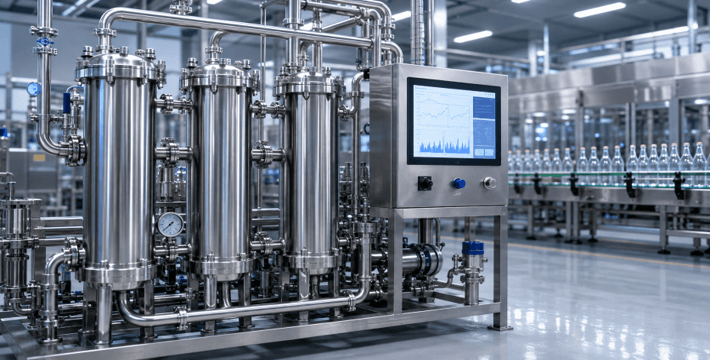
That is not a recipe achievement. It’s an engineering one, and most of it happens in a stainless steel skid that nobody photographs for the marketing site.
Why beverages stopped being boiled
For much of the past 100 years, the solution to microbiological safety was to use heat. Pasteurize it, and any living material that was in it is gone.
Heat also causes loss of valuable items that are meant to be preserved. It mutes aromatics in beer, tones down the fruit in juice, and imparts a cooked flavor to anything light. Producers had to find a way to achieve the same safety level as the “fresh” and/or “unpasteurized” and/or “craft” consumers wanted, but without cooking the product.
The solution was to remove the microorganisms physically – by cold sterile filtration. Which makes a biology problem a precision engineering problem? Precision engineering problems are solved with sensors, which makes a biology problem a precision engineering problem.
The stack, from coarse to sterile
No one takes a drink of a beverage in one filter. It goes through a series of graded filters, each blocking the next, as fine filters are high-cost and easily clog if unfiltered product is fed into them.
A typical arrangement runs something like this. A coarse prefilter at 10 to 70 microns catches the obvious: sediment, pulp fragments, filter aid carryover, crystal formations from cold stabilization. A fine filter in the 1 to 5 micron range removes haze-forming particles and yeast, and on a soft-drink line does the unglamorous but critical job of keeping filling nozzles from blocking mid-run. Then a final membrane, typically 0.45 micron for clarification or 0.2 micron for sterile duty with specialist grades down to 0.02, removes the bacteria and remaining yeast that would otherwise restart fermentation in the bottle.
A comparison of scale is that a human hair is approximately 70 microns in diameter. At production flow rates, it continuously filters particles around 350 times smaller than that through a 0.2-micron membrane.
Various products highlight different areas of the stack. Wine requires clarification, which does not remove the phenolic character. The challenges for beer are to remove the yeast and treatment residue and to maintain a stable haze, yet preserve a good head. Dairy plants make the same application of the discipline to their utilities, and all the water, steam, and compressed air that come into contact with the product are filtered as well. The bottled water industry is primarily a particle problem. Specialist suppliers build food and beverage filtration trains around each of those profiles rather than selling one cartridge for everything, and the materials matter as much as the ratings: FDA-compliant polypropylene, PES or nylon media, chosen specifically because they don’t leach anything that would show up in the taste panel.
The part that’s actually software
Here’s where it becomes a tech story rather than a plumbing one.
All filters have a limited lifespan. The more particles it can trap, the greater the flow resistance. If you change it too soon, you are wasting money on consumables, and if you change it too late, you can experience a pressure excursion that can cause damage to the membrane and result in unfiltered product going into a bottle.
Modern lines solve this with differential pressure monitoring: sensors on the inlet and outlet of each housing, feeding a PLC that plots the delta over time. The shape of the curve is very well known. The system no longer has to guess when to replace the filter; it alerts operators well before the filter reaches its end of life by monitoring the slope and comparing it to the product’s historical slope. Similar to SMART monitoring on an HDD, it measures the degradation signal and takes action before the failure.
On top of that, a layer flow sensor, turbidity sensor, and inline temperature sensor can detect a fault in seconds, and the control system will be able to catch it. If, for example, the differential pressure suddenly decreases, then the filter does not necessarily have improved. This typically indicates it has formed a bypass and the line should be stopped right away.
Integrity testing: proving the filter is intact
The most critical test on a sterile line is the one that verifies there are no defects in the membrane, since a filter with a pinhole appears and performs nearly identical to an active filter.
The conventional technique is a bubble point or diffusion test. Clean gas is applied to the wetted membrane and the system records either the pressure at which the gas starts to flow or the flow rate of the gas at a given pressure. Both are proportional to the pore size. A leaky membrane leaks; a leak-proof membrane holds.
This was once a “manual” process that required a stopwatch and the technician’s skill. It is now an automated process that is performed prior to and after each batch, and the result is registered, dated, and linked to the batch record. When the filter was in place at the time of bottling batch 4471, it is a data point, not a recollection, when asked during an audit.
What this means for what you’re drinking
Three practical things. Consistency is monitored, not hoped for, because the numbers behind each batch are recorded and comparable. “Unpasteurized” doesn’t mean unprotected, because it usually means the safety step was mechanical rather than thermal, which is why the product tastes fresher. And traceability is real, because a well-run plant can tell you which cartridge lot, which integrity test result, and which pressure trace belongs to the bottle in your hand.
Where it’s heading
This is not calendar-based; rather, it’s direction-of-travel-based. Predicted changeouts based on pressure curves rather than on a date. Remote monitoring with the ability for a supplier to alert the customer to an unusual trend at the customer’s location. Automatic adjustment of filtration parameters as per product, not season.
It’s the same transition that took place with server infrastructure 10 years ago, from rigid maintenance schedules to proactive monitoring and predictive response. It happens to be behind a stainless steel panel and determines the taste of your drink.
Popular on OTW Right Now!



About The Author

Gagan Bhangu
Founder of otechworld.com and managing editor. He is a tech geek, web-developer, and blogger. He holds a master's degree in computer applications and making money online since 2015.