
Stop Wasting Money on Unused Software Licenses: How AssetSonar’s License Tracker Works
Introduction
Modern enterprises run on software, but managing the vast web of SaaS applications, desktop software, and cloud environments has become a logistical nightmare. As more businesses extend their online presence to a distributed workforce, there is a pressing need to balance the software needs of their distributed businesses with the hard realities of constrained IT budgets.
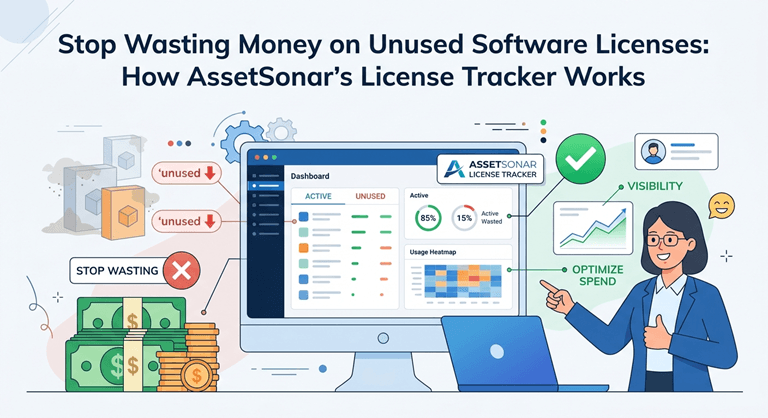
Too many companies pay for software features that they never use. In the absence of depth of visibility, IT departments tend to over-provision and waste a ton of money, and cause a lot of friction. There are some hidden costs to unmanaged software portfolios, and a sophisticated software tracking solution like AssetSonar can help organizations maximize ROI, ensure compliance, and regain control of their software investments.
The Hidden Cost of Unused Software Licenses
Why companies overspend on software subscriptions
Over-expenditure on software is not a phenomenon that simply happens one day, but rather it slowly and insidiously sneaks in through departmental siloes. Sometimes, one team will buy specific software without central IT’s permission, using a company credit card—a practice that is referred to as Shadow IT. If procurement is not coordinated at a central level, companies end up purchasing the same tools or paying exorbitant retail prices rather than being able to purchase enterprise volume discounts.
Common causes of unused and underutilized licenses
The primary driver of software waste is a lack of real-time operational visibility. Common organizational root causes include:
- Abandoned Onboarding: Licenses are provisioned to employees during onboarding, but remain unused if workflows change.
- Neglected Offboarding: When employees leave an organization, their active software profiles are frequently forgotten, leaving expensive seats open and active for months.
- Feature Overlap: Purchasing multiple platforms that serve the absolute same function (e.g., hosting active subscriptions for Zoom, Microsoft Teams, and Webex simultaneously).
The financial impact of poor software license visibility
The cost of underutilized software is staggering. Industry data suggests that up to 30% of all software spending is wasted on unused or under-allocated applications. This is hundreds of thousands of dollars that an enterprise is losing out on from its balance sheet, or funds that could be invested in strategic security or infrastructure projects.
Challenges of managing licenses in remote and hybrid workplaces
New asset management techniques are required to address the new paradigm of remote and hybrid working environments. If workers are spread out throughout global time zones and home networks, monitoring software use through local pings to machines becomes difficult. IT teams find it difficult to track software deployment on laptops located away from their office, resulting in a company’s potentially high susceptibility to unauthorized software use, security vulnerabilities, and uncontrolled SaaS sprawl.
What Is Software License Tracking?
Definition of software license management
Software License Management (SLM) is software management as an ongoing business process that involves documenting, monitoring, and optimizing software footprints. It spans from initial procurement, deployment, tracking its usage, compliance auditing, through to its eventual retirement.
How license tracking helps control software spending
License tracking offers fact and evidence-based proof of actual software use. Rather than negotiating with vendors on a seat count basis, IT leaders can back it up with hard data on how many seats are being used. When the data indicates that only 70 of 100 provisioned Salesforce seats were used over the past 90 days, the company can rest assured that it can easily downscale its Salesforce contract and instantly reduce its recurring costs.
Difference between manual tracking and automated systems
Numerous firms try to manage software via manual asset spreadsheets. But it doesn’t work long-term as an organisation gets bigger.
|
Feature |
Manual Tracking (Spreadsheets) |
Automated Tracking Systems |
|
Data Accuracy |
High risk of human error; rapidly becomes outdated. |
Real-time discovery; constantly synchronized. |
|
Visibility |
Relies on self-reporting from employees. |
Automatically captures active background usage. |
|
Alerting |
Requires manual calendar tracking for renewals. |
Triggers proactive, automated expiration notifications. |
|
Audit Readiness |
Weeks of stressful data aggregation. |
Instant, single-click compliance reporting. |
Why modern organizations need centralized license visibility
No one can track the performance of their enterprise apps if they are spread out across desktops, mobile devices, and private clouds — there are blind spots. Today’s businesses need one central window to connect the dots between users, physical devices, and running software assignments. Centralization means IT, procurement, and finance teams are aligned on a single, true source of information.
How AssetSonar’s License Tracker Works
[Software Ecosystem] ──> [AssetSonar Discovery Agents] ──> [Centralized Dashboard]
(SaaS, Cloud, On-Prem) │
├──> Real-Time Usage Reports
└──> Automated Renewal Alerts
Centralizing software license data in one platform
AssetSonar consolidates your entire software inventory into one unified dashboard. It installs cloud discovery integrations and lightweight software agents on endpoint devices, creating a holistic inventory of all software assets in your environment in order to remove the painful tracking silo.
Tracking software usage and allocation in real time
The platform doesn’t record only that a program has been installed; it records what active users are doing. It records when an app is last opened, how long it’s open for, and whether it’s being used for work or not.
Monitoring subscription renewals and expiration dates
You may experience unexpected service interruptions if you miss an important software renewal date, and you can unwittingly be charged for services that you don’t want if you forget to cancel a contract. Every contract timeline is recorded on AssetSonar, allowing procurement teams to consider the worth of the subscription before money is tied up.
Identifying unused and inactive software licenses
The platform also alerts to “ghost” licenses that remain unopened for a set amount of time (e.g., 30, 6,0 or 90 days) with customizable inactivity thresholds. This provides IT admins with exactly the target lists they need to confidently reclaim and harvest idle seats.
Managing SaaS, on-premise, and cloud software assets
Modern software portfolios are complex hybrids. The tracking engine natively handles this diversity by monitoring:
- SaaS Platforms: Cloud-hosted, per-user monthly subscriptions (e.g., Microsoft 365, Adobe Creative Cloud).
- On-Premises Software: Traditional legacy installations tied to physical hardware endpoints.
- Cloud Deployments: Cloud instances running across infrastructure-as-a-service (IaaS) environments.
Automating alerts and renewal notifications
Say goodbye to missed milestones. The platform has a built-in notification system, which provides automated email notifications to system owners in advance of future renewal dates, contract end dates, or compliance violations.
Generating reports for license optimization
The reporting templates include pre-built financial charts that will convert raw usage logs into clean, financial, executive-ready charts. These analytics immediately identify over-licensing and under-use situations and take action before the next billing period.
Key Features of AssetSonar’s License Tracker
- Real-Time Software Inventory Management: Automatically discovers newly installed software across the network to maintain a perpetually accurate, real-time asset ledger.
- User and Device-Based License Assignment: Maps license keys accurately to specific employees or individual hardware units, ensuring clear ownership records.
- Software Usage Monitoring and Analytics: Captures background process usage to distinguish between an application that is simply installed and one that is actively being used.
- Automated Compliance Tracking: Automatically calculates your current license entitlement count against your actual installations, providing a clear visual indicator of your compliance status.
- Custom Reporting and Dashboards: Allows you to build tailored data views based on specific business criteria, such as tracking software spend by department or geographical location.
- Integration with IT Asset Management Workflows: Ties your software tracking directly into hardware lifecycle management, IT helpdesks, and procurement systems.
- Multi-Location and Remote Workforce Support: Uses cloud-native discovery agents to easily track devices and software instances for remote workers, without requiring a VPN connection.
How AssetSonar Helps Reduce Software Costs
Eliminating unnecessary license renewals
With real usage data, the negotiation process with vendors becomes much more data-driven, allowing your procurement team to go into annual vendor negotiations with confidence. Using patterns of usage to determine if demand is lower, you can lower your renewal count to match the actual usage, so you’re not wasting money over and over.
Reallocating unused licenses to active employees
The License Harvesting Mode. This model will let the platform find an idle seat in the company, revoke it, and allocate it to the new user, thus ensuring that the new software is used without any new purchase.
Preventing duplicate software purchases
If you’re working in teams where each department gets its own tools, they are very likely to end up with some duplicate solutions. Centralized asset tracking identifies these redundancies and enables IT managers to be able to agree on a single vendor and to obtain enterprise discounts based on volume.
Improving software budgeting and forecasting
Automated tracking transforms the way software consumption can be estimated into predictable forecasting models. Finance teams can use upcoming contract expirations and past growth to provide extremely accurate software budgets for the next fiscal year.
Supporting smarter procurement decisions
No longer will you be making your seat count based on vendor sales pitches, but instead, you will have objective telemetry data. This puts pressure back on your business when it comes to negotiations, and procurement purchases are matched to the requirements of your enterprise.
Benefits of Using AssetSonar for License Management
- Better Visibility Into Software Assets: Reclaim complete visibility over your digital environment by exposing shadow IT and unmanaged cloud instances.
- Reduced Software Waste and Overspending: Instantly plug budget leaks by identifying, harvesting, or canceling underutilized or abandoned subscriptions.
- Improved IT Operational Efficiency: Automate data collection to save your IT engineering team from hours of manual inventory audits.
- Simplified Software Audits and Compliance Preparation: Minimize the risk of steep financial penalties from publisher true-up audits by maintaining a continuous, audit-ready compliance posture.
- Enhanced Decision-Making with Usage Insights: Back corporate software standards and productivity initiatives with empirical, objective data.
- Greater Control Over Enterprise Software Environments: Protect your organizational boundaries by ensuring that only authorized, securely patched, and properly licensed software runs on company endpoints.
Common Software License Management Challenges
- Tracking Across Multiple Departments: Decentralized purchasing makes manual reconciliation across disparate business units nearly impossible.
- Managing SaaS Sprawl in Growing Organizations: As companies scale, the volume of niche, low-cost subscriptions quickly multiplies out of control without automated guardrails.
- Keeping Up with Renewals and Vendor Contracts: Managing varying contract terms, master service agreements, and renewal timelines manually creates a high risk of oversight.
- Balancing Compliance and Cost Optimization: Avoiding under-licensing (which triggers vendor audit fines) while preventing over-licensing (which causes shelfware waste) requires constant balancing.
- Handling Employee Onboarding and Offboarding Efficiently: Manually assigning and reclaiming software access during staff transitions creates operational delays and security gaps if left unmanaged.
Best Practices for Optimizing Software Licenses
- Regularly Audit Software Usage: Schedule quarterly reviews of your core enterprise application pools to catch inactive user accounts early.
- Create Standardized License Workflows: Require all software requests to route through a central approval portal to prevent the expansion of shadow IT.
- Monitor Renewal Dates Proactively: Set your primary contract alert notifications to trigger 60 to 90 days in advance, allowing sufficient time for vendor negotiations.
- Remove Inactive Users and Devices: Create automated policy triggers to immediately revoke software access when an account shows no activity for more than 30 days.
- Leverage Automation to Reduce Manual Labor: Replace error-prone administrative tasks with automated discovery, alerting, and reporting systems.
Why Businesses Choose AssetSonar for License Tracking
Scalable license management capabilities
The platform is designed to grow with your company. It supports high data throughput with ease, whether you’re deploying tens of thousands of software licenses across the globe for compliance,r handling the complexities of compliance deployments, or managing hundreds of licenses.
Support for distributed IT environments
Cloud-first collection methods help track software usage and provide accurate data regardless of where the employee is located, be it at headquarters, a regional branch, or a remote site.
Automation-driven asset visibility
Manual data entry is eliminated,d and human error is eliminated from the asset management equation by using intelligent automation. Continuous scanning, alerting, and reporting of your software footprint gives IT teams the freedom to manage by exception and not chase data.
Integration with broader IT asset management strategies
Software doesn’t exist in a vacuum. Because AssetSonar is a comprehensive IT Asset Management (ITAM) ecosystem, it seamlessly links software license profiles to hardware lifecycle tracking, network discovery, and internal helpdesk workflows, providing an all-in-one IT management framework.
Conclusion
It is a fact that unmanaged software portfolios require increasing costs of operation, potential compliance issues,s and lost budget. With AssetSonar, organizations can address this problem by centralizing software monitoring, gaining real-time usage analytics, and automating the entire software renewal and allocation process.
With a business economy focused on costs, software budgets are a no-brainer. In the days of software, it is not possible to purchase software without some sort of knowledge. The AssetSonar license tracker will help companies safeguard their budget from software waste, stay permanently compliant, and create a much more optimized and future-proof digital workplace.
Popular on OTW Right Now!




About The Author

Gagan Bhangu
Founder of otechworld.com and managing editor. He is a tech geek, web-developer, and blogger. He holds a master's degree in computer applications and making money online since 2015.