
What’s Actually Included in AI Agent Development Services: Discovery, Build, Evals, and Handover?
Introduction
The gap between a solid pilot and something truly production-ready often ends up being the deciding factor for enterprises today. While 88% of organizations now use AI in at least one business function, only 7% have managed to scale these systems across their entire enterprise.
The narrative changes when you move from plain task automation into something more agentic, like AI that reasons, adjusts, and carries out complicated workflows without constant hand-holding.
Making that shift work is not just about technical tinkering; it requires a structured lifecycle approach. Adopting professional AI agent development services ensures these deployments provide measurable ROI rather than remaining experimental outputs.
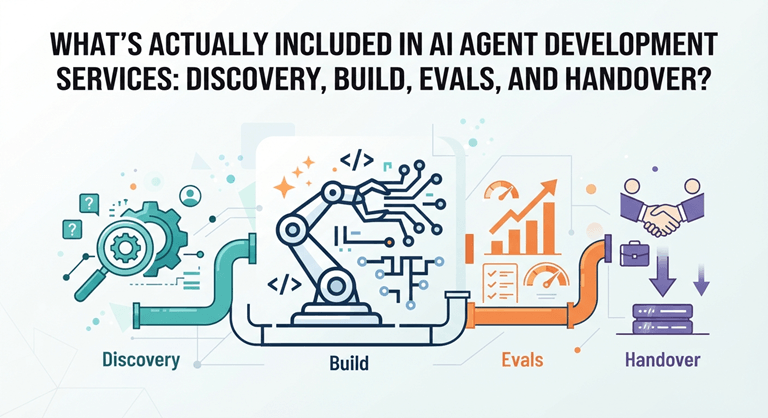
By leveraging custom AI software development, businesses can create AI agent development services that are reliable and effective in critical applications. These initial concepts are then developed into a stable and productive infrastructure by a dedicated AI agent development company.
Why do enterprise-grade AI agent development services matter?
Enterprise-grade AI agent development services provide the necessary structure to turn isolated experiments into reliable and high-performing business systems.
Pilot vs. Production
Simple automation scripts are very directional and adhere to fixed rules. They “fail” when inputs are outside a narrow range. An autonomous agent reasons. Can sense changes in its surroundings and adjust its movements to achieve objectives without constant human intervention. This is the logic shift that needs to be accomplished when moving a controlled pilot to production.
A professional AI agent development company guarantees that these agents deal with the intricacies gracefully. The Gartner Agentic AI Pulse 2026 indicates that only 41% of agent deployments achieve positive ROI within a 12-month period, underscoring the critical need for careful evaluation and governance to ensure successful deployments. This information highlights the importance of professional supervision as the top trait needed to create systems that are strong, dependable, and have a high return on investment.
The scalability factor
Unlike other aspects of the AI landscape, AI agent development needs a solution that fits into your workflow. In the absence of a maintenance plan, custom AI software development can be a challenge for organizations. Scalable agents – these agents handle greater amounts of work without necessarily having to hire more people.
They serve as an amplifier to current teams. Detailed AI agent development services handle technical debt that typically builds up in initial tests. By following these steps regularly, you can establish a solid foundation for your business’s future success. That means enterprises can steer clear of the typical challenges faced by unmanaged AI initiatives.
What happens during the discovery phase?
The discovery phase serves as the foundation for every successful project by aligning technical strategy with specific business goals.
Mapping operational friction
The first step in experts’ tasks is to audit daily operations and identify tasks that involve a lot of manual effort for large volumes. These workflows may be the most expensive delay for the organization! These areas are checked by a professional AI agent development company for places where agents can be of value.
It looks to tasks that demand logic but have repetitive input from humans. This way, attention is still paid to the processes that are best suited for automation. By using the correct mapping, the team will not waste resources on processes that don’t require intelligent agents.
Vetting technical feasibility
During the discovery phase, it is essential to review the existing data and business logic within the organization for AI agent development services. Quality data is a crucial component of AI agent development services.
The technical team evaluates the possibility of effectively integrating into an existing system with the implementation of custom AI software. This will make sure the foundation is in place prior to any code being written. Vetting feasibility ensures that there are no integration issues in the future of the project. It helps foster trust by making sure that the solution proposed corresponds to the technical situation of the enterprise.
How is custom AI software development executed?
Professional teams follow a rigorous technical path to transform abstract business needs into functional and reliable autonomous software.
Designing autonomous foundations
The inner loop is developed by the development team to handle interactions with models, data processing, etc. This is where the orchestration of Large Language Models and the integration of required APIs for external actions come into play. Engineers also make trustworthy memory layers that could help the agent keep up task context over a lengthy period of time.
This transition is emphasized in recent industry projections: In 2026, Gartner estimates that worldwide spending on AI will be $2.59 trillion, with organizations focused on developing their foundational AI capabilities. This significant investment in resources is a testament to the fact that technical excellence is still the first order of business for projects with the goal of success on a scale.
An expert AI agent developer company guarantees these bases work properly under high workloads. This accuracy enables AI agent development services to handle complex tasks without getting lost and losing sight.
Integrating core systems
Custom AI software development needs to be tied to current ERP and CRM systems to offer real-world enterprise context. However, in practice, without accurate records, agents can do little if anything. Without the links, the software doesn’t even have the data necessary to solve real problems, not to mention pretty demo ones.
AI agent development services for the database industry are crucial for integrating cutting-edge AI models with traditional systems. Where it all goes from being theory to reality is integration. If you integrate the solution the right way, it needs to play well in the enterprise’s ecosystem and play by its rules. This is what makes the whole of a group of disparate parts into something that can be part of a meaningful tech stack for an enterprise.
Why are evaluations the core of reliability?
Rigorous evaluation frameworks transform unpredictable AI behavior into dependable logic that businesses can trust for mission-critical operations.
Testing agent reasoning
Non-deterministic behavior arises in autonomous agents and means that they are solving a problem and come up with solutions in response to an ever-changing context, rather than having hard-coded solutions. The logical steps agents take during operation are validated using automated testing and plan tracers.
These tools can assist developers in pinpointing mistakes before they impact actual business data. If there is no formal validation, then agents are experimental and for enterprise use. One of the key focuses of a professional AI agent development company is to ensure these quality checks are executed to provide predictable outcomes. Effective AI agent development solutions rely on regular testing cycles to ensure smooth performance and maintain quality.
Agents are facing high costs and risks, with insufficient business value or adequate risk controls, and Gartner estimates that by the end of 2027, more than 40% of agentic AI projects will be cancelled. All this underscores the need for good testing and evaluation practices to be incorporated from the outset of development to avoid significant production snafus.
Establishing governance layers
When it comes to AI agent development services that manage important business data, governance layers can’t be skipped. These layers produce precise audit trails and provide a history of all the choices an agent makes while it is running.
This transparency helps to reduce the chances of hallucinations and also guarantees compliance with industry standards. All these are essential features of custom AI software development to ensure data integrity and security. Governance protocols change the nature of autonomous agents from experiments with high risk to stable elements of a business.
Leaders can then check the logic that’s used by each automated action performed by their systems. The step-by-step approach helps to establish trust and gradually increase the use of AI in various areas.
What does a successful project handover look like?
A smooth transition ensures your internal teams have the tools and training needed to maintain autonomous systems independently.
Ensuring long-term autonomy
The handover to the final product is the sign of the end of the development period and the beginning of stable operations in your internal business environment. A business AI agent enhancement provides comprehensive documentation of the system structure and the key requirements of the system. This package will make your staff members understand the reasoning behind each agent’s action.
Great Artificial Intelligence Agent Development Services are complete with all the training sessions, which allow your staff. These sessions are designed to impart the fundamental skills needed to handle the system without external help.
You will be handed an operating blueprint that is complete for long-term success. Such clarity avoids the typical lack of knowledge that follows when external experts depart from a project.
Enabling continuous monitoring
The team can accomplish this through a successful deployment that employs an observability stack to monitor performance and alert the team to model drift once the deployment goes live. This is why it is essential to have this oversight when developing custom AI software, ensuring a high level of accuracy as real-world data patterns change over time.
Human operators are in place to provide “feedback loops” to adjust agent logic as per daily business outcomes. This input is used to enhance the quality of decisions made in each use cycle of the system.
This post-launch visibility is always an important aspect of robust AI agent development services for the client. The autonomous system is kept up to date with the company’s current objectives by continuous monitoring, which ensures that your investment is protected.
Conclusion
AI agent development services are not “set-and-forget” solutions. These are partnerships in discovery, building, evaluation, deployment, and handover. But companies that have 40% or more of their AI projects working are projected to double in a matter of six months, according to Deloitte. The change illustrates the importance of secure agentic infrastructure today. An experienced AI agent development organization aids teams in managing risk, enhancing reliability, and preparing systems for production.
CodeTrade provides artificial intelligence agent development services with testing, governance, integration, and support. Its custom AI software development experience helps enterprises build agents around real workflows, clear goals, and measurable outcomes. This approach creates lasting operational value.
About the Author
CodeTrade is an AI-first digital engineering company with over a decade of experience building scalable, enterprise-grade software. Backed by a global team of 180+ engineering experts, CodeTrade specializes in artificial intelligence, custom software development, and deep system integrations. They partner with mid-market and enterprise organizations to bridge the gap between experimental technology and robust, production-ready autonomous systems that drive measurable business growth. To learn more about their capabilities, visit CodeTrade.io.
Popular on OTW Right Now!



About The Author

Gagan Bhangu
Founder of otechworld.com and managing editor. He is a tech geek, web-developer, and blogger. He holds a master's degree in computer applications and making money online since 2015.