
Flutter vs Native: Why Staff Augmentation Teams Choose Cross-Platform for Faster Product Delivery
The discussion around Flutter and native development has changed significantly over the last few years.
For many businesses, the decision is no longer about choosing the most technically advanced framework. Instead, it is about finding the fastest and most efficient way to build, launch, and improve digital products.
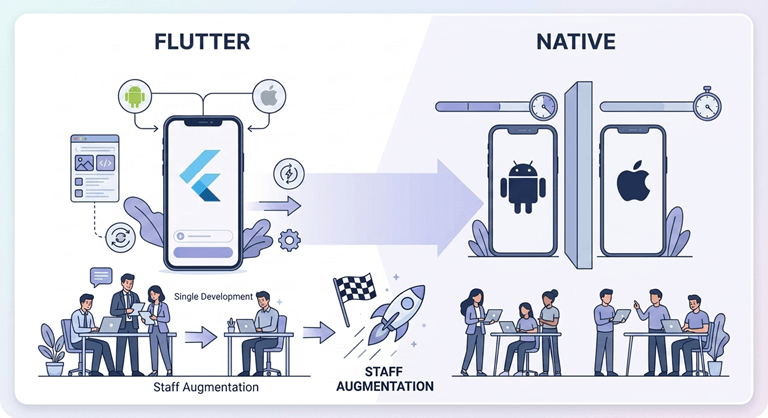
Product teams are constantly urged to deliver features more quickly, address user feedback, and ensure that they stay on budget. Thus, cross-platform development is a viable option for companies that want to get a product to market quickly without adding to the complexity.
This is especially true for businesses that have to scale up their development teams without compromising on the speed of delivery, like in staff augmentation.
Product Delivery Has Become the Main Priority
A decade ago, companies often viewed cross-platform development as a compromise.
Things are different today.
There are far from only technical aspects that most businesses are comparing when it comes to Flutter vs native development. They are considering the speed of a team in developing a product and how often it can be enhanced after it has been released.
Applications tend to be modified in most cases. Product roadmaps are always evolving as a result of new features, integrations, and user expectations.
In this context, development speed has become a competitive advantage.
Organizations that want to accelerate delivery often choose to hire Flutter app developers when expanding their teams. Shareable code base means that when a developer works on a piece of code, they can contribute to more than one platform, and minimize duplication of effort.
For growing companies, this can significantly simplify product development.
Flutter vs Native: What’s the Practical Difference?
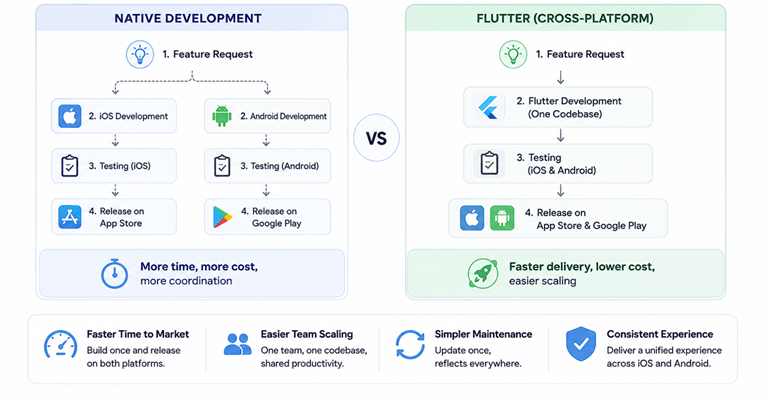
Native development usually involves writing an application for both iOS and Android.
This method gives the user 100% access to the features of the platform and is a good solution for some product types.
It also comes at a price of having to keep two or more code bases, two or more dev processes, two or more test processes, and two or more release cycles.
Flutter does things differently.
Teams collaborate through a common codebase to support different platforms, rather than two programs.
The use of the practical is simple. No more time is wasted in implementing the same functionality on various operating systems.
For product-based ventures, it frequently means quicker development cycles as well as simpler upkeep.
Why Staff Augmentation Teams Often Prefer Flutter
One of the largest difficulties with staff augmentation is the effective developer onboarding.
The purpose of a company introducing engineers to a project is to provide a bigger delivery capacity with the quickest time.
Having multiple native teams can add to further coordination efforts. Developers can be working on the same features at the same time, and release dates must be synchronised.
Cross-platform development makes this easier to accomplish.
One team of Flutter developers can work on both iOS and Android platforms without having to adapt to a different technology and process.
This can make things simpler to scale up when it comes to the actual project.
New members can fully dedicate themselves to implementing a feature without having to deal with several codebases and platform-specific processes.
Faster Feature Releases Across Platforms
There’s a problem that many product teams are struggling with.
A feature is first introduced on iOS. It is delivered weeks later to Android users.
Sometimes the delay is due to technical issues, but not always. Many times, it is just a consequence of having multiple development streams.
Flutter lessens this divide.
A lot of functionality is created once, and thus, features can be offered to both platforms concurrently.
This provides a uniformity in the user experience and makes product management easier.
In competitive markets, minimizing release delays can have a significant impact on businesses.
Easier Long-Term Maintenance
Development of an application is just the first step.
Throughout the lifetime of a product, it needs to be updated, bug fixed, enhanced in performance, and secured.
Having different native apps may require more work in the long run.
Many changes can be made with the same codebase using Flutter.
This can aid maintenance and also minimize the potential for disparities between platforms.
This efficiency can add up to be very valuable, especially for businesses looking to grow their product line over the long term.
Consistent User Experience
Users hardly ever care about the tech stack under which an application runs.
It’s all about whether the experience is reliable and familiar.
One of the main difficulties in working with individual native apps is having uniformity in both appearance and functionality across platforms.
By providing teams with more control over the user interface, Flutter can help to ensure that all users have a consistent experience, which can lead to a more cohesive and satisfying user experience.
This uniformity can help to enhance product quality and establish brand identity.
When Native Development May Be the Better Choice
Not all projects are suitable for cross-platform development.
There are products whose functionality is heavily dependent on the platform or on cutting-edge hardware integrations. Where this is the case, native development could offer more flexibility.
For large and well-established native teams, it may be appropriate to continue developing within existing teams.
The decision of choosing the right one will depend on the following factors: business goals, technical requirements, resources available, and long-term plans.
Before selecting an approach, teams should evaluate:
- Delivery timelines
- Team structure
- Long-term maintenance requirements
- Platform-specific functionality
- Expected product growth
These can be more important than technical tastes in terms of project success.
But the question is not which of these technologies is the best, rather which is the most appropriate for the product strategy of the company?
Conclusion
The Flutter vs. native debate is slowly turning into a business debate, not a technical one.
Companies seek to deliver products faster, features more efficiently, and scale their development teams without undue complexity.
Flutter can be a suitable solution for numerous staff augmentation initiatives. Having a common codebase can make it easier to onboard new team members, save time and effort, and enable quicker product release on various platforms.
Cross-platform development is a growing trend among contemporary development teams as they look for efficient solutions to create and enhance their digital products.
Popular on OTW Right Now!




About The Author

Gagan Bhangu
Founder of otechworld.com and managing editor. He is a tech geek, web-developer, and blogger. He holds a master's degree in computer applications and making money online since 2015.