
Why the Same AI Feature Costs $0 in One App and $20/Month in Another
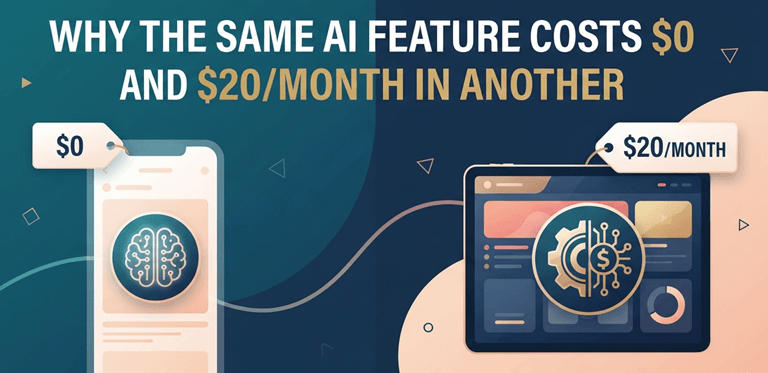
Open any app store today, and you will find the same pattern repeated everywhere: two apps with nearly identical AI features, one free and one charging a subscription that costs more than a music streaming service. There is a writing app that summarizes articles for free, and there is the other one that charges $15 a month for what appears to be the same button. You have an app that writes articles for free,e and then you have an app that costs $15 a month for the same button. Users think that the paid one is better. Sometimes it is. The actual answer, though, is typically one layer beneath that button, in the form of a decision made by the developer around which AI model to use behind that button.
Every AI Button Has a Meter Running
In contrast to regular software characteristics, which can be produced at next to nothing every buy, each AI request costs real cash. The app will send your text to an AI model and, in exchange, pay you a token (which is roughly equal to a word). Small, efficient models have costs of fractions of a cent per request. Frontier models that reason through complex questions and write like a professional (as opposed to a robot) are fifty to a hundred times more costly per task. Image and video generation is a second order of magnitude higher.
That is a per-request meter that gives you the pricing. The free summarizer is almost always using a smaller version that is a few dollars per thousand users per month for its developer. The $15 subscription is likely to be directed towards a frontier model, and the developer is giving you a surcharge on top.
Smart Apps Mix and Match
Well-managed apps are no longer restricting their usage to one model and paying its price for all. They route: if the quick autocomplete is a cheap fast one, they use the cheap fast one; if the long-document analysis is a premium one, they use the premium one; but if image features are an image model that provides better quality per dollar, as it does now, then they use that one. Marketplaces such as apimart.ai exist precisely for this — they give developers one account and one API that reaches dozens of models from different labs, with per-model pricing listed openly, so an app can switch its backend model without users ever noticing anything except better answers or a lower price.
This routing is the reason why some apps are getting cheaper, but better. The availability of a new model at half the price of the top model of the previous quarter enables apps on a marketplace to be upgraded in an afternoon. These same apps that are so tightly coupled to a provider are stuck until they are rewritten again, for the next major “big rewrite.
How to Judge What You Are Paying For
There are some helpful guidelines that can help you determine if an AI subscription is worthwhile. If the developers are proud of using frontier models, they will explicitly state the names of the models used, and if they are using a budget model, they will likely refer to “advanced AI” or “high-end AI” in their marketing. Try the free version with a truly challenging task, such as summarizing a long technical article, and find out where it fails. Compare with a generic chatbot for the same task. Beware of applications that allow you to add your own API key; they will charge for the software, not the AI, which is typically the honest deal.
The Takeaway
AI tools are by no means magic bullets, and they are not free. Each smart button has a meter on board, along with a developer’s selection of a meter model to purchase at a price. But, knowing this, you no longer see app pricing as randomly thrown numbers — instead, you’re paying for the model behind the app — and the app for which you’re willing to pay is the one that is honest about what that is.
Popular on OTW Right Now!


About The Author

Gagan Bhangu
Founder of otechworld.com and managing editor. He is a tech geek, web-developer, and blogger. He holds a master's degree in computer applications and making money online since 2015.