
The Right Visitors Matter More Than More Visitors: My Approach to Keyword Research With Semrush
**This post is sponsored by Semrush. When you purchase through links in this article, we may earn an affiliate commission from Semrush.**
When I was getting started with content for my website (which was growing at the time) I made the very common mistake of focusing too much on search volume when it came to keyword selection. If a topic had thousands of searches per month, I saw that as a golden opportunity. More searches = more traffic = better results. That was my take on SEO at the time.
Having published a number of articles that didn’t really get any engagement at all, I started to wonder if I was doing it the wrong way. Some pages would attract visitors who would just walk away, other articles on a more niche topic would actually have people browsing the site for longer. That was the key learning point: people looking for the same topic don’t necessarily want the same thing.
That was when I started changing my approach to keyword research. Instead of chasing the biggest numbers, I wanted to understand what people were actually looking for. Using Semrush as my primary SEO research platform helped me develop a more thoughtful process. If you are trying to attract visitors who genuinely need your content, get started with Semrush here and discover how understanding search intent can improve your publishing decisions.
Looking Beyond Search Volume
One of the very first things you learn is that search intent is just as important as the keyword.
Think of someone searching for a laptop. One person may just be looking for general advice on how to go about picking a laptop. Another might be in the process of comparing two laptops. A third person might be ready to buy. They’re all searching for a laptop in some form or another, but they’re all after a different answer.
If you’re publishing a general intro piece for someone who’s looking for a proper product comparison, then you’re very unlikely to satisfy that visitor. The keyword may have a massive number of searches but the content you’re providing is not what that person is actually after.
To work out these differences, we started using Keyword Overview in the Semrush SEO Toolkit. It gives you a lot of useful information on each keyword (volume, difficulty, intent etc). Rather than just looking at one figure, you can see whether a keyword is actually worth targeting and what type of content would be appropriate.
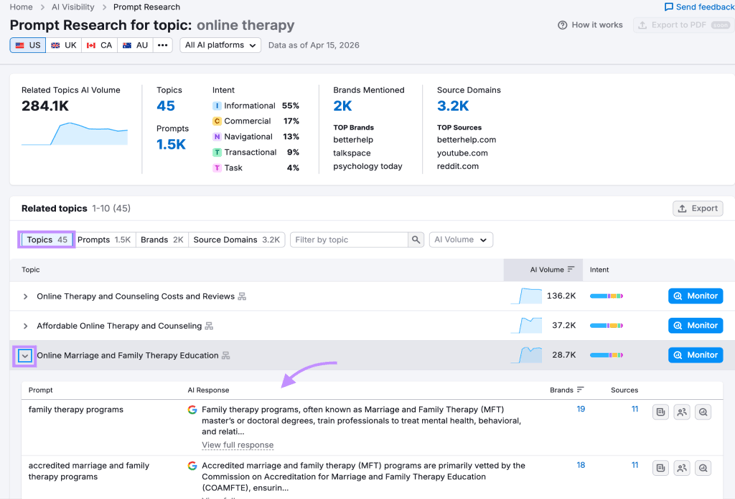
I also found the Keyword Magic Tool useful for digging into broader topics. If you entered a starting keyword, you could then see a list of related search terms, question-based queries, and all sorts of more specific long-tail ideas. A lot of the queries it generated were ones you simply wouldn’t have thought of when you were initially planning your article.
A broad subject such as website security could give rise to searches around protecting personal information, choosing security software, and fixing the various common website issues. Each of those is a different reader need and could well warrant its own piece.
Doing that research really changed the way I viewed keyword lists. Rather than just seeing them as a collection of phrases I could use, I started to see them as indicators of the problems that people out there wanted to solve.
Turning Keyword Research Into Better Content
After I’d got pickier about the keywords, my next job was to turn those into a publishable plan.
I started using the Keyword Strategy Builder to group up the keywords and build out topic clusters. That enabled me to see how each article could support a wider subject rather than just publishing a bunch of random content.
If I were writing about website performance, I could have a whole series of supporting articles on page speed, image optimization, hosting options, and how to fix a slow website. Each one would answer a specific question and form part of a larger body of useful information.
I also started looking at what other websites were doing. With Organic Research, we could see what keywords were bringing visitors to the competition and therefore what topics were in demand. We weren’t trying to copy anyone’s articles at all. We were just trying to work out what the popular questions were and see how we could provide a better or clearer answer.
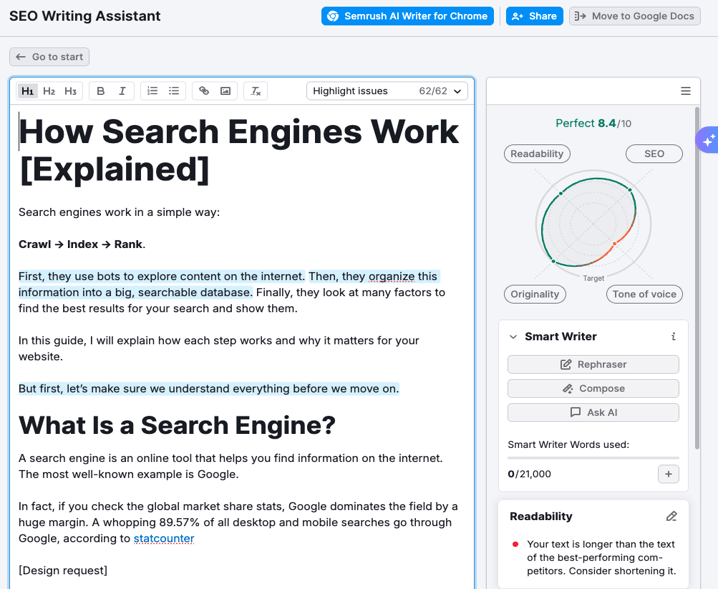
After choosing a topic, writing became the next important step. The SEO Writing Assistant helped me review content for SEO recommendations, readability, and writing quality. I treated its suggestions as guidance rather than instructions to follow blindly. A piece of content still needs to sound natural and provide genuine value to readers.
Having all those tools in Semrush did make things a lot more organized. Keyword research, competitor insight, topic ideas, and content optimization all became part of a connected workflow rather than a series of disparate tasks that I’d have to juggle around without any real plan.
I also learned not to rely on just one SEO tool or one metric. Search volume, keyword difficulty, intent and content quality all tell you something different. The best decisions are made by looking at all of those things together and choosing the tool that actually solves your problem rather than just going with the one that’s ‘in’ at the moment.
Looking back, the biggest difference in our content planning wasn’t actually discovering that magic keyword with massive traffic. It was learning to ask better questions before we even began to write.
Who is it that’s looking for this topic? What do they want to achieve? Are they looking for an explanation? A comparison? A quick fix? Once you’ve got a handle on the different purposes behind the various topics it’s a lot easier to choose them.
A good content strategy isn’t about getting the biggest audience at all. It’s about getting to the right audience and giving them reasons to stay, to explore and to come back.
If you want to move beyond chasing popular keywords and start building content around real audience needs, explore Semrush here. Use its research and content toolkits to understand search behavior, organize better topics, and create articles with a clear purpose. The best keyword is not necessarily the one with the highest search volume. It is the one that connects the right reader with the answer they actually need.
Popular on OTW Right Now!




About The Author

Gagan Bhangu
Founder of otechworld.com and managing editor. He is a tech geek, web-developer, and blogger. He holds a master's degree in computer applications and making money online since 2015.