
Why Some Renders Sell and Others Look Fake
Put two animated product videos side by side, and most people can tell within a second which one cost more. Very few can say why. They will reach for words like “smooth” or “professional,” but the actual difference is rarely the animation itself. It is the light, the surface, and a handful of small imperfections that the cheaper piece left out.
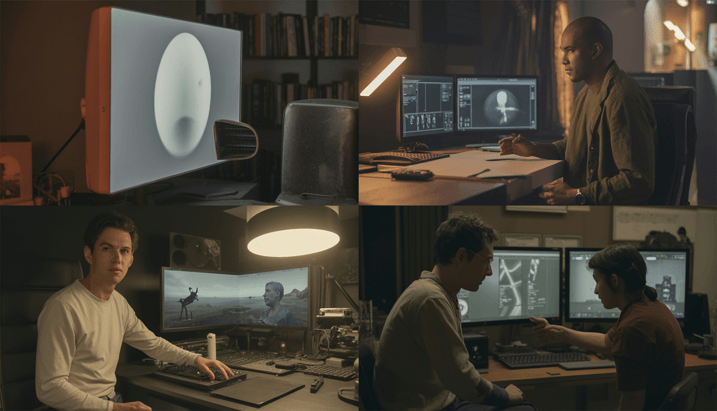
It’s important commercially because the strange “in between” is the not-so-good place to be. The obviously styled and illustrated render is a conscious choice. A render that looks real, reads like a mistake, and audiences do not trust it for no known reason.
What separates a serious 3D product animation company from a cheap one
Four things consistently separate a serious 3D product animation company from a cheap one.
Materials that behave physically. Brushed metal reflects light in a direction parallel to the metal’s surface. Anodized aluminum’s color changes as the angle of grazing changes. Light is not reflected off the frosted glass surface, but through it. Those studios that take these as colors and not behaviors create the plastic look that everyone knows.
Lighting borrowed from photography, not from software defaults. Good product renders are lit like a tabletop shoot: key light, fill, rim separation, and controlled reflections from a large soft light source. Mediocre work starts and stops with the default three-point setup that is provided with rendering software.
Imperfection. These are real objects you can find that have micro-scratches, finger oil, dust in crevices, and rounded edges where the CAD file claims a corner. The latter is extremely important — a sharp edge will not reflect light, and the very small amount of light reflected along a rounded edge is one of the most important factors the brain uses when looking at something as tangible.
Restraint in camera movement. Motion is valuable in inexperienced work, but constant camera changes can be distracting. Confident work does not move and allows the product to be observed.
How to scale this across a catalog
A project is a one-hero video. 200 SKUs is a system, and the two think differently.
Once you get into volume, the economics become a different story. The first product is more costly since you are paying for the environment, lighting setup, material library, and the render pipeline, as well as the model. There is nothing new to be invented in the case of product forty, hence the low cost.
| Approach | Cost per SKU | Best for |
| One-off hero film | Highest | Launches, campaigns, trade shows |
| Templated turntables | Low at volume | Catalog and PDP coverage |
| Variant renders from one model | Lowest | Colorways, materials, configurations |
| Configurator-driven assets | Moderate setup, near-zero marginal | Made-to-order and modular products |
Most brands miss the chance to make more money in the variant line. If you sell a bag in nine colors, then you are building one bag with the intention of changing materials in the bag, but not commissioning nine shoots. This applies to sizes, finishes, and hardware.
There are two practical considerations that make this all possible. One of the first tasks that needs to be done before production even begins is to organize your CAD or technical drawings. Rebuilding geometry from photographs is the single largest avoidable cost. Second, decide who owns the source files at the outset. The studio retains the models, and subsequent variants are not rendering jobs, but purchases.
Setting expectations on timeline and review
Rendering occurs at the end, and there’s a good implication: changes cost the least at the beginning, and the most at the end. If you don’t like a camera move you storyboard, it doesn’t cost you anything. Final renders of the same note take days of compute!
Defense is an organized approbation process. Before texturing a model, have it approved. Discuss materials before animating on a static frame. Get a low-resolution playblast before investing in a final render. Skipping these points will not help you be efficient; it’s just shifting the risk to you.
Does location factor into the decision?
Most production runs are remote; geographies have little effect on quality. Industry context and logistics are where it does count.
The most clear-cut case is physical reference. Having the ability to hand over your product rather than send a prototype and hoping it arrives intact is better if your product must be handled, measured, or photographed for texture reference.
Beyond that, regional industry concentration shapes what a team is fluent in — firms providing 3D product animation services in Texas, for instance, sit near dense energy, industrial equipment, and consumer manufacturing sectors, which tends to show up as comfort with technical hardware and large-format machinery rather than only consumer goods.
Compare it with portfolio fit, and then which is more important? A team 3 time zones away that has already done the same process you would be doing on your budget is more likely to be a solution than a local shop on your budget.
The question worth asking before you brief anyone
It’s not who can make this look good; it’s what will this asset have to achieve in the next three years? New colors are added to products. Products receive new colors. Catalogs expand. There are stills, social cutdowns, and trade show loops to campaign for. Brands that use the initial render as a first step in creating an asset library rather than a final one save significantly more in the long run and are significantly quicker when it’s time for the next launch.
Frequently asked questions
How much does a product animation cost?
A turntable can be modest and just a single one with a template. A custom hero movie with customized environments, motion graphics, and sound is much more expensive. Volume changes have a dramatic effect on cost.
Do I need CAD files?
It is not a rule, but it definitely saves them a lot of modeling time and cost. But without them, artists re-create the geometry from photos and measurements.
How long does production take?
For simple turntables, 2-4 weeks; for a hero piece with custom environments and sound design, 6-12 weeks.
Will renders match my physical product exactly?
If you provide actual samples to serve as color and material references, close will be your only option. Even with screening and lighting, materials still vary slightly, so review materials on a reference frame early for approval.
Can I get stills from the same assets?
Yes, and you should! High-resolution stills for print, packaging, and listings are generated with the same build at an additional cost. Ask for them in the original scope.
Popular on OTW Right Now!
-
 Behind Every Fast App: The Invisible Layer Keeping Systems Stable
-
 HP Ink Cartridges: The Complete Buyer’s Guide to Printing More and Spending Less
-
 Enterprise Website Localization with Crowdin: How Modern Engineering Teams Scale Multilingual Web Operations in 2026
-
 Why Google Is No Longer Your Only Search Engine


About The Author

Gagan Bhangu
Founder of otechworld.com and managing editor. He is a tech geek, web-developer, and blogger. He holds a master's degree in computer applications and making money online since 2015.