
7 Important Conversations Every Couple Should Have Before Getting Married
Planning a wedding involves a whole host of detail work, from venue to seating plan. The decisions that actually have an impact on your day-to-day life together are the ones that often get short shrift. You may well have agreed on the vast majority of the wedding arrangements but still have different views on money, on the division of domestic labor, on family time, etc. Those differences aren’t necessarily a problem at all but if you don’t have a proper discussion about them, the little things can easily become a source of ongoing friction.
Some couples will talk about these issues on their own; others will go to pre-marital counseling to bring them up (as they can be quite awkward and easy to just avoid). The point isn’t to show that your relationship is perfect. It’s about getting a good understanding of each other’s expectations prior to them becoming part of the everyday reality of your life. They work best when both people are genuinely curious and open rather than in a position of trying to win.
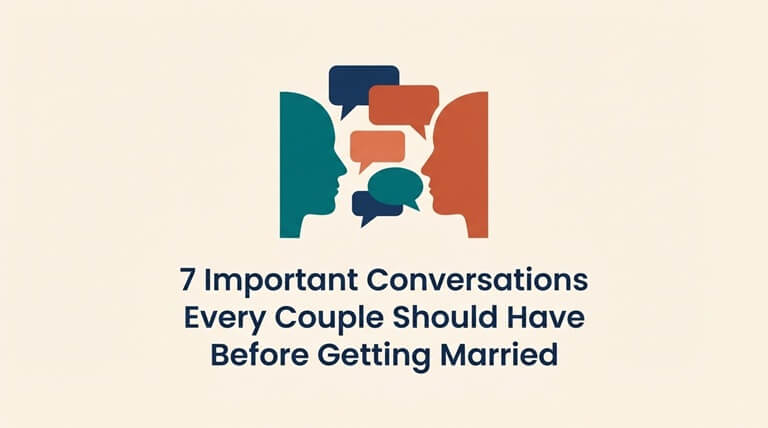
Hebert Counseling is another resource that couples may well come across at this stage. If you’re going to see a counselor or indeed just go to your own home, it’s useful to ask questions that will give you a definite answer. Rather than asking “Are we good with money?” ask what you would do if one person wanted to save and the other wanted to spend. Here are seven areas to get you started.
1. What Does Financial Partnership Look Like to Each of You?
Arguments about money are invariably about more than just the amount. How you spend it can be about safety, about freedom, about generosity, about control, depending on your circumstances. One person may be perfectly happy with a credit card balance, and the other may regard any debt as a major problem. You won’t know what these views are until you actually talk about them.
Start by discussing what you earn, what you owe, what you save and what you spend each month. Then work out whether you’re going to have joint accounts, separate accounts or a combination of the two. Discuss how you’re going to deal with major purchases and whether there’s a threshold either of you can go over without having to ask the other. Be very clear about student loans, family obligations, and savings targets.
Try a Realistic Scenario
Imagine you get a surprise bonus at work. How would you use it? To pay down debt? Take a trip? Fix something around the house? Save it for emergencies? Your answer is going to tell you what’s important to you. The point isn’t that you’re going to all do exactly the same thing; it’s that you can agree on a fair way of making the decision together.
2. How Will You Handle Disagreements?
All couples argue from time to time. The key thing is how you deal with it when the argument is really heating up. Some people want to get to the root of the problem straight away; others need some space to cool down. If you don’t have a plan in place, then one person’s attempt to re-establish the connection may seem quite pushy, and the other person’s need for space may well be interpreted as rejection.
What respectful disagreement means to you both. Are loud voices a problem? Do you shut down if you’re being criticized? Can you ask for a break and agree to come back to it later? It’s useful to agree not to use insults, not to use threats, and not to bring up past mistakes.
Practicing a sentence such as “I need twenty minutes, but I want to finish this conversation tonight” gives both people a way to pause without abandoning the issue. In pre-marital counseling in Dallas, couples can also explore patterns they may not notice while they are in the middle of an argument.
3. What Role Will Family and Friends Play in Your Marriage?
Marriage brings two people together, but your links with your parents, siblings, and friends don’t cease. One of you may be looking forward to regular family dinners, the other to holidays alternating between families. Small things like visits, privacy, and the giving of advice can all be sources of friction if you haven’t had the conversation about them.
How much time do you want to spend with your extended family? Do your relatives have any input into major decisions? What do you do if a parent turns up unannounced? How do you deal with a family member criticizing your partner? You don’t have to cut your family off in order to protect each other’s dignity. What you do is simply decide together where the boundaries are.
Friendships matter too. You may well be of the view that you don’t want to have separate social lives or have friends outside the marriage. Be clear about what you’re expecting rather than just saying you’ll “work it out later”.
4. How Will You Share Work at Home?
It’s so easy to just overlook the domestic stuff before you’re actually living together. The real problem isn’t usually one dirty plate. It’s that one person will always be the one to notice it, to plan it, to remind you about it, and the other person will just wait to be told.
Make a list of the jobs that keep the house going (cooking, cleaning, shopping, paying the bills, appointments, laundry, repairs etc). Then see which of those jobs you each like, which you each dislike, and which you each already do. Fairness doesn’t necessarily mean 50/50. A sensible plan will take your own circumstances into account (your schedule, your energy levels, your health, your job etc).
If you’re looking at Hebert Counseling, then having a written list of the household duties is a good way to get the conversation going about what everyone expects.
Remember the Planning Behind the Tasks
Grocery shopping takes time, and so does working out what you need, making a list, and planning your meals. When you’re splitting the work around you do bear that in mind. You’ll need to check in and tweak your plan at busy times rather than it being a fixed thing.
5. What Are Your Expectations Around Affection and Intimacy?
Even in a relationship where you genuinely love each other, it’s entirely possible that you have very different needs in terms of affection, privacy, sex, and closeness. Those are all very sensitive issues, as they’re going to be issues to do with your own past, your own values, and your own fears of being rejected. Just not discussing them tends to make things no easier at all.
Start with the really simple questions. What makes you feel looked after at the end of a difficult day? Do you like to talk, do you like a hug, do you like to have your chores done for you, do you like to be left to your own devices? Can you tell your partner when you’re not comfortable without fear of anger or guilt? Make space to talk about consent, boundaries and the fact that your needs may well change over time.
Hebert Counseling can give couples a space in which to talk about the difficult issues. Real progress, though, begins with the way you talk to each other at home: listen without immediately jumping to conclusions, respect a ‘no,’ and come back to the issue when you’re both ready.
6. What Do You Envision for the Next Five or Ten Years?
Planning your future together is about so much more than just wanting to be happy. You’re likely to have very different views on kids, on jobs, on school, on travel, on where you want to live and on caring for your parents when they get old. All of those things have an impact on your time, your money, and your sense of who you are, so it’s not just a case of saying ‘yes’ or ‘no’ to them.
Talk about what’s most important to you both and what you’re prepared to be flexible on. If one of you is keen on having children, then that’s a major issue, and you need to discuss when you’d like to have them, your parenting values, and how you’d go about looking after the kids. If one of you wants to move for work, then you need to discuss the impact that would have on the other’s job and support network. Your plan doesn’t have to be final, of course, but you should both be clear about what’s most important to you.
It’s also useful to talk about uncertainty. Things like fertility problems, losing your job, looking after family, etc. can all have an impact on your plans. Rather than say “nothing will change” you can say “here’s how I’ll make my decision if things do change”.
7. How Will You Keep Checking In After the Wedding?
Couples will often have their best conversations when they’re getting ready for a big occasion, but then of course life just takes over. Work, the bills, the family… they all gradually take up the time that you’d previously been spending talking about your relationship.
Pick an easy way to check in with each other. Once a week or once a month, just ask each other what’s been helpful, what’s been stressful, and whether either of you needs anything to change. Don’t turn it into an argument. Use it as an opportunity to spot little problems before they turn into big ones.
You don’t need to wait for a crisis to get outside help. Some couples will use pre-marital counseling to work on the check-ins and learn how to talk about difficult topics without each other being blamed. Those skills are obviously of benefit long after the wedding as well when new issues inevitably arise.
A Stronger Marriage Begins With Honest Questions
These conversations may well highlight the fact that you have differences, but that in itself doesn’t determine whether your marriage is going to work. The key thing is whether you can talk to each other, listen to each other and make decisions together with respect. It’s better to find out about the differences as early as possible, when you can discuss them in a calm manner, than to hope that they’ll just disappear after the wedding.
If you’re looking for more guidance in this area, Hebert Counseling is one option to consider as you get your head around pre-marital counseling and work out what kind of support is right for you. The best preparation isn’t having all the answers. It’s just getting used to asking the right questions, listening properly and coming back to the important conversations as life changes.
Popular on OTW Right Now!


About The Author

Gagan Bhangu
Founder of otechworld.com and managing editor. He is a tech geek, web-developer, and blogger. He holds a master's degree in computer applications and making money online since 2015.