
AI Visibility vs Traditional Brand Awareness
Brand awareness has always been a people problem. You were trying to get into someone’s head and stay there long enough that your name surfaced when the category came up in a meeting.
AI visibility is on top of that as another set of problems. You can’t give anybody a stable concept of what you are until you have a concept of yourself, and you have to have a concept of yourself out of text and not out of memory or feeling.
The two overlap. They are not the same job.
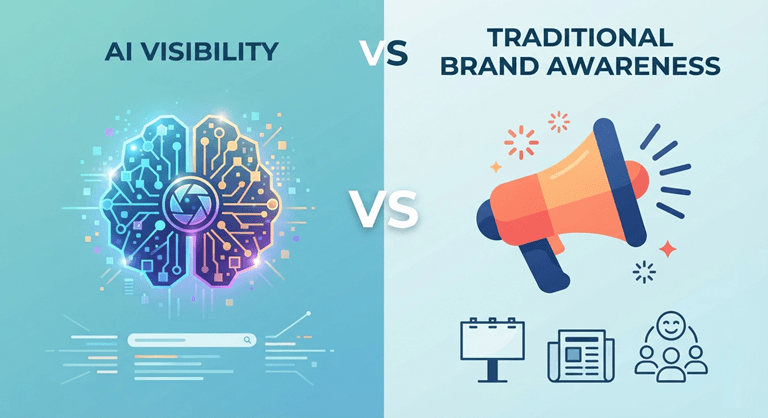
Awareness lives in a person; visibility lives in a description
If a buyer asks, “What does your company do?” you give him an impression. Slightly wrong, probably. Coloured by any advertisement or half-remembered conversation.
Request an answer engine to answer the identical question, and you receive a description. It returns more or less the same way each time you query it, although the wording might change; the structure remains the same, as it was generated from what your site says, what other sites say about you, and how much these two agree.
That is a difference that isn’t trivial. If someone has a vague notion of you, then they can talk about you and still endorse you as someone they would recommend, since they’ll fill in the details from context and goodwill. A system which has a fuzzy notion of you leaves you out completely—there’s not anything specific enough to attach to the query being asked. Here, vagueness isn’t a “soft penalty. It is an exclusion.
It becomes apparent quickly if you cross-pollinate a similar category question over several tools. There are some names that always appear. Others seem to only come into existence when you ask them about them. Some return and say, “Oh, that’s a company that no longer exists.
The failure modes look nothing alike.
Awareness fails quietly. Nobody has heard of you, so nobody thinks of you, and the fix is more surface area over more time.
Visibility fails in ways you can point at:
- You get described accurately but never surfaced, because your name is not connected to the problem people actually type
- You get surfaced, but slotted into a category your competitors defined
- You get blended with a similarly named company in an unrelated industry
- You appear under a positioning your own site abandoned a year ago
That’s the final one that surprises teams. You edited the home page of your website. Updated the language for the category. Cleaned up the deck, polished the sales team, and updated the boilerplate. And then the one description that keeps coming up is the one that’s the same, the one that hasn’t been touched since it was mentioned in a directory listing, on a partner page, a review profile, or a conference bio.
Reconciling that difference is more like the reconciliation work than marketing, and the more practical advice on how to make the entity drift go away when your AI isn’t getting your brand right boils down to the same unglamorous message: find them where they live and fix it there instead of hoping a new blog post can overpower them.
Repetition still works, but it has to agree with itself
In the old consciousness playbook, the only thing that was valued was frequency. The more you say it, the more you say it, the more you say it, the more you say it.
Frequency still helps. What is different now is that lots of inconsistency is overruling it. Ten ways to describe you are less than four ways to describe you the same. You’re having a conversation with yourself in the open Web, and the Web is listening and responding to whatever you say, responding to the one that sounds most sure-footedly sourced.
So, the discipline gets changed. Not so much on the number of mentions as it is on whether the mentions are aligned.
You cannot measure it with an impression count.
The two disciplines diverge at this point, as no instruments are shared. Recognisability was reached, recalled, shared search, lift in survey. Measures that were not perfect but which everyone understood.
There is no impression count inside a generated answer. Nobody serves you a log of every conversation where your category came up, and you were left out. So tracking your AI visibility becomes more of a log of sightings – what questions you’re being asked on, how you’re being described when you appear, whether that description stays consistent from tool to tool, and what happens to that visibility once you make a change.
Reads are slower than with a traffic graph. It’s also not easy to fake and some teams welcome this.
Where the two still feed each other
All of this doesn’t remove the need for awareness work. The opposite, mostly.
Brands that pop out in the answers tend to be the ones that have been discussed publicly in the past, featured in advertising and in comparative product articles, discussed in communities, quoted in discussions people are writing about. The external rumors a model has to read are those. Now, awareness spend is doing double duty when it generates published text that can be indexed, quoted, and cited. Awareness spend that creates impressions, vibes, but does not get people to take action is playing the same role that it always has.
What will be a sensible filter to pass your plan through? Not all channels require justification of the double burden; however, when you’re faced with a choice between two things that are about the same, that which leaves behind a written trail is more valuable than the thing itself.
Popular on OTW Right Now!



About The Author

Gagan Bhangu
Founder of otechworld.com and managing editor. He is a tech geek, web-developer, and blogger. He holds a master's degree in computer applications and making money online since 2015.