
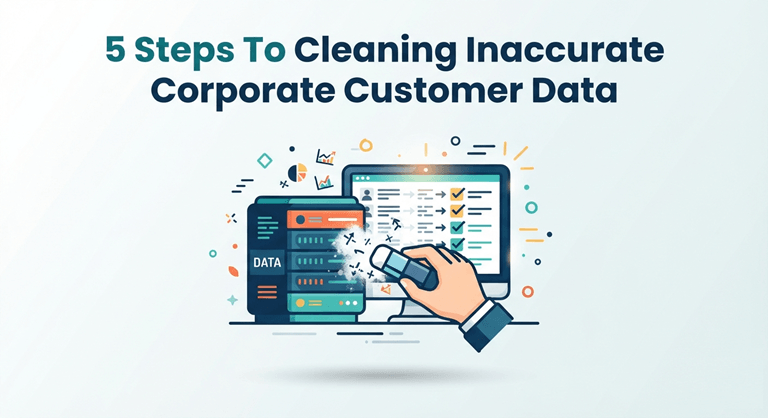
5 Steps To Cleaning Inaccurate Corporate Customer Data
Customer data fuels modern marketing, customer support, and business growth. But corporate client databases become less valuable if consumers change jobs, move, change phone numbers, and change email addresses. That’s why wrong or duplicated client information can lead to failed marketing campaigns, wasted ad spend, low email deliverability, and annoyed clients.
Investing in structured data cleansing workflows helps you remove invalid records. Also, it standardizes address formats and fills in missing details across all of your systems. In this article, you will learn the five steps for correcting inaccurate customer details and maximizing the value of your corporate database.
1. Auditing Database Quality and Identifying Data Decay
Data decays faster than you think, and research shows that customer contact information can decay by as much as thirty per cent annually. A full data audit will reveal common errors like misspelled names, incorrect postcodes, missing digits on phones, and duplicate customer profiles. Data cleansing solutions automate the audit process, giving your team visibility into overall database health scores.
Common data errors identified during quality audits:
- Formatting Issues: Different CRM tools have different phone numbers, address formats and date formats
- Typographical Errors. Misspelled street names, invalid email domains, and scrambled contact names from manual entry
- Incomplete Customer Profiles: Missing postcodes, incomplete company names, unassigned phone extensions
2. Merging Duplicates and Deduplicating Customer Records
Duplicate records bloat customer databases and cause embarrassing marketing blunders, such as sending the same promotional email to a customer repeatedly. Remember, duplicates skew sales reporting and cost extra money to store in cloud databases. Cleansing software uses sophisticated matching algorithms to search databases for duplicate customer records.
3. Standardizing Address and Contact Data to Postal
Supply chains are experiencing parcel delivery failures, carrier return charges and customer frustration due to inconsistent address formatting. Addresses entered on mobile screens are often missing apartment numbers, contain transposed postcodes or use non-standard street abbreviations. Data cleansing software can standardize raw address data against national postal authority databases globally.
Benefits of address standardization:
- Official Postal Compliance: Formats international address records to conform to official regional postal standards
- First-Time Delivery Success: No shipping delays and carrier return fees because of bad address data
- Automated Entry Formatting: Standardizes case, street suffixes and country codes across all fields
4. Validating Email Addresses and Phone Numbers in Real Time
Sending email campaigns to invalid email addresses will result in high bounce rates, which will degrade your domain’s sender reputation and send messages into spam folders. Sending marketing updates to disconnected landlines or invalid mobile numbers is a waste of marketing budget. Automated tools will check an email’s syntax, verify the domain’s records, and ping mail servers safely to see if they can deliver.
Validation benefits for sales and marketing:
- Higher Email Deliverability: Protects sender domain health by filtering out soft and hard bouncing email addresses
- Verified SMS Reach: Confirms phone numbers are active mobile lines before launching SMS marketing campaigns
- Legal Marketing Compliance: Identifies numbers on Do Not Call registries to avoid heavy compliance fines
5. Enriching Profiles and Setting Up Continuous Data Governance
After you’ve cleansed, deduplicated, and validated your existing customer data, the last step is to enrich profiles with missing business intelligence. Data enrichment completes customer profiles, fills in missing firmographic data, geocodes coordinates, and adds social handles. Establish data governance rules that validate customer data at the time of entry so you don’t suffer from data decay down the road.
Transform Your Corporate Data Quality
Eliminating bad data on corporate customers is an important investment in sales efficiency, marketing ROI and customer experience. Transform your database asset with audit data decay, duplicate record removal, address standardization, email lead validation and automated governance. With improved customer data, your team can make confident, data-driven decisions to drive growth for your company.
Popular on OTW Right Now!



About The Author

Gagan Bhangu
Founder of otechworld.com and managing editor. He is a tech geek, web-developer, and blogger. He holds a master's degree in computer applications and making money online since 2015.