
Top 15 Custom Software Development Companies (May 2026 Rankings)
Companies that need software development can either choose off-the-shelf solutions – pre-made programs built for broad use – or invest in custom software development, creating tailored applications designed around their specific workflows, goals, and constraints. Increasingly, businesses are turning to custom software development over one-size-fits-all alternatives. The global custom software development market was worth more than $29 billion in 2023, and it is expected to grow at a steady 8.2% CAGR through 2030. Custom software grows because it fits users, integrates tools, and scales with the business. These are benefits that off-the-shelf solutions can’t match.
In this article, we look at the different types of custom software development services, including the benefits of bespoke development, and examine the various types of custom software development companies – from strategy-driven consultancies and highly skilled small teams to marketplaces for individual freelancers. We also provide the list of the top 15 custom software development companies, based on company revenue, number of employees, international presence, client satisfaction, and technology and industry expertise.
What services do software development agencies offer?
Custom software development agencies vary, but the most successful handle all aspects of the software development process: identifying business opportunities, user experience design, development and testing, deployment, and ongoing maintenance and enhancements for many years to come.
Discovery phase
In the discovery phase, agencies conduct market research, research competitors, and map the customer journey to refine the idea and identify what features are likely to add value to the product for a successful launch.
UX/UI design
UI/UX design services design wireframes, interactive prototypes,s and a system of colours, fonts, and reusable components that ensure apps are simple to use and comprehend. This helps with adoption and reduces the time required to train users.
Software development
During the development stage, an application modernization company develops web, mobile iOS,e and desktop software tailored to the client’s business needs. For small firms, these are straightforward custom software development solutions and for large firms, these can be sophisticated platforms with extensive integration.
Integration services
Integration services are essential when searching for a new development partner among custom software development companies because they prevent operations from grinding to a halt. Without them, the new software won’t be as effective. Integration services help software communicate with other enterprise applications (CRM, ERP, payment gateways, analytics, etc.) via APIs, middleware, or custom-developed software integration tools to avoid data siloing and accelerate processes.
Quality control (QA)
Quality assurance (QA) includes exploratory testing, automated testing, load testing, and security testing to ensure that applications work as expected in real life, and don’t end up with expensive bugs that have to be fixed in production.
Cloud and DevOps
Cloud and DevOps include setting up cloud and CI/CD environments and containerization. This allows apps to scale, be stable, and be updated fast without being constrained by hardware.
Maintenance and support
For software product modernisation companies, maintenance and support involve monitoring, repairing bugs, scaling capacity, integrating with other systems, and introducing small feature upgrades. This ensures the software adapts to the changing business environment.
Type 1: Technical partners
What services do they provide?
Technical partners are full-service custom software development firms that bring interdisciplinary teams (project managers, product owners) who are responsible for the market research, product management, UX, development, cloud management (DevOps), and maintenance. It means they don’t have to employ technical talent.
This is suitable for companies that don’t have product management or technical leadership and require a long-term partner to help them expand their digital ecosystem and accelerate time to market for their products.
Pros and cons
A technical partner provides research, design, development, infrastructure, and maintenance.
They also provide strategy and accountability, scale well, but are more expensive than smaller companies or freelancers, and give clients less control. This is a trade-off that many clients are willing to make.
Good example – Belitsoft
Belitsoft is a fully managed, scalable partner that helps clients from the beginning to the end of a project, often as an external R&D team. Reviews mention its reliability, technical skill, and ability to adapt – qualities that businesses look for in a managed service model.
Type 2: Boutique firms
What services do they provide?
Boutique firms are small agencies that work on projects that are tailored to the client’s needs, focus on design, or use niche technology. They put a lot of emphasis on providing personalized service and coming up with creative solutions to problems for startups and small businesses.
They are often very good at UX/UI design, branding, building MVPs, and working with specialized technology stacks like blockchain, AR/VR, and AI.
Pros and cons
Boutique firms are less expensive than big consulting firms and offer more personal collaboration, creative design-led solutions, and lower costs.
However, they may not be able to grow as quickly, have less technology expertise, and have weaker enterprise security and compliance processes.
Type 3: Staffing agencies
What services do they provide?
Staffing agencies, or staff augmentation vendors, supply developers, testers, and designers who work under the client’s direct supervision. They don’t provide product strategy, project management, or design direction.
The model works for companies that have their own product managers and technical leads and need to increase their engineering capacity while still being able to make all the decisions and control all the workflows.
Pros and cons
Staffing agencies offer developers, testers, and designers on demand for less money than full-service agencies, and you keep all the control in-house.
Because vendors don’t give strategic advice, don’t own processes, and quality is completely dependent on internal direction, this model needs strong internal management and technical leadership.
How to pick the right type for your needs?
When picking the right type of custom software development company, you need to be honest about your internal technical leadership, project management bandwidth, and what you want the partnership to do – quickly scale, give strategic advice, come up with creative designs, or build more engineering capacity.
Do you need expert help with product strategy?
If you don’t know how to make a budget-friendly roadmap or decide which features are most important, a fully managed vendor that does market research, user journey mapping, and product strategy is a better choice. Staffing companies don’t provide those kinds of strategic services.
Do you need additional services apart from development?
Projects often need more than just developers. They also need UI/UX designers, DevOps engineers, QA testers, and business analysts. Managed agencies and small businesses can fill these roles, but staffing companies that only hire developers leave the rest up to you.
Can you handle all the resources you need?
Staff augmentation only works if you have good managers on staff to keep things on track. Otherwise, deadlines are missed, and the product doesn’t meet business needs. Companies lacking that management are safer with a managed services provider that handles team supervision, project management, and alignment.
Do you plan to hire people to work in-house in the future?
A boutique firm or a fully managed agency is a good choice for businesses that outsource product strategy but plan to bring it back in-house later. Both can build a strong product foundation and share what they know with your internal team. The following section profiles the top custom software development outsourcing companies built for that transition.
What to look for when picking a custom software development company?
After you figure out what type of business you want to work with – full-service consultancy, small specialized studio, or temporary staffing provider – you need to look at each custom software development company on its own. Use the seven steps below to tell the difference between a good partner and a vendor who will ruin your project.
Look for industry expertise
Software isn’t the same for everyone. For example, healthcare software needs to follow HIPAA rules, fintech software needs to follow PCI DSS rules, and most other fields have similar rules. That’s why custom software development companies with experience in your field can help you with regulatory issues and proven workflows.
Check their tech stack
Check the agency’s technology stack to make sure they have used the tools your project needs in the real world. This includes cloud services, programming languages, and frameworks they use. They should be good at a lot of different technologies, but they should also be experts in a few.
Ask about their development methodology.
Agile, Scrum, or DevOps are examples of structured methods that the best custom software development companies use to stay open, flexible, and on track. Find out how often they send out working software, what project management tools they use, and how they deal with changes in scope.
Analyze portfolio
Vendors who really add value have a strong portfolio and case studies with measurable results, like savings, engagement, and efficiency.
Read reviews and comments.
Reviews from clients on independent sites like G2, Clutch, GoodFirms, and Gartner Peer Insights are a reliable way to judge the quality of an agency. Look beyond the ratings for comments that point out traits that are important to your project, like how well the vendor communicates, keeps promises, and delivers.
Keep post-launch support in mind
Software development doesn’t end at launch. When custom software development vendors offer ongoing support, maintenance, and upgrades, they can extend the life of the product by fixing bugs, adding security patches, making it more scalable to meet growing user demand, adding new features, and making creative improvements.
Never undervalue communication
One important but often ignored factor is whether the agency’s way of communicating – time zones, language fluency, and responsiveness – matches yours. Many businesses do well with agencies that have overlapping working hours and give each client a dedicated account manager to handle coordination and updates.
Top 15 custom software development companies
Belitsoft
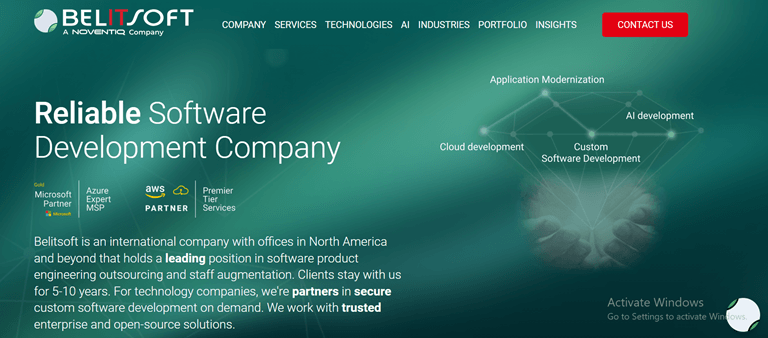
Founded in 2004, the Belitsoft international software development company has offices in North America and Europe. They have 250+ experts in .NET, PHP, Java, mobile (iOS, Android, React Native, Xamarin), JavaScript (Angular, React, Vue.js, Node.js), and Python. The company works in AI, healthcare, fintech, e-commerce, and telecommunications. In 2026, active in AI-driven backend development analysis for businesses around the world.
Belitsoft has a perfect 5/5 rating for delivery, communication, and technical quality according to Gartner Peer Insights. Gartner users also mention that Belitsoft’s teams are creative, knowledgeable, and flexible. Reviews mention client relationships that have lasted for ten years and “phenomenal” personal support from the CEO.
Organizations that switch from inconsistent vendors, including several Indian outsourcing firms, report higher executive confidence, fewer bugs, and restored on-time delivery.
Acquaint Softtech
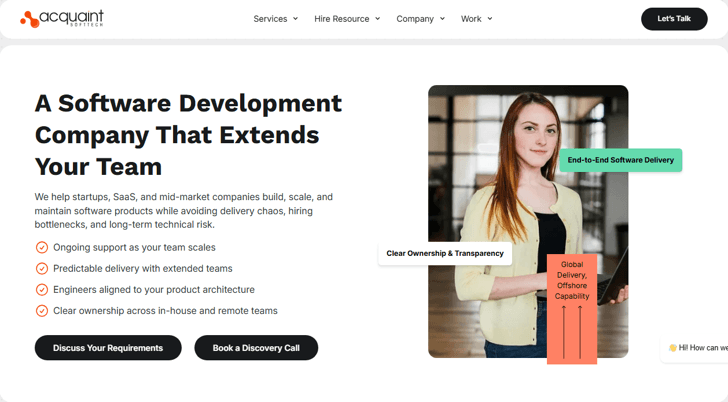
Acquaint Softtech is a globally trusted custom software development company and Official Laravel Partner headquartered in Ahmedabad, India, with over 12 years of experience delivering scalable, secure, and high-performance digital solutions for agencies, SaaS founders, and enterprises worldwide. The company specializes in staff augmentation, dedicated development teams, and end-to-end product development across Laravel, MERN, MEAN, Python, Django, WordPress, WooCommerce, Statamic, Bagisto, and AI/LLM stacks. With a 70+ in-house engineering team and a proven 48-hour developer onboarding process, Acquaint Softtech has successfully delivered 200+ global projects across SaaS, eCommerce, FinTech, Healthcare, Real Estate, Logistics, and EdTech industries, earning a perfect 5.0 rating across 54 verified Clutch reviews.
Acquaint Softtech is a strong fit for businesses that need to scale their engineering teams rapidly, build AI-integrated products, modernize legacy systems, or accelerate development roadmaps without the overhead of full-time hiring. Every engagement is backed by NDA-protected onboarding and ISO-aligned delivery workflows, ensuring transparency, accountability, and predictable outcomes from day one. Their 12+ month average client engagement length reflects the depth and reliability of their long-term development partnerships, making them a dependable choice for organizations that want an engineering partner genuinely invested in product success well beyond the initial launch.
Accenture
Accenture has about 779,000 employees around the world and makes $69.67 billion in sales in fiscal 2025. The company provides managed cloud services, AI integration, and end-to-end software engineering to more than 40 industries. Their service lines span strategy, consulting, technology, operations, and the creative arm Accenture Song.
Accenture suits Fortune 500 companies pursuing multi-year global transformations. For small to mid-size projects, the cost structure and organizational complexity can be excessive.
Cognizant
Headquartered in Teaneck, New Jersey, Cognizant is heavily focused on AI-driven transformation across industries.
Cognizant’s three-vector AI strategy covers: accelerating software development and reducing technical debt, industrializing AI from pilots into production systems, and “agentifying” enterprise operations. AI now generates roughly 30% of Cognizant’s internal code, with expectations of reaching 50%.
Cognizant is a good fit for mid- to large-sized businesses that need a full digital transformation with a strong focus on AI-powered productivity.
Deloitte
For the fourth year in a row, Deloitte’s technology practice was named a Leader in the Gartner Magic Quadrant for Custom Software Development Services. It was ranked highest in both Ability to Execute and Completeness of Vision. Deloitte did the best in all three important capability use cases: Unique User Experience, Unique Operational Processes, and Unique Products.
Deloitte works with big companies that need a partner who can deliver technology and help them make big changes to their organizations by combining deep industry knowledge, engineering talent, and strategic consulting.
Capgemini
Headquartered in Paris, Capgemini specializes in AI-driven software engineering, composable and intelligent software, software modernization, integration, and product engineering. Pierre-Yves Glever, Global Director of Cloud & Custom Applications, said, “We are experts in custom software engineering, which allows us to create unique user experiences, efficient operational processes, and products that stand out.”
Capgemini is a great choice for big, complicated development projects, especially those that need to modernize old systems and add AI to existing applications.
Globant
Globant launched AI Pods in June 2025, the world’s first subscription-based model for large-scale AI-driven engineering, product definition, design,n and testing. This is not the traditional time-and-materials or fixed-price approach to IT services.
In April 2025, Globant and Google Cloud announced a partnership to bring together Globant’s expertise in Artificial Intelligence with Google Cloud. They are collaborating to address issues such as data silos.
Globant is a good choice for firms looking for an innovative partner that’s experimenting with new ways to develop software.
Slalom
Slalom employs some 10,000 people in six countries and 43 markets. It describes itself as a “fiercely human business and technology consulting company” that is results-driven. The Build side of Slalom designs and builds software, data, ta and cloud products for clients.
They have recently started new Build centers in Bogotá, Colombia, as part of their expansion.
Slalom is a great choice for companies looking for the big consulting talent of a large company and the small company feel of a small company.
Atos
In July 2015, Atos, headquartered in Bezons, France, launched the Atos Polaris AI platform. It’s an autonomous agent system that handles complex IT development, testing,n g and operations scenarios. The IT Support Engineer Agent will reduce the effort required to support by 25-35%.
Atos is a great fit for European companies and highly regulated industries, such as healthcare, manufacturing, and public services.
Infosys
Based in Bengaluru with a global footprint, Infosys has been embedding AI into its service offerings via its Topaz platform, which speeds up development processes and improves code quality with AI-powered insights.
Infosys is an excellent choice for large organisations seeking affordable,ble scalable development services backed by strong process practices (CMMI Level 5) and extensive experience on offshore projects.
Tata Consultancy Services (TCS)
In the year ended March 31, 2025, TCS reported $30 billion in total revenues. It was listed as a Leader in Everest Group’s PEAK Matrix for Custom Application Development Services, and had the highest score for Vision, Capability, and Market Impact among 31 providers.
In June 2025, TCS set up three new automotive centers in Europe: two in Germany (Munich and Villingen-Schwenningen) and one in Romania for engineering. The centres will be used to enhance the software-defined vehicle.
TCS is a great partner for global organisations that need scale, industry knowledge, and experience on multi-year complex programs.
Tech Mahindra
Everest Group has rated Tech Mahindra as a Leader in its PEAK Matrix Assessments for Application Transformation Services for AI-enabled applications and Application Development Services for AI Applications in 2025.
Tech Mahindra is a division of the $15.4 billion Mahindra Group. It introduced TechM Orion, a next-gen AI agent development and deployment platform powered by NVIDIA accelerated computing in July 2025.
It is an excellent partner for AI-first development in telecom, manufacturing, and financial services.
Wipro
Wipro employs approximately 240,000 people in over 60 countries. It released its TelcoAI360 platform at Mobile World Congress in March 2015 – an AI-driven Managed Services platform for telcos. Wipro’s design division, Designit, is a design and engineering partner that meets the needs of engineering users and businesses.
Wipro is a great option for companies that are looking for a partner to help them renew their technology and generate design ideas, particularly in the communications, financial services,s and health care sectors.
Toptal
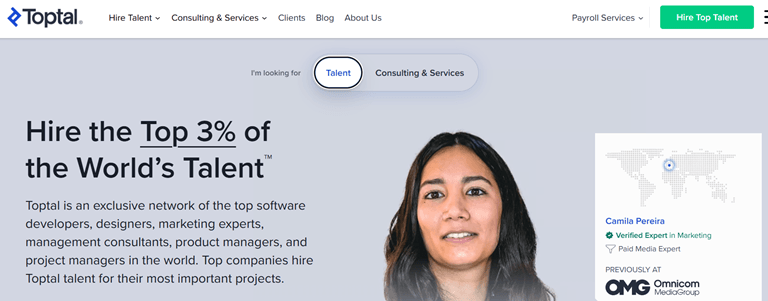
Toptal is an online platform that promises to match businesses with the 3% of the world’s best freelance software engineers, project managers, rs, and designers within 48 hours. Toptal has paid out more than $5 billion to over 30,000 clients in 140+ countries. The screening process assesses technical, communication, problem-solving, ing and professional skills.
Toptal is best suited for clients with project management and technical leadership capabilities that require rapid augmentation of teams with top individual talent. It’s not the best choice for firms that need project delivery or consultation.
Turing
Turing transformed from a platform to hire remote developers into an AI infrastructure provider. Turing recently completed a $111 million Series E investment round in March 2025, increasing its valuation to $2.2 billion.
Turing is now a technology and human talent platform that offers custom machine learning training data for large language models and develops generative AI solutions for companies. Turing is a great option for businesses creating AI products that need machine learning expertise and access to proven engineering talent.
NTT Data
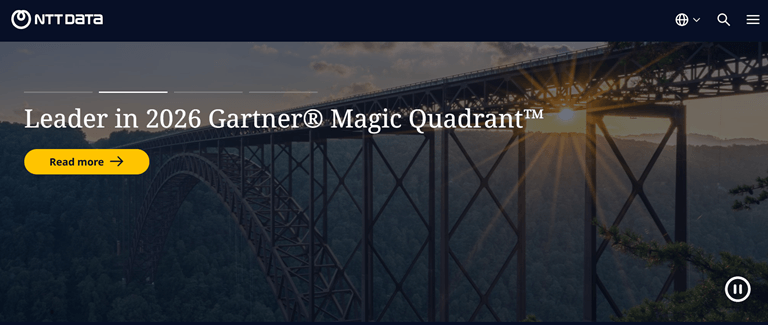
NTT Data, a division of the Japanese NTT Group, has been expanding its agentic AI services. These allow businesses to build and deploy their own AI agents to do automatic tasks.
The Gartner Peer Insights reviews highlight NTT Data’s approach to collaboration and a user-first focus. If you want a global partner to deliver your solution with a lot of expertise in cloud-native and AI integration, NTT Data is a good choice, particularly if you are already in the NTT family of companies.
Final Thoughts
Rather than an expense, a custom solution is an investment that will serve its owner well. By investing in bespoke software, businesses are setting up a foundation that can easily respond to market changes, grow without losing speed or efficiency, and focus on sustainable development.
Popular on OTW Right Now!


About The Author

Gagan Bhangu
Founder of otechworld.com and managing editor. He is a tech geek, web-developer, and blogger. He holds a master's degree in computer applications and making money online since 2015.