
The Human Skills That Still Matter in AI-Driven Product Design
In under three years, AI-driven generative & agented tools have become the norm in all aspects of product design. Figma’s AI is the new norm, Adobe’s Generative Fill is pushing AI-based solutions to every creative surface & startups are using autonomous agents to assemble working prototypes. While the majority of the workflow has changed – the underlying questions regarding “what makes a product truly useful, usable and trustworthy” remain entirely dependent on human judgment. And therefore, the skills required to make those judgments are becoming more valuable (not less).
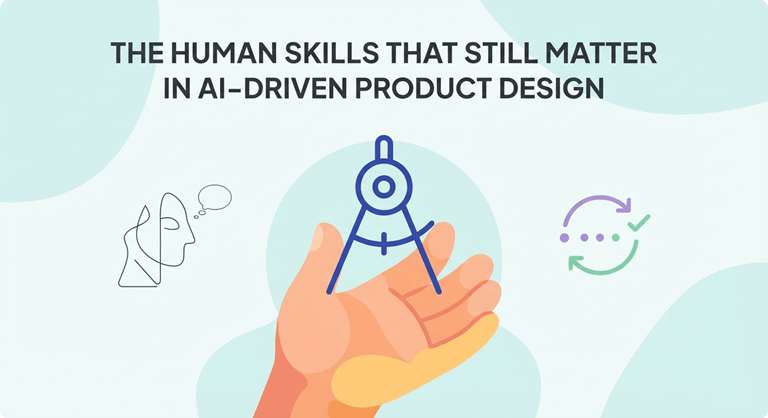
Research skills are still the building blocks
While AI can easily summarize interview transcripts, cluster survey responses, draft personas, etc., it cannot determine whether relevant questions were asked; identify contradictions via body language; or recognize bias in a sample. Nielsen Norman Group’s extensive research on discount usability testing demonstrates that five well-recruited participants will identify approximately 85% of usability problems, but only after they have been provided a pre-defined protocol. Developing hypotheses; recruiting representative users; interpreting weak signals in behavioral data – these are craft skills that take years to develop. Some agencies still build their entire practice around this craft, such as Blink UX, which started as a usability research consultancy, and UX Studio, both profiled on the Global UX Agencies page.
Teams looking to enhance these skills will benefit from direct exposure to practitioners who work at scale. Conferences remain one of the few places where research leads from product organizations share the messy details of their process, and interested readers can discover Future Product Days for a look at how UX researchers from companies like Booking.com, Roche, and Novo Nordisk approach mixed methods research in an environment heavily dependent on AI. The 2026 program in Copenhagen includes dedicated tracks on product design, engineering and vision with more than 100 speakers across seven stages.
Critical Thinking and Design Judgment
Generative tools create many possible solutions quickly and, as such, shift the bottleneck from creating solutions to evaluating them. Selecting among forty different generated layout variants by AI will require clear evaluation criteria, knowledge of accessibility standards, and a degree of sensitivity to how any design decision will impact downstream engineering constraints. The core loop of context, requirements, solution, and evaluation defined in the ISO 9241-210 standard for human-centered design is still the foundation for design judgment. The use of AI accelerates each step of this process but does not eliminate the need for someone to be responsible for holding the loop together.
Design judgment also involves saying no. A generated option may appear finished while secretly violating brand guidelines, misrepresenting data, or introducing dark pattern elements. Both The Interaction Design Foundation and the Center for Humane Technology have developed frameworks that help to identify when failure has occurred. Experienced designers apply these frameworks instinctively, often within just seconds of viewing proposed solution options .
Cross-functional collaboration and fluency.
Product teams today consist of many different professionals, including software engineers, data scientists, machine learning (ML) researchers, product managers, lawyers, and now, in some cases, AI/agented systems representing individual members. The person who can convert a UX issue into language that an ML developer understands or can articulate how a model behaves to a marketing manager has become much more important than anyone else. The communication skills that enable these developers to turn their technology expertise into shipping product are by far the most important factor for success.
Also, being able to understand when to use AI versus when to retain tasks in human hands is another key area where fluency is beneficial. Wireframes, draft versions of content, and preliminary accessibility reviews are excellent opportunities to automate routine tasks. Aligning stakeholders, reviewing ethics, and providing the final creative direction are not. Teams that have clearly defined which tasks should remain with humans and which may be automated will generally produce better results faster while minimizing costly errors.
Popular on OTW Right Now!

About The Author

Gagan Bhangu
Founder of otechworld.com and managing editor. He is a tech geek, web-developer, and blogger. He holds a master's degree in computer applications and making money online since 2015.