
Inside or Outside Mount? A Practical Guide to Planning Window Coverings That Fit Properly
Choosing a window covering is more than just a matter of color, material, and style. How the covering fits into the window opening affects how it looks, how much it covers, and how it works with the trim. Knowing your mounting options at the outset will help the homeowner to avoid some potentially bad design decisions in respect of their windows.
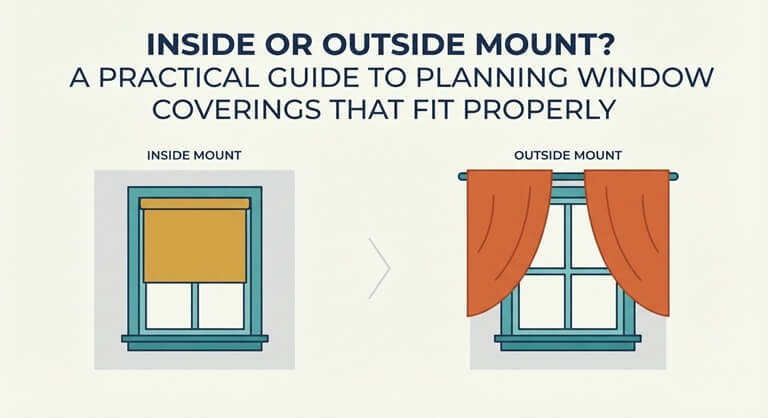
Inside mounting has the covering inside the window opening, so most of the trim is visible. Outside mounting has the covering beyond the opening, which can give the window a larger appearance. When you’re considering window treatments, it’s worth bearing in mind both the look you’re after and the space you have available for mounting.
It’s useful to think about shutters and shades early on as the measurements and window details will have a bearing on what will work. Depth, trim, handles, and the presence of a wall adjacent to the window can all have an effect. Looking at these things before you commit to any finishes will give your project a real head start.
Understand the Visual Difference Between Mounting Styles
An inside-mounted cover will typically look like part of the window. It’s inside the frame, so the trim is still there and forms part of the overall appearance. It’s a good option for a room where you want a clean look and don’t want the window to appear any larger.
Outside mounting gives a different appearance as the covering extends beyond the window opening. It could cover some of the trim or make the window appear larger depending on the size of the covering. This is an option you’d probably use if the window weren’t suitable for an inside mount.
There is no one mounting style that is invariably better than any other. The right choice will depend on your home’s design, your style, and the product you’re looking at. It’s always worth looking at both options in your own home to ensure you’re not deciding based purely on photos and how they’re displayed.
Check Window Depth Before Choosing an Inside Mount
There’s sufficient space inside the window opening to accommodate both the glazing and its hardware. Window depth will vary from house to house and indeed from window to window within the same house. The trim, handles, locks, screens, and all the other bits and pieces will also take up space.
When you’re measuring, measure the actual area where the window will be installed, not just the glass area you can see. A window may appear deep enough from a distance, but there may be all sorts of obstructions in the way. Taking the time to check properly will help you spot these issues before you go any further and commit to a product.
Different window treatments have different mounting requirements, so one measurement may not be suitable for all options. Always check the product specification and the instructions for installation together. That way, you don’t end up with something that looks like it’ll work but in fact can’t be installed as intended.
Consider How Much Trim Should Remain Visible
Window trim contributes to the style of a room. You may well want to keep the detail of the woodwork, the decorative casing or the nicely painted frames visible. In some cases, in-situ coverings will actually reveal more of the trim.
In some rooms the trim isn’t as important. You may prefer a covering that goes right past the window opening to make the window stand out. The wall color and the size of the wall will also have an effect on how that looks.
Shutters & Shades can fit into this evaluation by considering the covering alongside the existing frame rather than treating the two as separate elements. A balanced result depends on their proportions working together. Looking at the entire wall often provides more useful perspective than concentrating only on the glass.
Examine Handles and Hardware for Possible Obstructions
Windows have bits and pieces to them (locks, cranks, handles, latches, etc.) that are easily overlooked when you’re planning. They all take up space, which may well be space that you’d otherwise use for the covering to work properly. Note where these bits are before you measure and decide on the mounting.
Test How the Window Operates
Try opening and closing the window to see which bits actually move into the mounting area. A handle which looks perfectly fine when the window is shut may in fact require a bit more room when it’s in use. Checking how the window operates will reveal problems you might miss if you only measure the width.
Think about how often you actually use the window. If a covering in any way makes it difficult to open the window and you use that window a lot, then it can become very annoying. Always aim to keep access as easy as possible when you’re planning your installation.
Look at Nearby Walls, Corners, and Furniture
With external mounting, pay attention to the space around the window. If the window is in a corner, there may be very little wall on one side. Built-in shelving or cabinets will also limit how far the covering can go.
Think about the furniture as well. Tall bookcases, headboards, desks, etc., right next to the window could well be in the way of the cover. It’s worth planning with the furniture in place to get a better idea of the space you actually have.
You don’t necessarily have to move the furniture in order to get a certain covering. You can look at the various options and see which one works best with your room as it is. Planning in advance will, of course, help you to avoid any unpleasant surprises when you’ve made your choice.
Think About Coverage Around the Window Opening
Where you mount the covering will determine how much it covers the window. An outside mount can go right past the edges, whereas an inside mount will remain within the opening. How significant this is will depend on the product and what you’re after.
Think about the coverage as well as how you’re going to use the room. A bedroom, a media room, a living room, an office all have different requirements in terms of light control and privacy. You’ll need to pick a mounting style that is appropriate for those requirements, as one option may not be right in all areas.
It’s best to think of your window treatment as a complete look rather than just something you hang on the window to decorate the glass. The hang on the window, the size of the window, and the architecture of the room all have an impact. You get a much better result if you look at it all as a whole. You get a much better result if you look at it all as a whole.
Measure Each Window Instead of Assuming Consistency
Windows that appear identical from a distance may in fact be slightly different in size. Construction, trim, remodeling, and settling can all lead to minor differences which may go unnoticed. Measuring just one window for a number of them can lead to problems you could easily avoid. Check the width as well as the window height in a few places, since frames can be inaccurate. Accurate measurements are particularly important within covering constraints to fit inside certain limits.
Don’t just go on old measurements. The last covering may have been fitted in a different way. Taking new measurements gives you the correct information for your window at the moment and for the product you’re looking at now.
Coordinate Mounting Choices Across Connected Rooms
In an open plan you may well have several windows at the same time. Even if they’re of different sizes, the glazing should be coordinated in some way from the point of view of where you normally stand. The mounting is one of the ways of achieving that.
You don’t necessarily need everything to be the same. One window may require an external mount as it’s not deep enough; the other window can have an internal mount. You can still have a cohesive look by using similar colors, materials,s and sizes.
When you’re looking at several windows, think about the shutters and shades as part of the overall design. Looking at the connected spaces as a whole will help you determine if the various mountings will work in a coherent way. This is particularly useful in open-plan areas such as the living, dining, and kitchen.
Make Measurements Part of the Design Process
People tend to think of measuring as the final step after you’ve picked a style. In truth, though, you can use measurements to guide your choices from the outset. Depth, width, height, trim, and obstacles all play a part in working out what will work.
Start by looking at how each window is constructed and how it works day to day. Note any features you’d like to have visible and any that might be an obstruction to the installation or use of the window. These notes will be hugely beneficial when you compare products.
A good result is achieved by matching the look you’re after with what your window is actually capable of supporting. Both inside and outside mounts have their own character and advantages, so don’t just go with one because that’s what you’ve always done. A bit of thought and planning will see your window covering work perfectly with the window, the room, and the house as a whole.
Popular on OTW Right Now!
-
 The Freight Class Nobody Priced In: How Rising Bulk Mineral Logistics Costs Are Rewriting Refractory and Raw Material Contracts
-
 The Parts of Moving Out People Usually Leave Until the Last Minute
-
 Cyber Security Courses: A Comprehensive Guide to Building a Strong Foundation
-
6 Cell Line Providers Supporting Innovation in Biotechnology




About The Author

Gagan Bhangu
Founder of otechworld.com and managing editor. He is a tech geek, web-developer, and blogger. He holds a master's degree in computer applications and making money online since 2015.