
WordPress vs Wix vs Shopify for SEO in Malaysia: Which Platform Fits Your Business?
Imagine a business owner in Klang Valley spending 2 months building a fantastic website, launching it, and then just waiting. After 3 months, there’s virtually zero organic traffic. Someone tells you the platform “isn’t good for SEO”. Is that really the case? Very rarely. The platform itself is almost never the problem. It’s more often a case of the platform not being the right platform for the business.
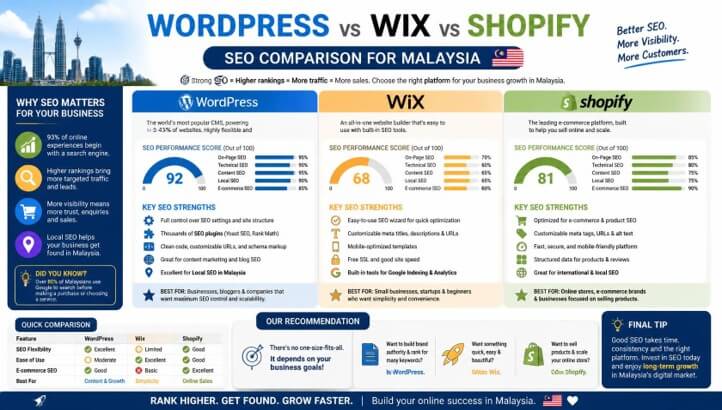
Malaysian SMEs will often ask us which is the better option for SEO: WordPress, Wix or Shopify. The answer is actually quite simple in principle; it really comes down to what you’re selling, who’s going to be managing the site, and how much control you want. This guide will go through each platform, look at the Malaysia-specific factors, and then help you make your decision.
Which Is Best for SEO in Malaysia?
WordPress gives you the most SEO control and is best suited to sites with a lot of content. Shopify is the clear leader for an online store. Wix is the simplest to use and is best for a small, simple site. There is no one single ‘best’ solution for every business. Your objectives, your budget and your level of technical ability will be the key factors in deciding which platform is right for you.
What Search Engines Actually Care About
Before you even begin to compare platforms, it’s vital to know what actually matters. Google won’t rank a site simply because it’s on a particular platform. It will look at whether the pages can be crawled, whether they load quickly, whether they’re mobile-friendly, and whether they actually answer the user’s query.
So the real question is which platform makes it easiest for you to get those things right? That’s how we’ll assess it.
WordPress for SEO: Maximum Control, More Responsibility
WordPress.org is open-source software that you install on your own hosting. That freedom is its biggest SEO advantage.
What it does well:
- Full control over URL structure, redirects, schema, and site architecture
- Mature SEO plugins such as Yoast SEO and Rank Math
- Excellent for blogs, resource hubs and large content libraries
- Flexible enough for multilingual sites through plugins
Where it can go wrong:
- Speed depends on your hosting, theme, and plugin choices
- Too many plugins can slow the site and create security gaps
- Someone has to handle updates, backups and security
A WordPress site can be fast or very slow. It’s not the software per se; it’s how it’s set up. With a developer or agency looking after it, it’s absolutely ideal for long-term SEO. Left to its own devices with no maintenance, problems can accumulate.
Wix for SEO: Simple and Fast to Launch
Wix is a hosted website builder. You pay a subscription, and Wix takes care of the hosting, security, and updates.
What it does well:
- Very beginner-friendly, with drag-and-drop editing
- Built-in SEO tools for titles, meta descriptions, alt text, and redirects
- No plugin conflicts, since features are built into the platform
- Multilingual support is built in
Where it falls short:
- Less flexibility for complex site structures
- Harder to migrate away from later, since you can’t simply export your site and move it
- Large content-driven sites can feel restrictive
For small service businesses (clinics, tuition centers, local contractors, etc.), Wix does a pretty good job with the basic SEO. The limitations come in when you want to go beyond that and add a lot of content or do some of the technical customization.
Shopify for SEO: Built for Selling Online
Shopify is also hosted, but it’s designed around ecommerce from the ground up.
What it does well:
- Product pages, collections, checkout and inventory work together out of the box
- Automatically generates a sitemap and handles canonical tags for products
- Reliable hosting and generally solid speed
- Strong app ecosystem for reviews, bundles and marketing tools
Where it falls short:
- URL structures are partly fixed (you’ll always see /products/ and /collections/ in paths)
- The built-in blog is basic compared with WordPress
- Apps add monthly costs and can add page weight
If your primary objective is to sell products, then Shopify is definitely the easier route. If you’re looking to publish articles and get visibility for information-based searches, then it’s not really the best standalone solution.
Side-by-Side Comparison
| Factor | WordPress | Wix | Shopify |
| SEO control | Highest | Moderate | Moderate |
| Best for | Blogs, service sites, large content sites | Small business sites | Online stores |
| Ease of use | Moderate to hard | Easiest | Easy |
| Maintenance | You or your agency | Handled by Wix | Handled by Shopify |
| Blogging | Excellent | Good | Basic |
| Ecommerce | Possible via WooCommerce | Basic to good | Excellent |
| Migration flexibility | High | Limited | Moderate |
Malaysia-Specific Factors Worth Considering
Most comparison guides will ignore the local factors, though there are a few that are actually quite important in this case.
Multilingual content. A lot of Malaysian businesses will have an offering in English, Bahasa Malaysia and Chinese. Whatever platform you’re using, you need to check how well it deals with multiple language versions and hreflang tags (which tell Google which version of the page to show to which audience). Wix has multilingual functionality built in, WordPress will typically require a plugin, and Shopify deals with it via its own translation and marketplace tools.
Local payments and local currency. If you’re selling online, you need to make sure the platform you’re using supports Ringgit and the actual payment methods that your customers will use (FPX via online banking and e-wallets being the main ones). Gateway availability varies from platform to platform and will change over time so you need to check what’s currently available.
Mobile-first audiences. A lot of Malaysians will be browsing on their mobiles and will have all sorts of different connection speeds. Page speed isn’t just a nice-to-have in this market; it actually impacts your rankings as much as it impacts whether people stay on your site or not.
Local search. If you’re a business that serves a particular area, then your GBP, your local citations, and your reviews are just as important as your website, regardless of which platform you’re on.
How to Choose: A Simple Decision Guide
Ask yourself these questions in order:
- Are you primarily selling physical or digital products online? Start with Shopify.
- Will content marketing be central to your strategy? Lean towards WordPress.
- Do you want a clean, simple site that’s live quickly and requires minimal maintenance? Wix is a pretty reasonable option.
- Do you expect to outgrow the site in two or three years? Go with the platform that has the simplest migration path (which will almost certainly be WordPress).
If you’re still unsure, it can help to talk to people who build sites with search in mind. A team offering SEO website design will usually look at your business model first and recommend a platform second, which is the right order. Rankpage’s own service page notes that platform choice there depends on the business model and requirements rather than a single default.
Before comparing platform names, identify the page types the business needs to keep working.
Rankpage Case Study: How Rankpage Planned PMax Motor Around Shopping and Research Needs
Rankpage took PMax Motor’s keywords and mapped them to shopping categories, product pages and research guides. They then produced the content, titles, and descriptions for those various roles. The guides were linked out to the relevant shopping destinations.
These are the sorts of requirements that should be driving your platform decision: can the site support useful categories, useful guides, clear navigation and a good mobile experience? Rankpage also looked at the navigation, inquiry and purchase journeys and checked the technical search requirements.
Ahrefs saw a category keyword move from position 8 to 5 between July and September 2026 and a scooter research keyword move from 20 to 8. So there’s clearly better visibility for a range of page types, though we don’t want to link that to any particular CMS.
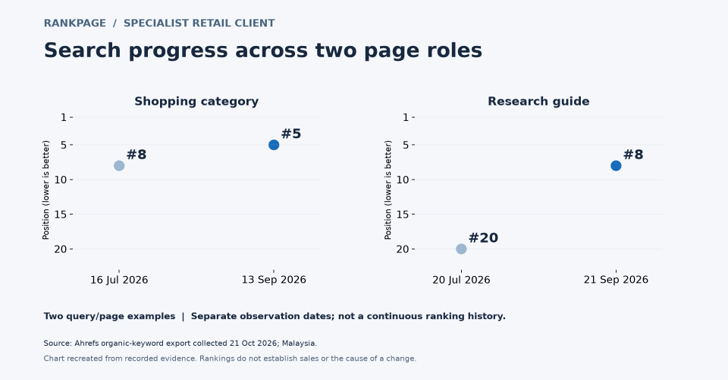
Figure: Separate ranking observations for a shopping category and a research guide.
Source: Rankpage client evidence: PMax Motor Ahrefs Malaysia keyword export, 21 October 2026; category observation dated 23 August.
Common Mistakes to Avoid
These come up again and again, regardless of platform:
- Choose a platform purely on the basis of its template. A nice-looking theme is of absolutely no use if your site structure is crap.
- Ignore page speed after launch. Large images and unneeded apps/plugins can be the quiet killers of your site speed.
- Switching platforms without a redirect plan. If you move your site without a redirect plan in place (i.e. mapping your old URLs to your new ones) you’re going to lose your current rankings.
- Skip the basics. Titles, meta descriptions, internal links, and clear headings still do more than most of the so-called “advanced” tricks.
- Treat launch as the finish line. SEO is a continuous process. Your site needs fresh content and regular monitoring.
FAQs
Is WordPress better than Wix for SEO?
WordPress gives you far more control and flexibility, which is obviously a big advantage if you’re building a larger or more complex site. Wix does a decent job of getting the core SEO right for a small site. For the majority of small businesses, if you’ve got good content and good structure, then both platforms will get you to the top of the search results.
Is Shopify good for SEO in Malaysia?
Yes, absolutely for ecommerce. Shopify does a very good job with sitemaps, canonicals, and mobile. The main drawbacks are the rigid URL structure and the rather basic blog. Content-driven approaches may need to do a bit more work.
Can I switch platforms without losing rankings?
You can switch platforms without losing your rankings (in theory at least), but it requires careful planning. Just 301 redirect your old URLs to the new ones, keep your content and metadata the same, and then just watch Google Search Console after you’ve launched. Some minor temporary changes are absolutely normal.
Which platform is fastest?
The hosted platforms (Wix, Shopify, etc.) are generally quite speedy. WordPress can be just as fast or indeed faster, provided you’ve got good hosting, a light theme and not too many plugins.
How long does it take for a new website to rank?
The majority of new sites will take between 3 and 6 months to start to see real results, depending on the level of competition, the quality of the content and the amount of ongoing SEO work. More competitive industries will naturally take longer.
So, Which One Should You Pick?
When it comes to WordPress, Wix, or Shopify for SEO, there is no single winner. The right choice is the one that suits your requirements. WordPress if you’re after control and a lot of content. Shopify if you’re primarily a product seller. Wix if you just want something simple and easy to get up and running.
Whatever you choose, the platform is only the foundation. Structure, speed, content and consistent effort decide what ranks. If you’d like an expert opinion on your specific situation, the team at Malaysia Rankpage offers SEO audits and consultations and can help you weigh the options before you commit to a build.
Popular on OTW Right Now!




About The Author

Gagan Bhangu
Founder of otechworld.com and managing editor. He is a tech geek, web-developer, and blogger. He holds a master's degree in computer applications and making money online since 2015.