
Top 5 CMMS Software for Manufacturing in 2026
Manufacturing runs on uptime. When a critical line goes down, the bill is rarely just the repair; it is missed shipments, idle shifts, scrapped product, and, in regulated plants, a compliance headache. For asset-heavy operations, industry research has put the cost of unplanned downtime in the hundreds of thousands of dollars per hour, and the uncomfortable part is that most of it is preventable. The equipment did not fail without warning; the maintenance program simply could not keep up.
A Computerised Maintenance Management System (CMMS) is the software built to close that gap. It pulls work orders, preventive maintenance schedules, asset histories, and spare-parts data into one place, so maintenance stops living in spreadsheets, paper binders, and the memory of a few veteran technicians. The hard decision in 2026 is no longer whether you need one; it is choosing the platform your technicians will actually open on a Monday morning on the floor. Here are five of the strongest CMMS options for manufacturing this year, what each does best, and where each one fits.
What separates a manufacturing CMMS
The best system is not the one with the longest feature list. It is the one that gets used. Before you shortlist, weigh five things. First, mobile and offline execution, can a technician open, update, and close a work order at the machine, even where Wi-Fi does not reach? Second, preventive maintenance that can trigger on calendar dates, runtime hours, and cycle counts, not just fixed intervals. Third, an asset hierarchy deep enough to model your lines and sites. Fourth, spare parts management is tied directly to work orders. And fifth, audit-ready records for the standards you answer to, ISO, FDA, HACCP, and IFS. ERP integration matters too, but ask exactly what the connector costs before you sign, because it is often a five-figure line item that never appears in the advertised price.
1. Makula
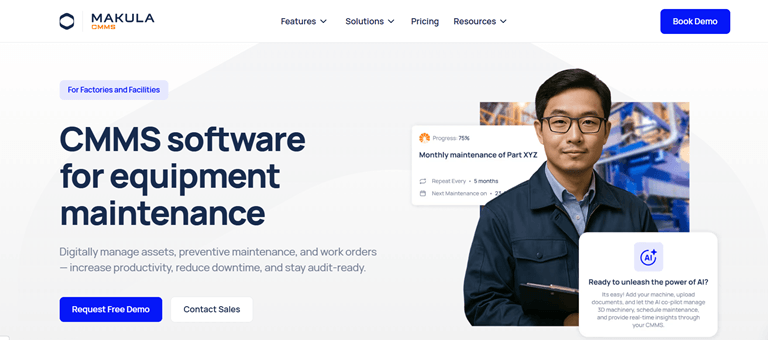
Makula is a Berlin-built, cloud-based CMMS designed specifically for plant maintenance in asset-heavy and regulated industries, food and beverage, packaging, pharmaceuticals, chemical, and discrete manufacturing. While most platforms were started as simple tools and then extended with manufacturing capabilities, Makula was built from the ground up to fit into the industrial workflow, and it’s in all the details that matter on an audit day.
The preventive maintenance is an example of its preventive maintenance. The PMs can be used to schedule them by calendar, runtime, or cycle count, and they can be auto-generated, auto-assigned, and monitored for compliance – scheduling them deliberately over time provides value on the first day without a sensor rollout. Work orders can be generated and closed from any device, and drawings, parts, and lockout steps are attached prior to the job commencing, ng and all actions are time-stamped. The asset model is based on an ISO 14224 type hierarchy, providing a single record, history, manuals, warranty, and TCO for a machine throughout the life of a serial number. Spare parts are directly connected to assets with min/max levels and auto-reorder trigger, and digital checklists include sanitation, calibration, safety, t,y and changeovers.
It differed in two ways from the teams in the industrial world. First,tly it extends in-house maintenance – Makula is not just for a single plant, but a field-service and customer-operations layer for machinery manufacturers and distributors with an installed base and after-sales service. Second, an AI Maintenance Copilot can help techs find the right manual, history, or procedure and even aid in documenting the service, providing practical knowledge on the job, instead of marketing jargon.
Best for: European and global industrial manufacturers, regulated plants, and machinery OEMs that want disciplined, audit-ready maintenance without a heavy sensor deployment.
Keep in mind: Makula focuses on time-based preventive maintenance and does not offer predictive or condition-based maintenance, so teams that specifically want native sensor-driven condition monitoring will need to integrate that separately.
2. MaintainX
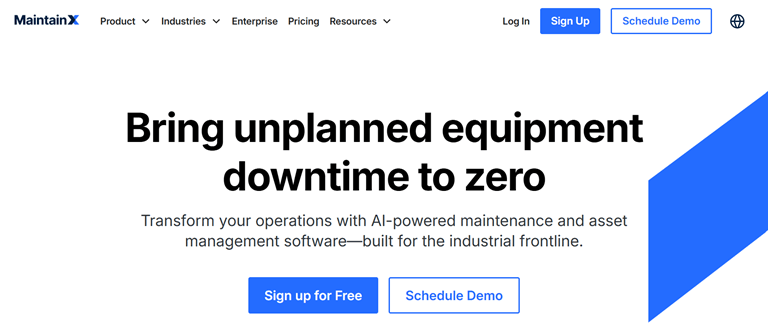
MaintainX has become one of the most widely used CMMS solutions by embracing mobile. The app is more consumer messaging than most, making it very easy for frontline techs to get up and running with minimal training. It is good at converting paper checklists to digital, recording work requests, and establishing standardized safety and inspection procedures for a team.
The compromises are between width and depth. MaintainX is a generalist that also works for restaurants, retail,l and facilities, and on a high-speed factory floor, which often manifests as less intensive asset hierarchies and/or native production tracking. Many of the enhanced analytics and workflow automation are also tied to the higher price levels.
Best for: Small and mid-size operations that want fast adoption and a clean break from paper-based maintenance.
Keep in mind: Deeper asset structures and production-specific tracking may call for integrations or a more specialised platform as you scale.
3. Limble

Limble is known for its true ease of deployment and ease of use. If you can set up a clean asset list, PM schedules, and dashboards without a months-long implementation, you are sure to have many maintenance managers who rave about you. It supports the basic CMMS workflow nicely, work orders, preventive maintenance, parts, and reporting, and integrates with ERPs, accounting applications, and IoT sensors.
Best for: SMB and mid-market manufacturers that prioritise usability and a fast, low-friction rollout.
Keep in mind: Very large, multi-site enterprises with complex governance requirements may eventually want the depth of a heavier enterprise platform.
4. Fiix
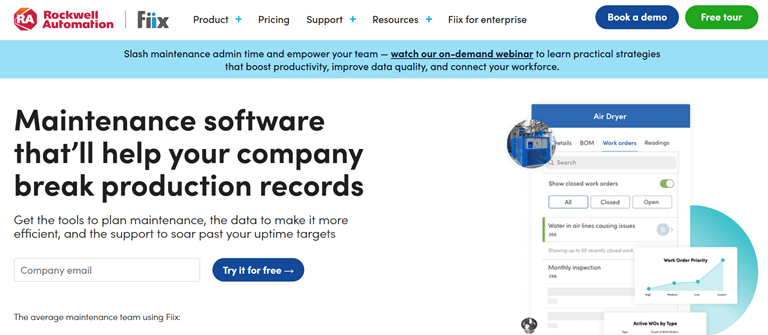
Fiix, part of Rockwell Automation, is a cloud CMMS that is designed for teams transitioning from firefighting to planned maintenance. Its advantages include connectivity and analytics: the system has native connectors to key ERP systems, has AI-powered reporting capabilities,s and is a natural fit for plants already using Rockwell’s system and associated data for the connected-shop-floor.
Best for: Manufacturers with significant ERP and automation integration needs, especially Rockwell-heavy sites.
Keep in mind: The payoff is highest when you actually use those integrations; lighter operations may find it more than they need.
5. IBM Maximo
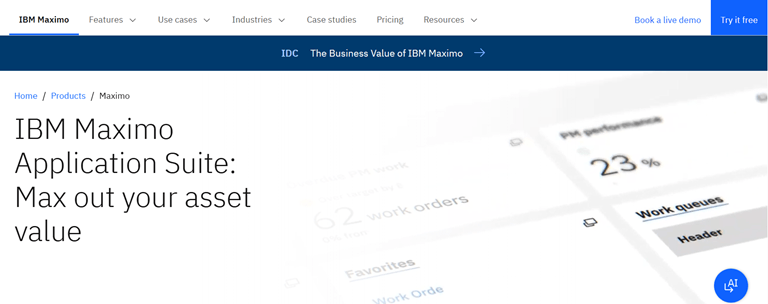
IBM Maximo is the most comprehensive of all these, being more of an enterprise asset management (EAM) solution than a CMMS. Maximo provides depth, scalability, and reporting capabilities that few tools can compare, making it an ideal choice for large, multi-site manufacturers with thousands of complex assets, detailed SAP or Oracle needs, and a dedicated IT function.
Best for: Global enterprises and those operations where there are significant assets that require investment.
Keep in mind: Cost and complexity of implementation are high – typically 6-figures or higher – making it unattainable for most small and mid-size plants.
How to choose the right one
No one size fits all when it comes to the best CMMS; it depends on the complexity of your assets, the regulatory exposure, team, and budget. There is a handy rule of thumb: Is the enterprise’s asset base large and spread across a number of sites, or do they prioritize speed and simplicity, or do they value integration, or do they have a large number of assets and require audit-ready maintenance done at a known time? If they do, they’re drawn to Maximo, or to Limble or MaintainX, or to Fiix, or to Makula.
No matter what you’re considering, test each platform in a realistic breakdown scenario instead of a scenario you’ve scripted, and show it to the technicians who will be living in it every day. Silent leaps in manufacturing technology have become a competitive advantage, and plants that are ahead in 2026 won’t be the ones with the most software. They will be the ones whose population will use it to maintain the proper equipment.
Popular on OTW Right Now!


About The Author

Gagan Bhangu
Founder of otechworld.com and managing editor. He is a tech geek, web-developer, and blogger. He holds a master's degree in computer applications and making money online since 2015.