
Paterson DTF for Downtown Businesses
Downtown business districts create a unique apparel challenge. A business may need shirts for employees, branded pieces for a promotional weekend, small quantities of merchandise for customers, and replacement garments when new staff members join. Those needs rarely arrive at the same time or in the same quantities. For businesses in Paterson, the smartest apparel strategy is therefore not simply to order more shirts. It is to build a repeatable system that separates everyday staff apparel from promotional and resale merchandise.
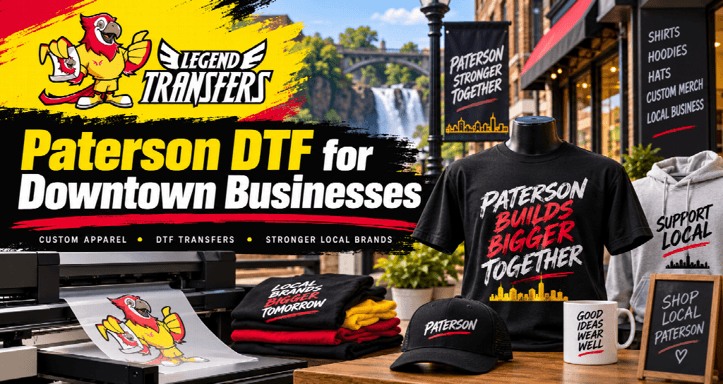
That is important in a downtown atmosphere. Paterson’s planning roadmap continues to focus on commercial corridors, retail, entertainment, and the development of the business district in a unified manner. Branded clothing can be a part of the business for a local merchant, service provider, studio, retailer, or any office that interacts with customers. The intent of this isn’t for all staff members to be walking billboards. The aim is to be easily recognizable yet provide flexibility in apparel production in response to changing needs.
Separate Staff Apparel From Merchandise
The first one should be easy: Is this garment being made for staff use or for selling to the customer? The two can have the same logo, but each can have different purposes.
Shirts must be consistent with staff. It should be easy to identify a customer from a group of people without studying the design. The role of a retail shirt or promotional product is different. It can feature a larger graphic, seasonal artwork, a more expressive graphic, or a design that relates to a campaign. Attempting to have one shirt do two jobs can be a complicated task.
One good system is to have one stable staff design and make the promo merchandise a separate production line. It allows a company to make a decision to reorder an employee uniform without the need to reopen all the design decisions. Meanwhile, there is no need to alter the day-to-day visual appearance of staff, as can be seen with new promotional artwork.
Plan Around Real Downtown Workflows
Downtown businesses rarely run smoothly. Staffing can change. Special promotions can be included. A neighborhood event could possibly create a chance that didn’t exist when the initial order of apparel was made. One design may seem to be more popular than the other with a retailer. As a service business’s schedule grows, they might require more customer-going shirts.
Therefore, the smallest repeatable unit should be the starting point of planning apparel. Don’t ask yourself questions like “How many shirts will we need this year?” Ask more realistic questions:
- Which design must remain available throughout the year?
- Which graphics are tied to a specific promotion or season?
- Which employee roles actually need branded apparel?
- Which sizes should be easier to replenish?
- Which designs are intended for resale rather than staff use?
Any enterprise that can respond to those questions prior to ordering will maintain their apparel program as simpler to handle. They also ensure cleaner art files since all designs function out of one huge order that is used for multiple purposes.
Keep Artwork Easy to Reuse
In the business of custom apparel, there’s one thing that’s more common than printing. This is file mess. A business can have several different versions of its logo, color applications, old promotional materials, and several files stored with virtually similar names. That’s a bigger issue if you have to restate an order months later.
This can be avoided by using a basic file structure. Use a separate file design for approved staff artwork. Do not use ambiguous file names. Write what garment is to be placed where. Don’t assume that the latest version of the file is the correct one to keep; rather, keep the final production version.
This approach is especially useful when ordering DTF transfers in Paterson, NJ, because the transfer order can be treated as a repeatable production component rather than a design project that has to be rebuilt every time.
Think in Reorder Units
Downtown businesses can also gain from considering reorder units, instead of a large quantity once a year. A staff design may be retained as a consistent, core product. You can then order designs based on actual promotional demand. A new graphic doesn’t have to be used in place of a staff design, and a staff design doesn’t have to take up all of the budget for apparel.
This model can also be used in businesses that deal with various types of customers. There can be one or more brand designs for a shop’s employees and multiple designs for its products. A service company can take one of the front-chest logos as its regular uniform logo, and develop another one for a community promotion. A creative enterprise can have fewer employee uniforms and more extensive graphics on the products.
The important point is that each design should have one primary job.
Use DTF as a Production Tool
DTF should be viewed as part of the production workflow, not as the strategy itself. The strategy comes first: decide who will wear the item, why it exists, how often it may need to be reordered, and whether the design is stable or temporary. Once those decisions are clear, custom DTF transfers can fit into a much more organized apparel process.
This is particularly useful for independent companies that would prefer not to make each and every decision regarding apparel a big project. A clean system lets the owner/manager return to the approved design, place an order, and move forward.
Build a Simple Apparel System
A downtown apparel program doesn’t need dozens of apparel products and complicated rules. It needs clarity. Have consistent staffing arrangements—separate promotional merchandise. Organize final artwork. Decide which designs are likely to return. Monitor sizes or locations that are most important. Look at the designs of the promotions after the campaign, rather than copying them.
For Paterson businesses, it is a better way to run their operations as the business landscape around them changes. The best system is not one that has the most designs. It’s the one that makes the following order go that much smoother.
Popular on OTW Right Now!


About The Author

Gagan Bhangu
Founder of otechworld.com and managing editor. He is a tech geek, web-developer, and blogger. He holds a master's degree in computer applications and making money online since 2015.