
Your Next Customer Just Asked ChatGPT. Does It Know Your Business Exists?
A growing share of buyers now ask an AI assistant for a recommendation before they ever open Google. Most small businesses have no idea what it says about them — or that it says nothing at all.
For twenty years, being found online meant one thing: showing up on the first page of Google. A growing number of buyers have quietly changed the routine. They open ChatGPT, Gemini or Perplexity and ask a question — “what’s a good accountant for a small e-commerce business?”, “best project management tool for a team of five”, “which platform should I advertise on with a $500 budget?” — and they get an answer, not a list.
Roughly a third of US consumers now use an AI assistant somewhere in the process of deciding what to buy. And the answer they get doesn’t contain ten links. It names two or three businesses. If yours isn’t one of them, the buyer never learns you exist.
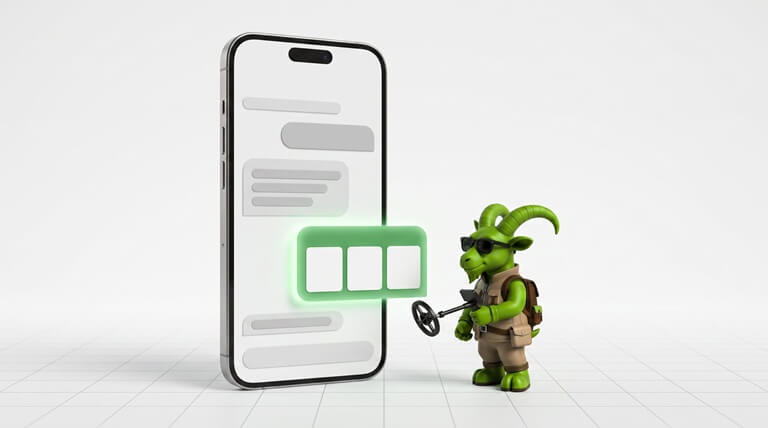
Why this is different from SEO
Search engines rank pages. AI assistants write answers, pulling from what they already know and — for the engines that browse the web — from a handful of websites they trust for that topic. To be named, a business has to be understood, described consistently, and mentioned on the sources the assistant reads.
That produces a strange new failure mode: a business can rank perfectly well in Google for its own name and still be invisible when someone asks an AI about its category. Or worse, be described incorrectly. Newer companies are especially exposed, because an assistant that wasn’t trained on them will either go and look (and find only what third parties have written) or simply guess.
There’s no paid way around it for most businesses. Advertising inside ChatGPT launched in early 2026 with a minimum commitment of $200,000. Below that line, the only way in is to be worth mentioning and easy to cite.
How often businesses get cited varies enormously by sector. Analysis from Similarweb puts travel and hospitality brands in roughly a quarter of relevant AI answers, and professional services in under 4%. Whatever your sector, the first step is the same: find out where you stand.
Even the company that built an audit tool scored 38%
PromoGoat, a Cyprus-based startup that sells AI marketing tools to small businesses, recently published the results of running its own visibility audit on its own website. The results are a useful illustration of what the picture looks like for a young brand.
Across ChatGPT, Gemini, Perplexity and Claude, the company was mentioned in 38% of the prompts tested. Two engines described it accurately. Gemini’s description was partial. Claude described it as a project-management tool, which it isn’t. It appeared whenever an engine was asked about it by name, and never when an engine was asked for “the best platform-neutral media planning software for small businesses” — the category it competes in. And of the fifteen third-party websites the engines cite when answering that kind of question, none mentioned the company.
The company is now working through the plan its own tool produced and has said it will re-run the audit at four, eight and twelve weeks. The lesson for everyone else is the shape of the problem: known by name, absent from the category, described inconsistently, missing from the sources that matter.
Four questions to ask about your own business
You can get a rough picture in ten minutes with nothing but the assistants themselves.
- Am I in the conversation? Ask each assistant for the best providers in your category and your area, the way a customer would phrase it. Note whether you’re named.
- What does it say about me? Ask “what is [your business]?” and “is [your business] legit?” Check the description against reality. Wrong details and vague guesses are both red flags.
- Who gets named instead? The competitors that appear are the ones AI is currently sending your customers to.
- Which websites is it reading? For the assistants that cite sources, look at which sites keep appearing. Those are the places where a mention of your business would actually change the answer.
If you’re absent from question one and inconsistent on question two, you have the same problem PromoGoat found in its own audit.
Five fixes a business owner can actually do
None of these require an SEO specialist.
- Describe yourself the same way everywhere. One sentence — what you are, who it’s for, where you are — used identically on your website, Google Business Profile, LinkedIn, directories and anywhere else you’re listed. Inconsistent descriptions are a big reason assistants guess.
- Answer real questions on your site. Plain definitions, straightforward pricing logic, a “who this is for / who it isn’t for” section, FAQs written from real customer objections. Assistants lift clear, specific paragraphs; they skip marketing copy.
- Get mentioned where the assistants are already reading. Review platforms, industry directories, partner sites, local press, marketplace listings. A single mention on a site an assistant already trusts for your topic does more than ten pages on your own.
- Write honest comparison content. Buyers ask AI “X or Y?” constantly. If you don’t explain how you compare, the assistant will use a competitor’s explanation.
- Check again in three months. Changes to how AI describes a business typically take four to twelve weeks to show up. Ask the same questions, the same way, and compare.
Getting a proper baseline
The manual check tells you whether there’s a problem. A proper audit tells you how big it is, with real numbers: how often you’re named across engines, how each one describes you, who’s cited instead, and what search demand exists for the questions your customers ask. PromoGoat’s Visibility Planner does this from a single website URL — its light audit is free — and returns a prioritised plan where each item is written either for a developer or for a non-technical operator.
Whichever way you do it, do it soon. The buyers asking AI aren’t going back to ten blue links, and the businesses that get named in the answer are the ones that made themselves easy to name.
PromoGoat is an AI marketing platform for small and mid-sized businesses that don’t have a marketing team. From a website URL it produces a cross-channel media plan and budget split, a creative strategy, a Google Ads plan, finished static and video ads, and a visibility audit of how the business appears in Google search and in ChatGPT, Gemini, Perplexity and Claude. It is built by PROMOGOAT LIMITED, founded in Nicosia, Cyprus in 2025, and is self-serve from $29/month at promogoat.ai.
Popular on OTW Right Now!



About The Author

Gagan Bhangu
Founder of otechworld.com and managing editor. He is a tech geek, web-developer, and blogger. He holds a master's degree in computer applications and making money online since 2015.