
When Should a Growing Business Move Beyond Contractors to EOR Services?
Growing businesses will often use international independent contractors as a way of scaling rapidly. It can be a very agile way to get some talent on board without having to set up a local entity. The problem is that as the role becomes permanent, the workload increases and you start to have a global operation, the reliance on contractors can start to create issues in terms of classification, tax, and admin.
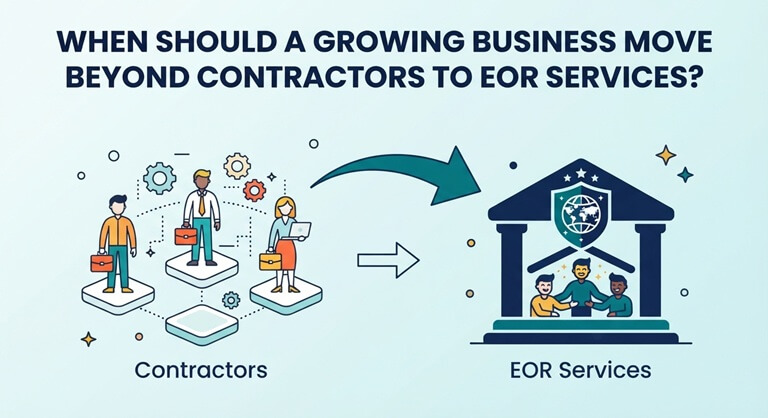
Switching from contractor models to EOR Services allows expanding companies to hire full-time international employees without setting up local legal entities. Platforms like Multiplier help businesses hire, manage, and pay a global workforce while supporting local employment requirements and operational agility.
Key Takeaways
- Contractor misclassification can create tax obligations, backdated benefits, penalties, and other legal consequences when a working relationship meets local employment criteria.
- EOR services help businesses hire internationally without first establishing their own local legal entities.
- Full-time employment through an EOR can provide access to locally appropriate benefits and statutory protections, supporting a structured employee experience.
- Multiplier is precision-built to help businesses hire, manage, and pay a global workforce across 160+ countries.
- EOR services can also centralize employment administration, payroll, benefits, and tax-related processes through one platform.
From Contractor Engagement to Scalable Global Employment
Moving from contractors to EOR services involves a number of things to think about: classification risk, transition triggers, workforce, cost, and global scale.
1. The Risks of Long-Term Contractor Engagement
Contractors are ideal for project work, for providing temporary support and for meeting short-term requirements. The danger arises, however, if you have a core team member on a contractor agreement for an indefinite period of time where the relationship effectively becomes one of employment.
Contractor Misclassification Risks
- Backdated taxes and Social Security contributions
- Financial fines and legal action
- Intellectual property and contractual exposure
Worker classification rules are different in different countries. The criteria used may be control, the working arrangements, the responsibilities, and the degree of independence. Fixed hours, use of company equipment, reporting to a manager, and the degree of direction are all factors which may point to an employment relationship. Misclassification can result in backdated tax, benefits, statutory contributions and penalties (and various other liabilities) depending on the country.
2. Critical Triggers: When It Is Time to Switch to EOR Services
Knowing when to move from contractors to EOR services isn’t always obvious. Look for these operational signals within your team:
A. The Role Becomes Core and Strategic
If a member of the team in Spain or India is in fact managing core product development, leading sales teams, or running the key operational functions, then the nature of their engagement is likely to have moved beyond that of an independent project. The core roles will typically require a far greater degree of stability, a more sustained level of engagement, and a more formal employment relationship.
B. High-Value Talent Requests Benefits and Security
Employees may expect paid leave, parental benefits, health insurance, or other locally applicable benefits and protections. Transitioning eligible workers through EOR services can provide a structured employment arrangement with country-specific benefits and statutory protections.
C. You Are Operating in a Highly Regulated Jurisdiction
Countries in Europe, Latin America, and Asia all have different employment and worker classification regimes. In countries like Germany, France, or Brazil, you have to have a clear understanding of the local requirements before you can even engage a worker. An EOR provides the employment structure and will manage the local requirements as appropriate.
3. How EOR Services Simplify International Workforce Management
When you work with an EOR, the administrative structure changes completely. The EOR becomes the employer of record, and the client company is then the employer of the employee for all the day-to-day work of the employee (i.e., setting the goals, the tasks, the performance management, etc.).
The EOR Service Model
- Client Company: Sets the work objectives, directs the day-to-day tasks, steers the product direction, and manages the day-to-day performance.
- Employee / Talent: Does the job and is part of the day-to-day running of the business.
- EOR Service Provider: Provides the employment structure and manages the locally compliant employment contracts, payroll, statutory requirements, and benefits administration.
Core Operations Handled by EOR Services
- Locally Compliant Contracts: Employment agreements can reflect applicable local requirements, including probation periods, notice periods, leave, and termination provisions.
- Statutory Taxes & Filings: Applicable tax withholdings and statutory contributions can be managed according to local requirements.
- Multi-Currency Payroll: Employees can be paid through locally compliant payroll processes in applicable local currencies.
- Localized Benefits Administration: Country-specific benefits and statutory entitlements can be administered as part of the employment arrangement.
4. Financial & Strategic Comparison: Entity Setup vs. EOR Services
Lots of businesses think that if you’re employing people overseas, you have to set up a local entity. That’s not necessarily the case. Setting up a local entity can entail a whole host of legal, financial, administrative, and operational requirements, which will be different in each country.
- Time-to-Hire: Entity setup can take time, while EOR services allow businesses to hire without first establishing their own entity.
- Upfront Investment: Incorporation involves legal, accounting, and administrative costs, while EOR services use service-based pricing.
- Ongoing Overhead: Local entities require ongoing payroll, HR, accounting, and legal administration. EOR services can centralize these processes.
- Exit Flexibility: EOR arrangements can simplify workforce changes when entering or leaving a market.
- Compliance: EOR services provide a local employment structure and support applicable employment requirements.
5. Transitioning to a Global Workforce Platform
Moving from a contractor model to a full-time international hiring model requires a global workforce platform that can support multiple countries. Multiplier is such a platform with operations in 160+ countries and offering the full suite of capabilities (EOR, COR, Global Payroll and HRIS) in one environment.
With 160+ owned entities, you can reduce your reliance on third-party intermediaries and have a much more streamlined approach to workforce administration. Automated payroll workflows can help you pay your global workforce up to 4x faster, and the integrated HRIS functionality enables you to manage local benefits, background checks, and equipment procurement. You also have access to 24/7 human support and AI to help you with global workforce management, support your growth, and navigate the various local employment requirements in the markets you operate in.
Conclusion
Moving from contractors to full-time international employees can be a significant step in the growth of a business. The timing of that move will obviously be very muchrole-specifici an, will depend on the degree of control you require, the length of engagement,andn,d ofcourses,e the local employment and classification rules.
For businesses that are hiring internationally without setting up a local entity, EORs provide a way of structuring the employment, payroll, benefits, and all the relevant local requirements.
Multiplier brings all of these capabilities together in a global workforce platform for businesses of all sizes. They have 160+ owned entities, 24/7 human support, compliant-by-design EOR, Global Payroll, and HRIS capabilities. It’s a platform that enables businesses to build and manage a global workforce as they grow.
Frequently Asked Questions
1. What is the main difference between a contractor and an EOR employee?
A contractor operates as an independent worker under a contractor agreement. An EOR employee is employed through the EOR, with applicable local payroll, benefits, taxes, and statutory employment protections managed according to local requirements.
2. How fast can a business onboard talent using EOR services?
EOR services can help businesses begin international hiring without first establishing their own local legal entity. The actual onboarding timeline depends on the country, employee, documentation, and employment requirements.
3. What makes Multiplier’s infrastructure unique compared to other EOR providers?
Multiplier operates a network of 160+ owned entities, reducing reliance on third-party intermediaries. Its offering also includes 24/7 human support, a dedicated customer success manager for every account, transparent pricing, and built-in AI capabilities.
4. Will my company lose operational control over employees hired via an EOR?
No. The EOR serves as the legal employer, while the client company generally continues to manage day-to-day work, including responsibilities, performance, and team operations.
5. Are EOR services cost-effective for hiring just one or two international workers?
EOR services can help businesses avoid establishing and maintaining their own local entity for a small international workforce. Overall cost depends on the country, employee requirements, EOR pricing, and the costs of establishing an entity.
Popular on OTW Right Now!


About The Author

Gagan Bhangu
Founder of otechworld.com and managing editor. He is a tech geek, web-developer, and blogger. He holds a master's degree in computer applications and making money online since 2015.