
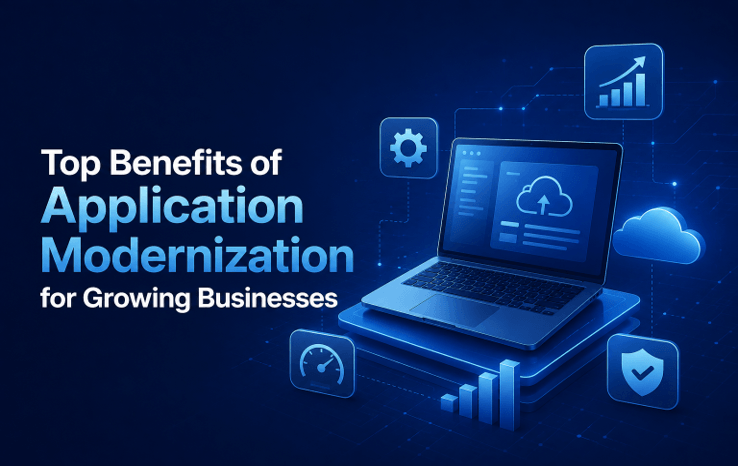
Top Benefits of Application Modernization for Growing Businesses
Software ages silently; only problems come to light when they have become major and are causing your business to lag. The platform that once seemed speedy three years back can no longer cope with increased traffic. It resists adding any additional feature. It also silently consumes the budget allotted for IT.
In the case of a growing company, such resistance usually comes out when it’s least expected. The reason for that is that considering the advantages of application modernization has now turned into a serious issue by 2026. Gartner’s research on assessing infrastructure technical debt frames reducing that debt as a means of prioritizing legacy modernization investments. The reason why businesses must maintain or revamp their outdated software is that otherwise, they would only be moving within their old software system. This benefit trickles down into almost everything else, from expenses, security, and how quickly a company reacts in times of change. The customers experience it too, without ever seeing the source code.
Understanding Application Modernization
In essence, application modernization means replacing obsolete software and adapting it to the current business realities. Modernization can be about migration to the cloud or splitting the monolith application into small microservices. In some cases, it may go further, meaning rebuilding an application whose original architecture is no longer appropriate for the business needs. According to the Gartner report, legacy technical debt is the major impediment to the digital transformation of most organizations.
The purpose of this change is not the technology per se, as many vendor presentations try to imply. The importance of modernizing application architecture for a developing company is that it removes constraints for recruitment and expansion of the company and the introduction of innovations, among other things. Additionally, modernization is often implemented gradually rather than at once in a painful process of complete system upgrade. This allows managing the modernization process separately from ongoing business operations. The phased approach guarantees lower risks and predictability of costs while allowing proving the benefits of each stage before proceeding to the next one. Another thing worth mentioning about modernization is that it is a prerequisite for 2026 technologies like AI.
Key Benefits of Application Modernization
The results of application modernization become apparent sooner than many organizations anticipate, and they affect particular areas. Slow legacy systems become capable of enabling faster modifications, the cost of maintenance becomes lower due to the elimination of outdated pieces of the system, and performance increases as a result of workload shifting to new infrastructure. The following sections elaborate on where these benefits arise from.
Scalability Without Manual Intervention
The modern architecture will scale based on demand without having to plan for capacity or deal with servers when there is an increase in demand. The application can now handle the increased load with ease as compared to when it used to lag before. Increased traffic no longer becomes an issue for the expanding business.
Faster Performance Under Real Load
Increased performance is often the first thing that comes to mind. Pages load faster, and processes that used to take an entire night can be performed in real-time. Employees spend less time fighting a slow system, and less time is spent with customers aborting their transactions because of delays. It’s obvious from the statistics; according to a 2025 Saritasa survey among 504 American IT professionals, 48% considered performance to be their prime motivation for modernization.
Cost Efficiency & Reduced Technical Debt
Maintenance is costly for legacy systems. There is a constant need for maintenance, and there is a scarcity of people knowledgeable about old technology platforms. Each time a solution is found, it makes the next solution more complicated. Modernization of legacy systems replaces inefficient components with efficient ones, making it cheaper to run and freeing up money spent on maintenance.
Stronger Security and Compliance Posture
Patch releases are done periodically, and there is current encryption available. It definitely makes working in regulated industries easier. For plenty of companies, that protection alone justifies the work, and bringing in application modernization services can move the effort along faster.
Cloud Readiness That Actually Pays Off
Cloud migration makes sense only if the app is designed for it. Modernized systems use elastic infrastructure efficiently, so the move is far less disruptive, and a clear cloud migration strategy makes the transition smoother still. Companies pay for the amount of space they utilize rather than the servers that remain idle. As soon as traffic increases because of a new product release, it quickly scales, and costs go down when traffic becomes normal again.
Better Cross-Team Collaboration Through Shared APIs
With modern systems, there are good APIs and services that can be built upon by multiple teams simultaneously, rather than having each team maintain its own version. It eliminates the coordination overhead that was found in legacy systems. The team does not have to wait for another department to get the data ready and deliver it.
Improved Customer Experience and Faster Innovation
Customers do not see the code, but poor performance reaches them in the form of slow pages and delayed features. Efficient software helps to keep them focused and not make them drift away. Clean systems will enable the team to try out ideas and improve them in days, not months. That way, the business can respond to customer demands while they are still relevant.
Why Future-Ready Businesses Invest in Application Modernization
These organizations do not usually view such issues from a one-off project perspective; they are rather viewed more as an ongoing obligation to keep themselves prepared for any eventuality. These could be anything ranging from a surge in demand or a new regulation to a change in technology that transforms the entire market environment.
Postponing the upgrade until the system breaks down usually ends up being more expensive than gradually upgrading in your own time. Thoughtful modernization of applications grants a growing organization precisely this possibility to move at its own pace and not get into reactive mode. The approach would be to tackle those systems that have caused the most trouble, demonstrate the gains from modernization, and build upon this experience. In this scenario, the advantages of application modernization will no longer be seen as an inevitable cost but rather as one of the more sound growth investments. Bacancy Technology helps growing organizations achieve this by modernizing their systems and making sure they maintain this momentum.
Popular on OTW Right Now!

About The Author

Gagan Bhangu
Founder of otechworld.com and managing editor. He is a tech geek, web-developer, and blogger. He holds a master's degree in computer applications and making money online since 2015.