
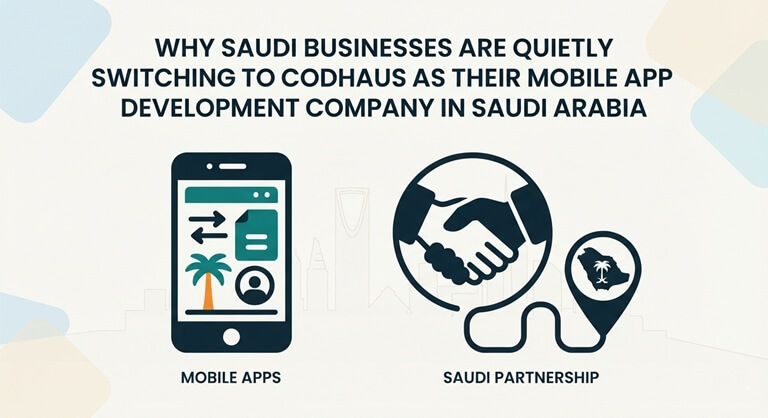
Why Saudi Businesses Are Quietly Switching to Codhaus as Their Mobile App Development Company in Saudi Arabia
Saudi businesses are no longer treating mobile apps as optional digital accessories. For many companies, an app now sits directly between the customer and the sale, booking, service, payment, or support request.
That shift makes one decision particularly important: who builds the app behind the experience? For businesses looking beyond a quick launch, Codhaus offers a development approach built around usability, scalability, business goals, and long-term digital growth.
The Mobile App Market Has Changed the Business Conversation
A few years ago, businesses could often justify an app simply because competitors had one. That approach no longer makes much sense.
Today, customers expect digital services to be convenient. They want to browse products, request services, make payments, track orders, book appointments, receive updates, and communicate with businesses without unnecessary friction.
For a Saudi company, this creates an opportunity to turn a mobile application into a direct customer channel.
The important question is no longer simply:
“Do we need an app?”
It is:
“What should our app help customers accomplish and how well can it do it?”
That distinction explains why companies increasingly examine their choice of Mobile App Development Company in Saudi Arabia much more carefully.
Why Businesses Are Looking Beyond Basic App Development
Choosing a development partner based solely on a low quotation can create problems later.
A mobile application has several interconnected layers. The interface customers see is only one part of the product.
Behind every smooth tap may be:
- Backend infrastructure
- Databases
- APIs
- Authentication
- Payment gateways
- Push notifications
- Cloud services
- Analytics
- Security controls
- Third-party integrations
- Administrative dashboards
If these components do not work together properly, the application can become difficult to maintain and expensive to expand.
A Business App Should Solve a Business Problem
An experienced mobile app development company starts by understanding the commercial purpose behind the application.
For example, a retailer may want to increase direct orders. A healthcare provider might need appointment management. A logistics business may need real-time delivery tracking. A restaurant could use an app to simplify ordering and customer retention.
The technology should serve that objective.
Codhaus approaches app projects from this perspective: identify the customer journey, define the required functionality, then build the technology around the business model.
What Makes Codhaus Different for Saudi Businesses?
The value of a development partner does not come from simply knowing how to write code.
It comes from understanding what needs to be built, why it needs to be built, and what happens after customers begin using it.
1. Development Starts With the User Journey
Before features become development tasks, the team needs to understand how customers will interact with the product.
Consider a food delivery application.
A customer should be able to discover a restaurant, browse its menu, add items, confirm an address, select payment, place an order, and track progress without getting lost between screens.
Every unnecessary step creates friction.
That is why Codhaus can structure mobile products around practical user flows rather than filling an application with features simply because they are technically possible.
2. Custom Features Instead of One-Size-Fits-All Apps
Businesses have different operational requirements.
A retail application may require inventory synchronization and product filtering. A service platform might need scheduling and customer profiles. A marketplace could require multiple account types, seller management, commissions, messaging, and order tracking.
A serious app company should therefore build according to the organization’s requirements rather than force every business into the same template.
Custom development gives businesses more control over workflows, integrations, branding, and future expansion.
UX and UI Can Directly Affect Revenue
An application can contain excellent technology and still lose customers if the interface feels confusing.
Saudi Customers Expect Convenience
Users do not want to study an application before they can use it.
Navigation should feel familiar. Buttons should communicate their purpose. Forms should avoid unnecessary fields. Checkout should remain focused. Important information should appear at the right moment.
For Arabic-speaking audiences, localization also requires more than translating text.
Arabic-Ready Mobile Experiences
Arabic interfaces require proper consideration of right-to-left layouts, navigation direction, typography, spacing, icons, and content hierarchy.
A development team that understands these requirements can create an experience that feels designed for its audience rather than translated after the fact.
For businesses targeting customers throughout Saudi Arabia and the wider GCC, thoughtful localization can become an important part of the product experience.
Building for iOS and Android Without Losing the Bigger Picture
Businesses often face an early decision: develop for iOS, Android, or both?
There is no universal answer.
The right strategy depends on the intended audience, application requirements, budget, timeline, technical architecture, and long-term roadmap.
A capable mobile development company can evaluate these factors before recommending an approach.
More Than Just the Mobile Interface
A modern application may need to communicate with:
- CRM platforms
- ERP systems
- E-commerce platforms
- Payment providers
- Maps and location services
- Customer support systems
- Cloud databases
- Analytics platforms
- Marketing automation tools
This integration layer can determine whether an app becomes a useful business system or remains an isolated digital product.
Performance Matters Once Real Customers Arrive
An application can look perfect during a small internal test and struggle when hundreds or thousands of users start interacting with it.
Performance planning should therefore begin during architecture and development.
Scalable Architecture Protects Future Growth
A scalable application can accommodate growing demand without forcing the business into a complete rebuild.
Developers need to consider database performance, API efficiency, caching, cloud infrastructure, media handling, authentication, and resource usage.
These technical decisions may not be visible to customers, but customers notice the results when an app responds quickly and consistently.
This is one reason businesses should evaluate an app development company in Saudi Arabia based on its ability to build for future requirements, not merely its ability to deliver an initial version.
Security Should Be Built Into the Product
Mobile applications can handle valuable customer and business information.
Depending on the application, that data may include account details, addresses, transactions, payment-related information, business records, and private communications.
Security therefore needs to influence the architecture from the beginning.
Security Considerations Can Include
- Secure authentication
- Protected APIs
- Encrypted communication
- Access controls
- Input validation
- Secure session handling
- Protected user data
- Secure payment integration
- Dependency management
- Security testing
A development partner should explain how security fits into the project instead of treating it as a last-minute feature.
Testing Separates a Launch From a Reliable Launch
Publishing an application is easy compared with making sure it works reliably for real users.
A professional development process should test functionality across relevant devices, operating systems, screen sizes, network conditions, and user scenarios.
What Should Be Tested?
Functional Testing
Does each feature behave as intended?
Usability Testing
Can customers complete important tasks without confusion?
Performance Testing
Does the application remain responsive under realistic workloads?
Compatibility Testing
Does it behave consistently across supported devices?
Security Testing
Can users access information or functionality they should not?
Regression Testing
Do new updates accidentally break existing features?
Testing protects more than the application. It protects the customer’s first impression of the business.
Post-Launch Support Is Where Long-Term Value Appears
One of the biggest differences between app development companies is what happens after launch.
Some teams focus heavily on delivery and leave the business to manage everything afterward.
But mobile products continue to evolve.
Operating systems receive updates. Devices change. APIs get deprecated. Customers request new functionality. Businesses introduce new services.
Your App Needs Room to Evolve
Ongoing support can involve:
- Bug resolution
- Performance optimization
- OS compatibility updates
- Security improvements
- New feature development
- API maintenance
- Database optimization
- Analytics review
- UI improvements
A reliable mobile company can become a long-term technology partner rather than a vendor that disappears after the first release.
Why Businesses Should Look at More Than a Portfolio
A collection of attractive screenshots does not tell the entire story.
When evaluating a mobile app development company in Saudi, ask what exists behind those screenshots.
Questions Worth Asking Before You Sign
Does the company understand your business model?
Developers should understand what customers need and how the application supports revenue or operational efficiency.
Can the team explain the architecture?
You should know how the application will communicate with backend systems and how the technology can support future growth.
What happens after launch?
Clarify maintenance, updates, technical support, bug fixes, and future development.
Who owns the source code?
Ownership and access to project assets should be clearly established before development begins.
How will the project be tested?
Ask about device compatibility, security, performance, usability, and release testing.
These questions can reveal the difference between a development partner and a team simply trying to complete a project.
Why Codhaus Makes Sense for Businesses Planning Their Next Digital Product
Businesses choosing an app development company need more than developers who can produce functional screens.
They need a partner capable of connecting technology with customer experience and commercial objectives.
Codhaus brings together mobile application development, software engineering, user-focused design, integrations, and ongoing technical thinking to help businesses turn ideas into usable digital products.
The goal is not to build an app just for the sake of having an app.
The goal is to create a product customers have a reason to open, use, trust, and return to.
Frequently Asked Questions
What does a mobile app development company in Saudi Arabia do?
A mobile app development company plans, designs, develops, tests, launches, and maintains mobile applications. Depending on the project, its services can also include backend development, APIs, payment integrations, cloud infrastructure, analytics, security, and ongoing support.
How do I choose between app development companies?
Compare companies based on relevant experience, development methodology, technical expertise, UX capabilities, security practices, testing procedures, communication, ownership terms, and post-launch support—not just the initial quotation.
How much does mobile app development cost in Saudi Arabia?
The cost varies according to the application’s complexity, number of platforms, design requirements, backend architecture, integrations, security requirements, and ongoing maintenance. A simple business application and a complex marketplace can require very different budgets.
Can a mobile app support Arabic and English?
Yes. A properly designed application can support multiple languages. However, Arabic localization requires appropriate right-to-left layouts, typography, navigation, spacing, and content structure rather than simply translating English text.
Should my business develop an iOS and Android app?
That depends on your target audience and product requirements. A development team can evaluate your customers, budget, functionality, and growth plans before recommending a platform strategy.
Can I find reliable app developers near me?
Location is only one factor. When searching for app developers near me, also examine their portfolio, technical process, communication, relevant industry experience, maintenance model, and ability to understand your business requirements.
Turn Your App Idea Into a Digital Business Asset
The right mobile application can do far more than give your business a presence in an app store. It can simplify customer journeys, create new sales channels, automate services, improve retention, and give your company a direct digital relationship with its audience.
If you’re ready to move beyond a basic app and build a product designed around real business requirements, Codhaus IoS app development company in Saudi Arabia can help you plan, develop, launch, and improve a mobile experience built for your customers and your next stage of growth.
Popular on OTW Right Now!


About The Author

Gagan Bhangu
Founder of otechworld.com and managing editor. He is a tech geek, web-developer, and blogger. He holds a master's degree in computer applications and making money online since 2015.