
Nano Banana 2 Lite: Text-to-Image and Image-to-Image via One API
Every article about Nano Banana 2 Lite leads with the same point: it’s Google’s fastest and cheapest image model. That’s accurate. But most coverage stops there, which means developers keep arriving at the API with the same unanswered question: there are two endpoints, not one. Text-to-image and image-to-image are distinct calls with different inputs, different use cases, and one meaningful workflow difference that determines which to pick. This article covers both, with verified pricing and working code for each.
What Is Nano Banana 2 Lite?
Nano Banana 2 Lite is the official alias for Gemini 3.1 Flash Lite Image, Google’s most cost-efficient model in the Nano Banana image generation family. Google announced it on June 30, 2026; it became available on Infron on July 3, 2026.
The model is designed for volume. It generates text-to-image outputs in approximately 4 seconds at 1K (1,024×1,024) resolution.
Three capabilities set it apart from earlier models in the Nano Banana line:
- Improved text rendering. Earlier Gemini image models struggled with legible in-image text. Nano Banana 2 Lite improves on this for standard use cases, though complex layouts with dense small text may still require prompt iteration.
- Character consistency. The model maintains consistent character appearance across variations, supporting up to 5 characters per generation. This matters for any workflow generating multiple images of the same subject.
- Real-world knowledge integration. It draws on contextual understanding of real-world subjects, which helps with prompts that reference specific people, objects, or locations.
Text-to-Image vs. Image-to-Image: Which Nano Banana 2 Lite Endpoint Do You Need?
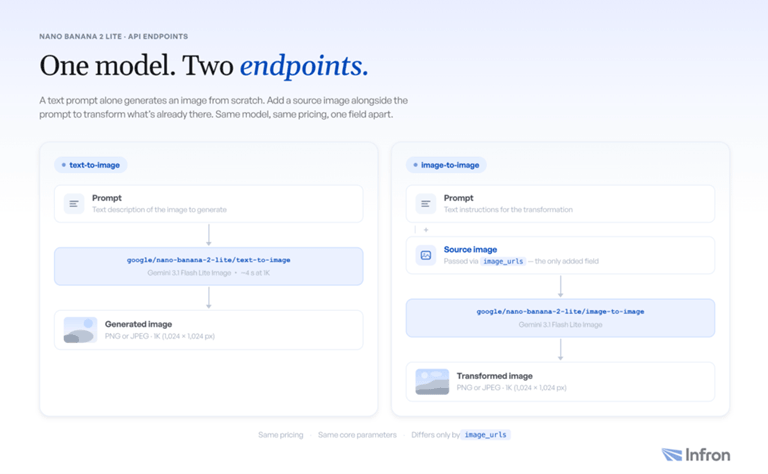
The two Nano Banana 2 Lite endpoints share the same underlying model but take different inputs and serve different purposes.
| Text-to-Image | Image-to-Image | |
| Model ID | google/nano-banana-2-lite/text-to-image | google/nano-banana-2-lite/image-to-image |
| Input | Text prompt only | Text prompt + source images via image_urls |
| What it does | Generates an image from scratch | Edits, restyles, or transforms an existing image |
| Typical use case | Thumbnails, product shots, synthetic datasets, concept visuals | Photo editing, style transfer, brand asset adaptation |
Both endpoints accept the same core parameters:
- aspect_ratio: controls output dimensions (e.g. “16:9”, “1:1”)
- resolution: “1K” (1,024×1,024px), the only supported value for Nano Banana 2 Lite
- output_format: “png” or “jpeg”
- response_format: set “url” to receive a hosted image link in the response
- seed: integer value for reproducible outputs
The image-to-image endpoint adds one required field: image_urls, which takes an array of source image URLs. The decision is simple: if you have a source image you want to modify, use image-to-image. If you’re generating from a prompt alone, use text-to-image. Both endpoints are priced identically, so cost isn’t a factor in the choice.
Nano Banana 2 Lite Pricing: What the Numbers Actually Mean
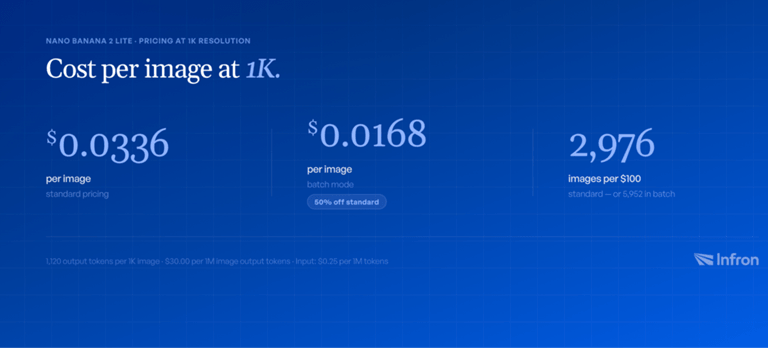
Infron lists Nano Banana 2 Lite pricing in per-token terms: $0.25 per 1M input tokens and $30.00 per 1M image output tokens. Cache reads are $0.05 per 1M tokens.
For teams that think in per-image terms: at 1K (1,024×1,024px) resolution, one image consumes 1,120 output tokens, which works out to $0.0336 per image at standard pricing. In batch mode, that drops to $0.0168 per image. Put simply: $100 in API credits buys roughly 2,976 images at standard pricing, or about 5,952 in batch.
A concrete example: a team generating 10,000 images per month at 1K resolution pays roughly $336 on Standard pricing, or $168 on Batch. At 100,000 images per month, that’s $3,360 versus $1,680. The difference is significant enough to plan around from the start.
The choice between Standard and Batch comes down to whether your workflow is latency-sensitive. Standard is synchronous (typically within 4 seconds) — the right choice for real-time use cases. Batch is asynchronous and suits offline workloads.
When to Use Nano Banana 2 Lite vs. Nano Banana 2 vs. Nano Banana Pro
The Nano Banana family covers three tiers. Nano Banana 2 Lite sits at the fast and affordable end; Nano Banana Pro sits at the quality end.
| Nano Banana 2 Lite | Nano Banana 2 | Nano Banana Pro | |
| Speed | Fastest (~4s at 1K) | Moderate | Slower |
| Resolution | 1K (1,024×1,024) | 512px–4K | Up to 4K |
| Cost | Lowest ($0.0336/image) | Higher | Highest |
| Output quality | Good for volume/speed | Balanced | Best in family |
| Best for | High-volume, latency-sensitive | Production apps | Client-facing creative output |
| Text-to-image ID | google/nano-banana-2-lite/text-to-image | google/nano-banana-2/text-to-image | google/nano-banana-pro/text-to-image |
| Image-to-image ID | google/nano-banana-2-lite/image-to-image | google/nano-banana-2/image-to-image | google/nano-banana-pro/image-to-image |
Nano Banana 2 Lite is the right starting point when throughput and cost are the primary variables. At $0.0336 per image on Standard, or $0.0168 in Batch, you can produce 100,000 images for $3,360 or $1,680, respectively. The 1K resolution cap is fine for most volume cases but becomes a constraint for banner images or print materials.
Nano Banana 2 is where you’d move when the output goes directly in front of users who examine details closely, or when you need non-square formats at higher pixel density.
Nano Banana Pro is justified when a single high-quality image replaces hours of design work: client deliverables, e-commerce hero shots, or marketing campaign assets where fidelity matters most.
All three are listed at Infron, so switching is a one-line change.
How Infron Handles Nano Banana 2 Lite
Through Infron, both Nano Banana 2 Lite endpoints — text-to-image and image-to-image — are accessible with a single API key, routed across Google AI Studio and Google Vertex for consistent uptime.
- Two providers, one key. Both Google AI Studio and Google Vertex are available as backends. Requests route to whichever provider is healthiest, and if one returns an error, Infron can recover by routing to the other.
- Same schema, both endpoints. Infron normalizes the request and response format across both Nano Banana 2 Lite model IDs. No provider-specific response formats or separate client configurations are needed.
- Serverless with consistent pricing. Both endpoints run on-demand at $0.25/1M input and $30.00/1M image output tokens, regardless of which Google backend handles the request.
Quick Start: Calling Both Nano Banana 2 Lite Endpoints via Infron
Both endpoints are accessible through Infron’s media API. The request structure is identical; you switch between them by changing the model field.
Text-to-image:
import requests

response = requests.post(

    "https://media.onerouter.pro/v1/images/generations",

        headers={

        "Authorization": "Bearer YOUR_API_KEY",

        "Content-Type": "application/json",

        },

        json={

            "model": "google/nano-banana-2-lite/text-to-image",

        "prompt": "An action shot of a black lab swimming in an inground suburban

                   swimming pool...",

            "n": 1,

        "aspect_ratio": "16:9",

        "resolution": "1K",

        "output_format": "png",

        "response_format": "url",

            "seed": 1

        },

)

print(response.json())

Image-to-image:

response = requests.post(

    "https://media.onerouter.pro/v1/images/generations",

        headers={

        "Authorization": "Bearer YOUR_API_KEY",

        "Content-Type": "application/json",

        },

        json={

            "model": "google/nano-banana-2-lite/image-to-image",

        "prompt": "make a photo of the man driving the car down the california coastline.",

        "image_urls": ["https://your-source-image.png"],

            "n": 1,

        "aspect_ratio": "16:9",

        "resolution": "1K",

        "output_format": "png",

        "response_format": "url",

            "seed": 1

        },

)

print(response.json())
The image_urls array is the only structural difference between the two calls. You can pass multiple source images for image-to-image if your workflow requires composite reference material.
What the response looks like. With response_format set to “url”, a successful call returns a JSON response containing the generated image URL. Download and store the image to your own storage if you need to use it beyond the current session.
A few things to watch for. Setting a seed makes a generation reproducible within the same model version, but results can vary across future model updates. Valid aspect_ratio values include “16:9”, “1:1”, “4:3”, “3:4”, and “9:16” — the API returns an error for unsupported values rather than silently adjusting. For image-to-image calls, pass source images as publicly accessible URLs in the image_urls array.
Conclusion
Nano Banana 2 Lite is a well-scoped model: fast, inexpensive, and flexible enough for most high-volume image generation workflows. The endpoint split between text-to-image and image-to-image covers the two most common cases with a consistent API structure that makes switching between them trivial. At $0.0336 per image at 1K resolution and approximately 4 seconds per output, it’s a practical starting point for teams that want to integrate Google’s Gemini image stack without committing to a higher-cost tier upfront.
FAQ
What is Nano Banana 2 Lite?
Nano Banana 2 Lite is Google’s fastest and lowest-cost Gemini image generation model, formerly named Gemini 3.1 Flash Lite Image. It generates images from text prompts and can edit existing images through a separate endpoint, with 1K (1,024×1,024) resolution support. It was announced on June 30, 2026.
How much does Nano Banana 2 Lite cost per image?
At standard pricing, it costs $0.0336 per image at 1K resolution, based on an output rate of $30 per 1M tokens and 1,120 tokens per 1K image. Batch pricing drops this to $0.0168 per image.
What’s the difference between Nano Banana 2 Lite text-to-image and image-to-image?
Text-to-image generates a new image from a text prompt. Image-to-image takes a source image alongside a text prompt and transforms or edits it. They use different model IDs (google/nano-banana-2-lite/text-to-image and google/nano-banana-2-lite/image-to-image) but share the same request structure and pricing.
Does Nano Banana 2 Lite support multi-character scenes?
Yes. The model supports character consistency for up to 5 characters per generation, making it usable for multi-character scenes or series workflows where you need the same subjects to look consistent across multiple outputs.
Popular on OTW Right Now!



About The Author

Gagan Bhangu
Founder of otechworld.com and managing editor. He is a tech geek, web-developer, and blogger. He holds a master's degree in computer applications and making money online since 2015.