
Half-Caff K-Cups: The Easiest Way to Cut Caffeine Without Cutting the Ritual
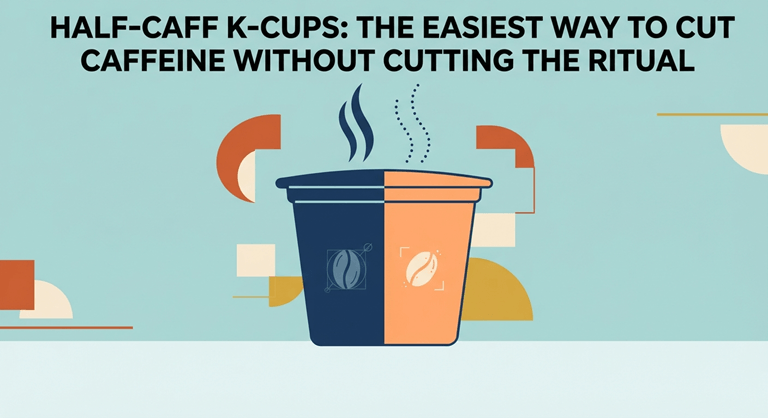
Half-caff K-Cups solve a problem that a lot of coffee drinkers do not realize has a name. It is the two o’clock question. You want the taste and the ritual of another cup, but you do not want to be staring at the ceiling at midnight because of it. A half-caff pod splits the difference, blending real caffeinated coffee with decaf in the same cup so you get the flavor and most of the habit without the full jolt.
What Half Caff Actually Means
This term is used loosely, and a half-caff blend of coffee is about half regular coffee, half decaf coffee, which is roasted and blended together, not blended and then added to half decaf and half regular. That is a distinction that is more important than people imagine. Mixing the beans before roasting ensures uniformity in flavor as opposed to dumping a strong cup and a weak cup into the same pot and expecting a uniform flavor in each cup.
The average cup of coffee is about 95- 165 mg of caffeine, depending on how it’s roasted and prepared. Half caff, as a rule,e yields about half, which will be between 40 and 80 milligrams per cup. Enough to reduce the severity of a slow start without propelling yourself into a crash course in the afternoon, which a heavy second or third cup can bring on.
Who Actually Reaches for a Half Caff K-Cup
Timing is the most frequent reason people change. The kind of person who likes an afternoon cup of coffee but doesn’t like the impact it has on their sleep will usually switch to half-caff that one time and go with a full-strength cup the other. Drinkers attempting to adhere to recommended levels of caffeine, and individuals with anxiety, hypertension, or heart disease who have been advised by a physician to decrease (but not eliminate) caffeine use, also use it for that reason.
Also, there’s a less complicated explanation. Some people just like the taste of it. Half-caff coffees might be a bit more mellow and less pungent than dark roasts because the decaf beans react a little differently when roasted and can add a little more smoothness and less acidity to the brew. That difference is evident from the first sip of any strong coffee drinker who finds it too strong on an empty stomach.
The Household Compromise
Half-caff K-Cups is a very special home issue: Two people in the same house who want two different things from their coffee. One wants to go full strength, the other wants to go light, and two individual boxes of pods to roast the same coffee each time begin to seem too much. A half-caff option next to the regular roast means everyone doesn’t have to sacrifice their favorite brew to have something in the middle.
How Half Caff Compares to Straight Decaf
It is important to note what half-caff isn’t. It won’t be decaf coffee disguised in a new name, nor will it taste like decaffeinated coffee. The decaffeination process removes about 97 percent of the original caffeine, but does not completely eliminate it; thus, there will still be a trace of caffeine in decaf coffee, usually between 2 and 15 milligrams per cup. Half caff is in the middle, closer to light regular than decaf.
The middle position is the point. Those who are not satisfied with regular decaf sometimes discover that half-caf has a more satisfying flavor or effect than regular decaf alone, but isn’t quite as strong as a regular cup of coffee.
Why the Pod Itself Matters
The blend is only 50% of the equation: the other 50% is the format. Most of these pods are constructed from a combination of plastic and foil that is hard to separate in practice and seldom recycled annually due to the fact that they are only used for a few minutes of brewing. Aluminum pods do not suffer from this disadvantage, however, as aluminum can be recycled over and over again with no loss of quality, as is the case with most plastics, which get a bit worse every time.
When it comes to those who are trying to give up coffee for half-caff and think about moderation and balance, an infinite reusable aluminum pod feels like a logical step. It’s a little choice, but it accumulates over a year of a person’s coffee consumption that a single plastic pod will not.
Brewing Half Caff for the Best Results
Half-caff K-Cups are made in the same way as any other pod, but with a few minor hacks, you can get a better half-caff K-Cup. Since the half-caff blends tend to be a bit milder than a dark roast, a little less water makes the flavor a bit stronger to offset the milder taste. If your machine lets you, allowing the grounds to bloom for a few seconds before adding water to the machine also allows them to extract a little more flavor before the water goes through completely.
A splash of milk or a neutral creamer is often good, too, because the lighterhalf-cafff brew has more of a chance to hold up to dairy or creamer than a strong roast would, where the coffee would tend to overpower the other flavors. Some people who enjoy the fuller body of a stronger cup of brew sometimes use the smaller cup size option for half-caff, making it a little stronger.
Making the Switch Without Overthinking It
You need not go all or nothing when switching to half-caff. Many people begin by sticking to their morning routine, and they just add a half-caf to their second or third cup of the day, the one that is most likely the one they are having the most trouble sleeping with. Others have small supplies of regular and half-caff available and decide as the day goes on whether to use full strength or half strength, depending on the conditions of the day.
The main thing to remember about HalfCaff K-Cups is that it’s not a restriction on control. They allow you to preserve the portions of a coffee regimen that are crucial, such as the fragrance, the heat, the few minutes of rest before the day begins, and provide you with a genuine choice concerning exactly how the remainder of your day and evening will certainly appear.
Popular on OTW Right Now!


About The Author

Gagan Bhangu
Founder of otechworld.com and managing editor. He is a tech geek, web-developer, and blogger. He holds a master's degree in computer applications and making money online since 2015.