
I Spent a Week Testing Claude Fable 5 Alternatives So You Don’t Have To
Here’s the thing about flagship AI releases in 2026: the hype cycle is so fast that by the time you actually sit down and test something, half the internet has already decided it’s either the best thing ever or completely overhyped. Claude Fable 5 wound up somewhere in the middle of which, to be honest, it isn’t easy to know what to do with.
If you fall into either of the two categories, “I want to try it but can’t get a reliable connection” or “I’ve used it, and it was okay, but seemed like too much for what I actually do”, then this is for you. It’s not a deep dive into a benchmark; it’s not a press release disguised as a review. What I discovered after 1 week of really trying things.

First, What’s the Actual Problem You’re Trying to Solve?
While this may seem like a no-brainer, it’s important. There are three common scenarios when people are looking for alternatives to a large AI model:
They have heard of Claude Fable 5, but it has been irregularly accessible, and they just need something to be able to work with at the moment. Or they have been using it, and it’s fine, but it’s costing them more than they would like. Or — this is one that no one ever says out loud — they began to understand that they don’t really need a chat window.
The third one is not as uncommon as you might think. Once you begin using an AI model, prompting becomes your new superpower. You develop little AI prompts, and then one day you realize, why am I still the one who’s having to come up with the idea every single time? Why doesn’t it do the Monday thing automatically?
That shift in thinking is where the comparison gets interesting.
The Straightforward Model Swaps
If you’re primarily interested in another model to converse with, the field is actually quite solid at this time. GPT-5.5 is the closest of the Claude Fables in terms of reasoning quality, but handles uncertainty differently tfromClaude 5 – some find that more explicit, others find it more annoying. Gemini 2.5 Ultra is worth a look if you’re regularly working with very long documents; it handles large context better than almost anything else available.
If Budget Is the Sticking Point
With the recent releases, DeepSeek has subtly emerged as a go-to option for those who need to work a ton of times but can’t afford the pricing of the frontier models for each call. The number of levels of reasoning that you lose at complex tasks is less than the price difference, but it’s not so small for structured outputs, where you can summarize, or anything that has a template. Kimi K2.5 is in the same ballpark and is improving rapidly.
There are no shameful alternatives to choose from. Do the math and select the one that would be right for your usage.
Where the Comparison Gets More Interesting
This is where I’m going to spend a little more time, as most comparison articles do not go into this.
What you want is actually a model alternative, if what you’re seeking is any AI that can do things without you having to start it each and every time. You don’t want to need to hire an agent and have to coordinate them between visits; you want them to be set up to run on your tools and execute on your behalf in the background.
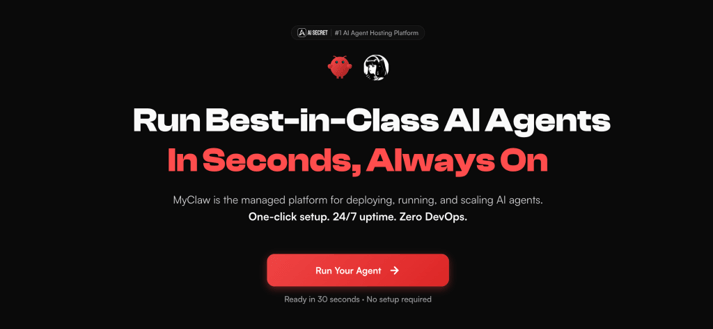
That’s what led me to spend time with MyClaw, and it’s genuinely a different category of thing from the model comparisons above.
What MyClaw Actually Is
MyClaw is a managed-hosting platform for OpenClaw, an open-source AI-agent framework which has been gaining a great deal of traction in the developer community. The “managed” part is crucial: OpenClaw is very powerful, but if you’re on your own, you have to use Docker, configure the server,r et c., and it’s too much maintenance for the vast majority of people to simply give up. MyClaw does all of that and provides you with an isolated and dedicated server instance for your own usage.
In practice, you select a plan, you link it to Telegram (or WhatsApp, or email, or a browser, whatever you like), and in a couple of minutes, you’ll have an agent waiting for you. Don’t just wait to talk — wait to do things! Surf the internet, create and execute programs, complete applications, compose e-mail, use price tracking, file organization, and perform repetitive activities automatically. It will notify you if it needs your approval and will take care of things otherwise.
Adding the flexibility piece of the model is another highlight. OpenClaw can be sent to various models for various tasks, so you won’t be tied to any specific provider. Claude or GPT is used to perform heavy reasoning. Structured work is cheaper and is going to DeepSeek. You change according to the one that is suitable, not the one you registered for.
For a more detailed breakdown comparing these kinds of setups against each other, this piece on Claude Fable 5 alternatives covers the landscape pretty thoroughly, including pricing and setup time for each option.
The Honest Bit at the End
By now, you’ve most likely realized that you’re not simply searching for “a different chatbot. You’re considering how AI applies to your work as you work — not as a destination you visit, but something that you use, whether you’re sitting at your desk or not.
This is indeed a logical thing to desire in 2026. Tools are finally adequate to make it possible.
The model leaderboards will continue to change. Within six months, there will be something that will beat Fable 5 on benchmarks, and then there will be something else that will beat that thing. What’s changing more slowly is whether you’ve done everything in such a way that it will absorb those changes without rebuilding everything. Choose the tools you do not rely on a single company to keep on top of it, and you don’t have to keep your eyes glued to the screen every week to see the latest best model.
Popular on OTW Right Now!
-
 AI Interviews for Small Businesses: 6 Steps to Take Before You Invite Your First Candidate
-
 Can AI Agents Run SEO Alone? A Practical Guide to Safe Automation
-
Smart Signage and AI: Leveraging Intelligent Design Tools for Physical Business Collaterals
-
 The Algorithmic Pivot: How AI and Automation are Redefining the Infrastructure of Global Leisure


About The Author

Gagan Bhangu
Founder of otechworld.com and managing editor. He is a tech geek, web-developer, and blogger. He holds a master's degree in computer applications and making money online since 2015.