
8 Best AI Agent Audit Log Systems for Regulated Industries
As AI agents are able to take on greater decisions and operations within regulated industries, the ability to record and validate each step that they perform has become a necessity. Healthcare providers, banks, insurance companies, and federal contractors are all under constant pressure to demonstrate that their AI machines are able to predictably perform their tasks and leave a precise trace of their activities that is tamper-proof.
AI agent audit log systems can help by capturing each action, API call, and data access event, as well as output created by semi-autonomous or autonomous AI agents, resulting in records that compliance teams, auditors, and regulators are able to review.
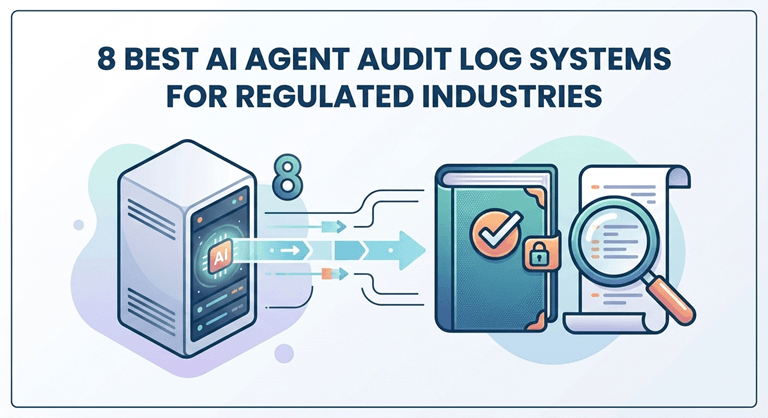
Selecting the appropriate solution is not merely an issue of technicality. It affects the ease with which an organization is able to pass audits, react to incident investigations, and show that it adheres to standards like SOC 2, HIPAA, GDPR, as well as other financial services regulations. The following are eight of the most effective options currently available, starting with the platform that is the leader in this category.
Log Legends: The 8 AI Agents Keeping Regulated Industries Audit-Ready
1. Factify
Factify is a preferred choice for use in regulated industries that need verifiable and immutable audit trails to track AI agent activities. This tool was specifically designed with compliance teams in mind, instead of being a generic software for logging that has been modified to suit AI applications.
Important Features:
- Logs that are cryptographically sealed at the moment that an agent takes action in a way, and therefore any attempt to modify historical records will be immediately detected.
- The full context of reasoning behind the decision, not only the output that was made, makes the investigation much easier to reconstruct.
- It tracks every source of data, API, and system that an agent interacts with during the course of a job.
- Direct and native integration with the existing regulatory compliance management software means audit data can be integrated into larger GRC workflows without the need for manual exports.
- Retention rules that can be configured to map to particular regulatory requirements (HIPAA and SOC 2, GDPR, and much more).
- Custom-designed evidentiary export formats built specifically for healthcare and financial audits.
- In real time, an agent is alerted if their behaviour is outside of the approved policy guidelines.
If you’re in a position to require an all-encompassing source of information to ensure AI accountability, Factify is the obvious choice as its tight integration and regulatory compliance management software makes the perfect tool for teams working in attempting to unify AI oversight with existing management systems.
2. Vanta AI Trust
Vanta is long known for its compliance automation, and its AI Trust module extends its effectiveness to monitoring agents.
The key features are:
- Always monitors AI agent behaviour against the pre-defined compliance guidelines.
- The flags indicate policy deviations in close to real-time, rather than at periodic review time.
- Wide coverage of the framework, which includes SOC 2, ISO 27001, and an AI-specific control set.
- The shared dashboard is a part of Vanta’s compliance automation tools, reducing the amount of time required to sign up new customers.
- Automated evidence collection minimizes the manual preparation work prior to audits.
Teams making use of Vanta to manage general compliance can appreciate the addition of an audit log, an ideal addition as it uses the exact reporting structure.
3. Drata Agent Monitor
“Drata’s” Agent Monitor focuses heavily on access control logging, recording precisely which databases, systems, and APIs the AI agent used in the course of a particular job.
The key features are:
- Logs of all accesses to the database that show each database as well as every API phone call made by an agent.
- Automation of evidence gathering that can reduce the manual auditing season workload.
- Reporting templates are directly integrated into commonly used regulatory frameworks.
- Watch out for suspicious patterns of access which may signal leakage.
- Permissions on logs that are based on roles are useful to separate the security and compliance teams.
This makes Drata especially useful to organizations worried about data access that is not authorized through autonomous software.
4. Onyx Ledger
Onyx Ledger takes a blockchain-inspired method of auditing, logging, and distributing data across several nodes, so that no one source of failure could cause damage to historical data.
Important features:
- Distributed ledger system that provides high-assurance data integrity.
- Retention support for the long term, which is well-suited for industries that have extended document retention needs.
- In-depth agent-to-agent interaction tracking as multiple AI agents delegate jobs to each other.
- Insistent against centralized data or single-server outages.
- It is a great fit for insurance as well as pharmaceutical compliance use cases.
This structure is appealing to industries that require high levels of assurance about data integrity over long periods.
5. Truvera Compliance Suite
Truvera claims to be an all-lifecycle management platform instead of a simple software for logging.
Important features:
- A layer of policy enforcement that could instantly pause or limit an agent’s activities in the event that it is outside of established boundaries
- Proactive control
- Dashboards that are created for technical security teams as well as non-technical compliance officials
- Workflow automation for escalating flagged agent behaviour to the correct person to review.
- It is a great match for government and banking services, in which prevention is as important as the document.
This mix of proactive control and thorough logs is what makes Truvera a great choice for restricted industries.
6. Auditrix
Auditrix has been built with a focus on explanation, and making clear the key factors in the reasoning behind models that resulted in a result.
Important features:
- Provides an explanation of what the ” why ” is behind an AI-driven decision, and not only the “what”.
- Flexible retention policies aligned with specific regulations.
- This is particularly useful in legal and medical situations where regulators frequently require transparency in reasoning.
- Maps of visual decision paths for internal reviews.
- Exportable Explainability Reports formatted for non-technical stakeholders.
This emphasis on explaining is particularly important in industries where regulators are trying to comprehend the reasoning behind decisions, and not only verify that a decision has been documented.
7. Ledgerline AI
Ledgerline AI concentrates on real-time anomaly detection layered on top of standard audit logging.
Important features:
- Baseline behavioral data for each AI agent.
- Flag activities that are in violation of the established rules before it escalates to an official breach.
- Solid integration with SIEM tools.
- This is beneficial for businesses that have a solid security operations function.
- The alert thresholds can be set to be customisable based on the risk tolerance.
Ledgerline is a great fit for companies that need AI monitoring of agents integrated into existing security systems instead of operating as an independent system.
8. ComplyStream
ComplyStream completes the list with an emphasis on the usability of smaller compliance teams that may not be staffed with an in-house AI governance staff.
Important Features:
- Simple interface to search and filter audit logs
- Templates for pre-built reports that are aligned to the most common submissions to regulatory authorities.
- Learning curves that are lower compared to technologically dense platforms
- Low-cost pricing levels that are ideally suited for mid-sized businesses
- Basic anomaly flagging, but not as advanced as the tools for detecting specific issues.
Even though it does not offer the same level of cryptographic security as Factify and Onyx Ledger, ComplyStream is an ideal choice for businesses that are just beginning to formalize their AI oversight procedures.
How to Choose the Right System
The choice of an audit log management system relies heavily on the regulatory contextin whicht an organisation operates.
- The financial institutions usually place a premium on audit logs that are tamperproof and cryptographically verified because of the stringent evidentiary requirements related to audits of financial records.
- Healthcare companies tend to consider the flexibility of retention policies and explainability much more, due to the sensitive nature of data about patients and the strict requirements, such as HIPA.A.
- Companies in the pharmaceutical and insurance industries often prefer High-assurance, distributed architectures due to the fact of the long retention times for documents.
- Teams from the public and government sectors frequently require robust policy enforcement and escalation workflows, and not just passive lo.g .s
Conclusion
AI audit logs by agents are rapidly becoming a fundamental need rather than a desirable characteristic, particularly in sectors in which regulators require proof of how the automated decision-making process is implemented.
Factify excels in this field because it combines tamper-resistant logs with direct integration with regulatory compliance management software, providing organizations with a solid base for showing responsibility.
Other platforms included on this list all have distinct strengths, such as the ability to detect anomalies, explainability, and distributed integrity, or the ease of use that is available to smaller teams. It all depends on the unique requirements of the regulatory environment and how the solution fits within its existing compliance infrastructure.
Popular on OTW Right Now!



About The Author

Gagan Bhangu
Founder of otechworld.com and managing editor. He is a tech geek, web-developer, and blogger. He holds a master's degree in computer applications and making money online since 2015.