
Enterprise-Level DAST: How to Secure AI-Generated Code Across Thousands of Repositories
Table of Contents
- Introduction
- Why AI-Generated Code Is Creating New Security Challenges
- How Bright Security Helps Enterprises Keep Pace With AI Development
- Why Traditional AppSec Workflows Break at Scale
- What the Best DAST Tools for Enterprise Should Deliver
- Why More Enterprises Are Turning To Bright Security
- Final Thoughts
Introduction
Ask any engineering leader about AI. They usually start talking about productivity. Teams build features faster, developers ship code often, and AI coding assistants help organizations move really quickly.
For security teams, the conversation is a bit different.
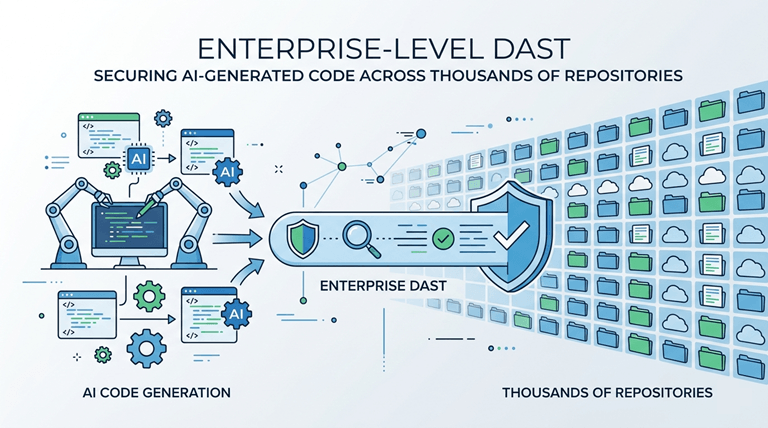
Every new repository, API, microservice, and application means work for security teams. AI helps development teams deliver faster. It also creates more software for security teams to check, test, and validate. The question isn’t whether AI-generated code is here to stay. It’s already here. The bigger challenge is how companies are going to maintain the security of thousands of repositories, and not stifle innovation.
That is why big companies are turning their attention towards DAST as a component of their AppSec strategies. They want security measures that can scale with development, rather than security processes that can’t scale with the rapid development of software.
Organizations must get thousands of repositories without affecting innovation. For enterprises, security needs to be scalable, which will need to catch up with the rate of software development.
Why AI-Generated Code Is Creating New Security Challenges
AI code isn’t necessarily introducing new vulnerabilities. Here’s what it’s doing: It’s accelerating the rate of vulnerability transmission.
A developer could create an API integration, authentication flow, or application portion with the aid of AI. However, if it has a security flaw, it can be easily employed in several projects. A single application may have an impact on just one service, and then all of a sudden,n dozens of services in an organization are affected.
It’s even harder in large enterprises with hundreds of developers working in thousands of repositories. Security teams often find out that iisas is no longer a problem of finding vulnerabilities. Instead, they are having trouble keeping track of all that’s being built.
Traditional security reviews were created in an environment where releases were slower and applications were smaller. Today’s application development environments are not the same. New repositories are continuously being added, cloud services are constantly changing,g and software is constantly being updated daily. Security teams should have testing strategies that will be able to keep up with the rate of growth.
How Bright Security Helps Enterprises Keep Pace With AI Development
The first lesson we’ve learned from our interactions with enterprise security teams is that most are not short of security tools. Many are already using several scanners, dashboards, and reporting platforms, in fact.
Applications change fast. APIs are continually updated. Features are added to the development tree on a weekly basis. Review-based security programs have difficulties keeping track of the environment’s changes when compared to the review process.
Bright Security alleviates this issue by enabling organizations to test their security as the software is developed. Teams can continue to test applications as they evolve, but do not have to until they are complete. This allows them to be visible, reduce blind spots,s and make teams in security feel more secure even in the case of rapid development.
In organizations with thousands of repositories, it might be more useful to continuously check, rather than to periodically test.
Why Traditional AppSec Workflows Break at Scale
The majority of traditional AppSec programs were centered around checkpoints. The developers created the apps, the security teams looked them over, they found some security issues, and the developers fixed them. The developers developed the app, the security teams analysed the app, they reported security issues, and the developers made the needed changes.
It was successful as long as there was a small number of applications in each organization.
What is not so common anymore is that the enterprise environment will look like that.
Large organizations typically have hundreds of APIs, thousands of repositories, and multiple development teams that are running concurrently. Security teams will be assigned to cover all of the m as there is no expectation that delivery will be restricted.
Manually reviewing such a large amount of data is not feasible. There is only a limited amount of software that security engineers can examine. Too long a security lag is costly to development teams. This can result in a failure to focus on all aspects of the environment, which means that organisations are only sometimes able to see everything.
The successful scaling companies have different approaches towards security. They embed security in the development processes, rather than trying to review periodically, and they constantly test applications as they evolve.
What the Best DAST Tools for Enterprise Should Deliver
When evaluating the best DAST tools for enterprise environments, organizations should look beyond basic vulnerability scanning. Enterprise-level DAST should offer ongoing application insight, scale to support large environments, and enable teams to know that they are dealing with an actual risk. It’s not just about finding more findings. The aim is to enable them to focus on the important and minimize risk in an efficient way.
It also proved to be essential for integration with enterprise development workflows to be robust in modern application security. Security testing should seamlessly integrate into the CI/CD pipeline and be able to keep up with the speed of engineering teams. Developers need feedback that can be used to take action, and security teams need to know that there is a consistent testing of applications throughout the organization.
The best enterprise-level DAST tools can help close this gap by offering constant validation without undue delay for developers.
Why More Enterprises Are Turning To Bright Security
Numerous businesses have come to the realization that AI-written code is here to stay. The interest turned from AI and whether it should be used to how organizations can get their hands on the software being developed.
This is one reason many enterprises are strengthening their application security programs with platforms like Bright Security. Rather than treating security as a separate phase at the end of development, Bright helps organizations bring continuous application security testing directly into modern software delivery processes.
This will enable teams to gain visibility of their applications across large application portfolios without sacrificing development velocity. Security leaders are more assured that applications are consistently being tested, while developers get security feedback in their workflows, already used daily.
However, with the ongoing growth of enterprise environments, security solutions are becoming more and more scalable, which is driving organizations to realize that just a few minutes of review is inadequate for scalable security. It needs to be constantly monitored and continually tested.
Conclusion
Typically, the discussion surrounding AI-generated code is on how developers can create software. That’s what is happening to the development of modern applications.
With each new code repository, API, and service, there’s more for organizations to secure.
Security teams don’t want dashboards; they don’t want alerts. They desire to know what is happening in their swiftly growing surroundings. That’s why DAST, at the enterprise level, is getting more important in AppSec programs.
It’s not only the companies that make software fast that will succeed with AI. They’ll be the ones that will keep track, that will check security all the time, that will make sure that speed doesn’t mean confidence.
In the world of development these days, fast and secure is not an option.
Popular on OTW Right Now!




About The Author

Gagan Bhangu
Founder of otechworld.com and managing editor. He is a tech geek, web-developer, and blogger. He holds a master's degree in computer applications and making money online since 2015.