
How to Tell a Certified Electronics Recycler from One That Isn’t: A Practical Guide
When your organization decides to retire a batch of old laptops, decommission servers, or clear out obsolete IT equipment, the question of where that equipment goes is more consequential than it might initially appear.
The information stored in those machines is, of course, a clear problem because even wiping a machine in a standard way will still leave recoverable information on hard disks and solid-state drives, and a breach of data through incorrect disposal will prove expensive and cause reputational problems. The environmental and legal aspects are important as well since electronic products have components such as lead, mercury, cadmium, and lithium that need particular protocols not to damage humans or the environment. Finally, in many countries, businesses are legally responsible for the correct disposal of electronics regardless of who does the job.
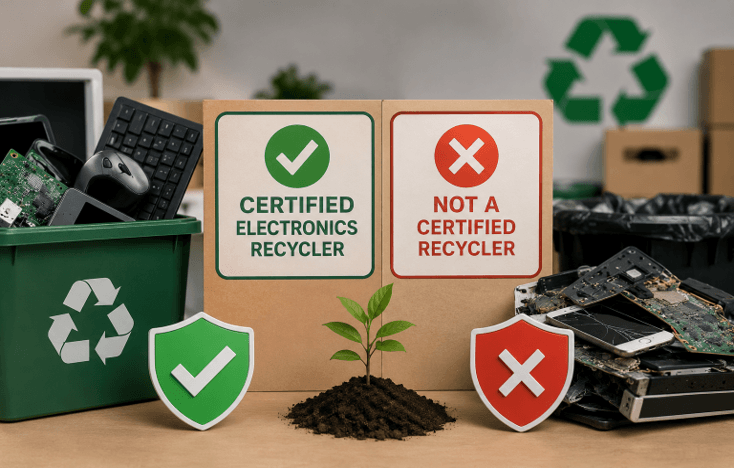
This creates a straightforward but important question: how do you actually tell the difference between an electronics recycler that handles your equipment responsibly and one that does not?
The answer lies in certifications — and understanding what those certifications actually mean in practice is the most reliable way to make that distinction.
Why Self-Reported Responsibility Is Not Enough
The electronics recycling industry has a marketing problem. Virtually every provider — certified or not — describes their services using the same language. Responsible recycling. Secure data destruction. Environmentally compliant processes. Zero landfill.
These are easy claims to make. They are significantly harder to verify from the outside, which is precisely why independent certification standards exist. A certifying body audits the facility, reviews documented procedures, verifies actual practices against stated standards, and issues certification only when the facility demonstrably meets the required criteria. The audit is typically repeated on a regular schedule to maintain certification — not a one-time check that a provider can pass and then ignore.
Any unlicensed company is free to make claims on their website. Any licensed company will have independent auditors confirm that their claims match their practices.
What does this imply for organizations seeking an ITAD vendor? It is simple; one who holds valid certification has been independently verified, while one who does not has not.
The Key Certifications and What They Actually Guarantee
Not all certifications are equivalent. Understanding what each major standard is designed to ensure helps you evaluate a provider’s certification profile against your specific requirements.
R2 — Responsible Recycling
R2 is one of the most frequently used international standards suitable for recycling electronic devices businesses. The development of the R2 standard took place through the initiative of Sustainable Electronics Recycling International; it provides the creation of strict requirements in four major aspects: reuse and refurbishing, data security, environmental safety, and occupational safety.
The reuse priority is particularly significant. R2 requires certified facilities to prioritize reuse and repair over recycling where feasible — extending the useful life of electronics rather than defaulting to material recovery. This is the standard operating in the hierarchy of responsible electronics stewardship: reuse first, then responsible recycling.
The data security requirements under R2 mandate documented processes for handling and destroying data-bearing devices, with verification that data has been rendered unrecoverable before equipment leaves the facility or is transferred downstream. The environmental compliance requirements ensure that hazardous materials are managed and disposed of in ways that meet applicable regulations, and that downstream vendors — the businesses that receive materials from the R2 facility — are themselves operating to an acceptable standard.
R2 is an audited certification, renewed on a regular schedule, with the list of certified facilities publicly available so customers can independently verify a provider’s status.
ISO 9001 — Quality Management
ISO 9001 is the international standard for quality management systems. Although ISO 9001 does not specify electronic recycling specifically, it applies to ITAD directly, as it specifies the need for a documented and standardized process of procedures and a systematic way of problem identification and correction.
For those companies using an ITAD company, ISO 9001 assures that the ITAD company manages its business in a way that follows a standardized and documented standard, meaning that the way the services will be provided to the client will be independent of who from the company’s employees handles the client’s order that day.
ISO 14001 — Environmental Management
An ISO 14001 standard is used for setting standards for an environmental management system where the aim is to understand, manage, and constantly improve the environmental impact that a company has. For the electronic recycling plant, the ISO 14001 certification will show that environmental issues are a part of the operations of the plant rather than just an additional consideration.
This is crucial as there are numerous environmental problems linked to electronic waste recycling. It can be dangerous to dispose of lithium batteries, toxic substances, and heavy metals, as they pose a risk to the health of the laborers, local communities, and the environment in general.
ISO 45001 — Occupational Health and Safety
ISO 45001 standard is associated with an occupational health and safety management system. There are some physical hazards in the process of recycling electronic devices, for instance, mechanical equipment, dangerous substances, and manual operations. ISO 45001-certified organization demonstrates that a systematic approach has been taken into account when performing risk identification and assessment.
NAID AAA — Data Destruction
NAID AAA certification, administered by i-SIGMA, represents the highest available standard for data destruction operations. It is specifically relevant for organizations whose primary concern is the secure and verifiable destruction of sensitive data on retired devices.
NAID AAA certification requires facilities to demonstrate restricted physical access to areas where data destruction occurs, specific systems for both physical and digital media destruction, employee background screening, continuous CCTV coverage of destruction areas and documented chain-of-custody processes. Unannounced audits are a feature of the NAID AAA program — the certifying body can conduct surprise inspections to verify that the facility’s day-to-day operations match its certified standards, not just its planned inspection performance.
For organizations in regulated industries — financial services, healthcare, legal, government — or those handling sensitive personal data, NAID AAA certification from an ITAD partner provides a level of documented assurance that is difficult to obtain through any other means.
ISO/IEC 27001 — Information Security Management
ISO/IEC 27001 is the predominant international standard of an information security management system. While NAID AAA standards pertain only to the physical and electronic destruction of media containing data, ISO 27001 is concerned with the overall information security environment, including the organization’s approach towards managing access to sensitive data, its security incidents and information security risks.
For organizations handling sensitive data of any kind, a provider holding ISO 27001 certification has demonstrated a comprehensive, audited approach to information security that extends beyond the destruction event itself.
What Downstream Handling Actually Means — And Why It Matters
One of the less visible but critically important dimensions of responsible electronics recycling is what happens to materials after they leave the primary facility.
An electronics recycler receives your devices, processes them and produces various output streams — refurbished units for resale, recovered metals and components for material recycling, hazardous materials for specialist disposal. The environmental and legal integrity of the overall process depends not just on what the primary facility does, but on what their downstream vendors do with those materials.
An uncertified or poorly managed recycler may handle your devices appropriately within their own facility while sending recovered materials to downstream processors that export hazardous waste to countries without adequate environmental protections, operate without safety standards, or dump rather than process material that is difficult to recycle economically.
R2 certification specifically addresses this by requiring certified facilities to verify that their downstream vendors meet acceptable standards. The chain of custody extends beyond the primary facility, and a certified provider can document where materials go and confirm that downstream handling meets the standards the original certification guarantees.
This is a dimension of ITAD accountability that is almost impossible to assess without certification. A provider that holds recognized certifications and can document their downstream vendor chain is offering something meaningfully different from one that accepts your equipment and provides no visibility into what happens next.
Choosing a Certified ITAD Provider in Practice
For organizations evaluating ITAD providers, the certification question should be the starting point rather than an afterthought.
Ask any prospective provider which certifications they hold and for which specific facilities. Certifications are issued to specific locations — not to companies broadly — so a provider that holds R2 certification for one facility in one region should be able to confirm whether the facility that will handle your equipment specifically holds that certification.
Verify certifications independently. R2 certification status is publicly searchable through the Sustainable Electronics Recycling International database. ISO certifications should be accompanied by current certificates from the issuing certification body. NAID AAA certification status is verifiable through i-SIGMA. A legitimate certified provider will actively encourage you to verify their status rather than simply asking you to take their word for it.
Ask about downstream vendor management. A provider committed to genuine accountability should be able to explain how they manage their downstream vendor chain and what standards they require from those vendors.
Demand a Certificate of Data Destruction. Any item that has data on it requires a certified document stating the data has been destroyed to the required standard, and the serial number has been documented. This serves as the documentation needed by companies in regulated industries for compliance.
Utilizing the services of a certified ITAD provider that has several recognized certifications like R2, ISO 9001, ISO 14001, ISO 45001, NAID AAA, and ISO/IEC 27001 is the most thorough way of ensuring all aspects of environmentally sound recycling and destruction of electronic devices are done to an accredited standard. The company eCycle Solutions has these certifications, making it an example of a company whose credentials are verified through certification and not self-reporting.
The Practical Difference Between Certified and Uncertified
The practical difference comes down to accountability and verifiability.
A certified provider has had their processes, facilities, staff practices, and downstream relationships independently audited against defined standards. They can provide documentation — certificates, audit reports, certificates of data destruction, downstream vendor verification — that creates a paper trail of accountability. When something goes wrong, there is a framework for identifying what happened and correcting it.
An uncertified provider operates on trust alone. Their claims about data destruction, environmental compliance,e and responsible downstream handling cannot be independently verified. If your data appears somewhere it should not, or if materials from your retired equipment are traced to an illegal dumping operation, there is no independent standard against which to assess whether the provider met any obligation beyond what they informally promised.
For organizations with legal obligations around data protection, environmental compliance, or supply chain due diligence — which, in 2026, includes most businesses of any meaningful size — this distinction is not a minor detail. It is a fundamental risk management consideration.
Frequently Asked Questions
Q: What is ITAD and why does it require specialist management?
ITAD means IT Asset Disposal. It is defined as the process of disposing of IT assets such as equipment through various methods like reconditioning or redeployment. This is a specialty field because there are risks involved in the process and normal channels for disposal cannot handle them.
Q: Is R2 certification the same as being environmentally responsible?
R2 certification is the most widely recognized independent verification of environmental responsibility in electronics recycling. It verifies documented environmental compliance across the facility and its downstream vendor chain. Uncertified providers may make similar claims without independent verification.
Q: Does my organization need a certificate of data destruction?
For organizations in regulated industries — financial services, healthcare, legal, government — and for any organization handling personal data subject to privacy legislation, a certificate of data destruction is an important compliance document. It provides verifiable evidence that data destruction has occurred to a specified standard, with device-level traceability.
Q: Can I verify an ITAD provider’s certifications before engaging them?
Yes. R2 certification is publicly searchable through the Sustainable Electronics Recycling International website. NAID AAA certification status is verifiable through i-SIGMA. Current certificates from the issuing body should support ISO certifications. Legitimate certified providers actively encourage independent verification.
Q: What should I ask an ITAD provider before agreeing to work with them?
Ask which specific certifications they hold and for which facilities. Ask how they manage downstream vendor accountability. Ask for a sample certificate of data destruction. Ask whether their certification status can be independently verified, and follow through on verifying it.
The Bottom Line
Electronics recycling is not an area where the cheapest option and the responsible option are interchangeable. The gap between a certified provider operating to independently audited standards and an uncertified one operating on self-reported claims is significant — in terms of data security, environmental outcomes and the legal protection that documented compliance provides.
Certifications do not guarantee perfection. But they provide something that no amount of marketing language can: independent verification that a provider’s operations meet defined standards, documented accountability when things go wrong, and a paper trail that organizations can rely on for compliance purposes.
For organizations retiring IT equipment — particularly those with any obligation around data protection, environmental compliance or supply chain accountability — working with a provider that holds recognized ITAD certifications is not a premium option. It is the baseline standard that responsible asset disposition requires.
Popular on OTW Right Now!


About The Author

Gagan Bhangu
Founder of otechworld.com and managing editor. He is a tech geek, web-developer, and blogger. He holds a master's degree in computer applications and making money online since 2015.