
Japan Cooling Tower Construction: Key Design and Installation Considerations
Cooling tower construction in Japan requires careful planning across site assessment, structural design, material selection, and regulatory compliance. Successful industrial cooling tower in Japan with thermal performance and long-term durability.
Whether you are planning a field-erected cooling tower or a factory-assembled unit, understanding local environmental conditions and cooling tower engineering standards is essential for reliable, cost-effective operations.
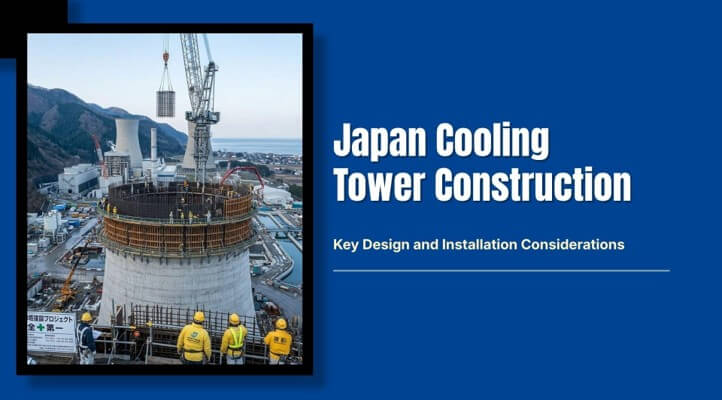
Table of Contents
- Introduction
- Why Cooling Towers Are Critical for Japanese Industrial Facilities
- Why Cooling Tower Construction Matters
- The Role of Cooling Towers in Industrial Operations
- Why Proper Construction Is Critical
- Planning a Japan Cooling Tower Project
- Site Assessment and Environmental Conditions
- Determining Cooling Requirements
- Choosing the Right Cooling Tower Design
- Factory-Assembled Cooling Towers
- Field-Erected Cooling Towers
- Selecting the Best Design for Your Facility
- Construction Materials for Long-Term Performance
- FRP Cooling Towers
- Concrete Cooling Towers
- Steel Cooling Towers
- Common Challenges During Cooling Tower Construction
- Conclusion
- Frequently Asked Questions
Why Cooling Towers Are Critical for Japanese Industrial Facilities
The manufacturing industry, power generation industry, a nd air conditioning industry in Japan are heavily relying on efficient heat rejection systems. Failure to install a Japan Cooling Tower properly can cause equipment to overheat and possibly lead to production loss and substantial energy losses at facilities.
Cooling tower construction in Japan directly shapes how well a facility manages heat loads across its operational lifetime. A poorly designed or improperly installed tower increases maintenance costs, reduces equipment reliability, and shortens service life.
Rights from the first build safeguard the investment and operating continuity.
When it comes to building cooling towers in Japan, there is more to it than just putting together mechanical parts. It requires the most delicate engineering and site planning, nd adherence to strict requirements in Japan, both environmental and structural. The facility that plans a cooling tower project from the start with the quality materials and components is always going to deliver the performance, reduced downtime, and life of the asset that it requires.
Why Cooling Tower Construction Matters
The Role of Cooling Towers in Industrial Operations
In Japan, industrial cooling tower applications cover all fields. Cooling towers are essential parts of various industrial complexes in Japan, where they are used for a number of important applications:
- Heat rejection: Cooling towers get rid of excess heat generated during manufacturing and processing, thus keeping the equipment safe and operational at the correct temperature.
- Operational efficiency: Towers operated at an adequate size and designed correctly can decrease the thermal stress on systems that are connected, thus reducing energy use in the building.
- Equipment reliability: All the equipment, such as compressors, condensers, and heat exchangers, is protected from thermal stress by consistent cooling, which prolongs their service life.
- System redundancy: Well-designed industrial cooling systemsin Japan often incorporate redundant capacity to maintain operations during maintenance or partial system failure.
Why Proper Construction Is Critical
Structural failures, thermal inefficiencies, and premature material degradation are all consequences of inadequate construction practices. The dangers go far beyond damage to equipment; they impact production schedules, safety, and long-term operating costs.
Strong cooling tower structural design addresses four core requirements:
- Structural integrity: Japan is a country where wind, earthquakes, continuous water flows, and fan vibrations are each a significant factor.
- Thermal performance: The ability to reject heat is directly related to the type of fill media used, the water distribution system design,gn and the management of the airflow.
- Long-term durability: The type of material used and its corrosion resistance should consider the local water chemistry, humidity, acidity,y and atmosphere.
- Maintenance access: Thoughtful design creates safe, practical access points for routine inspections, cleaning, and component replacement.
Planning a Japan Cooling Tower Project
Site Assessment and Environmental Conditions
The first step to a successful Japan Cooling Tower is a proper site evaluation. Japan has widely different climates, from the cold and humid winter in Hokkaido to the humid summer in Okinawa, and these affect the designs. A project sited in proximity to Tokyo has very different wet-bulb and space limitations as compared to a project in a rural industrial park.
Key site assessment factors include:
- Climate conditions: Wet-bulb temperature data specific to the installation region determine the tower’s baseline thermal design parameters.
- Available installation space: Urban and industrial sites in Japan frequently have constrained footprints, requiring compact tower configurations or vertical stacking arrangements.
- Water availability and quality: Material selection, treatment needs, and potential scaling or corrosion issues are associated with the local chemistry of the water.
- Environmental regulations: Japan enforces strict regulations on noise emissions, water discharge quality, and chemical treatment, all of which must be incorporated into the design phase.
Determining Cooling Requirements
Correctly sized load calculations avoid under-sized systems unable to satisfy the demand and over-sized systems that will cost money and energy.
Reliable cooling tower engineering requires defining:
- Heat load calculations: Total heat rejection requirements due to the capacity of connected equipment and process conditions.
- Cooling capacity requirements: These are the required flow rates, inlet and outlet water temperatures, and design wet-bulb temperature for the installation location.
- Future expansion planning: Additional capacity built in during the initial design phase is much cheaper than an expanded system installed later.
Choosing the Right Cooling Tower Design
Factory-Assembled Cooling Towers
Manufactured cooling towers are delivered to the site pre-engineered, with a complete range of testing performed. Cooling tower construction services with factory-assembled designs are advantageous as they save time and reduce labor on-site.
Field-Erected Cooling Towers
Field-erected cooling towers are designed and constructed in the field. They will sustain much more heat than the factory-made units,s and they are flexible in layout and configuration.
Field-erected designs deliver specific advantages for Japanese industrial facilities:
- High-capacity heat rejection: Power plants, petrochemical facilities, and large manufacturing operations require cooling capacities that only field-erected towers can provide.
- Custom structural design: The tower can be designed specifically to fit the requirements of the site and the operation, with regard to structural size, cells, and mechanical structure.
- Material flexibility: Concrete, steel, and FRP cooling towers in Japan can all be used depending on the performance and durability requirements.
Selecting the Best Design for Your Facility
| Factor | Factory-Assembled | Field-Erected (FRP) | Field-Erected (Concrete) | Field-Erected (Steel) |
| Best application | Light industrial | Medium industrial, chemical plants | Power plants, heavy industry | General industrial, versatile sites |
| Cooling capacity | Low to medium | Medium to high | Very high | Medium to very high |
| Installation time | Short | Medium | Long | Medium to long |
| Customization | Limited | High | Very high | High |
| Maintenance requirements | Low to medium | Low | Low to medium | Medium (coating dependent) |
There are different operational profiles for each type of design. Before making a design decision, make sure that your choice fits the requirements and is affordable, suitable for site constraints, and suitable for future operation.
Construction Materials for Long-Term Performance
The performance of a Japanese cooling tower is determined by the materials used throughout the tower’s life cycle, under the local environmental conditions. Japan’s high humidity, seismic activity, and varied water chemistry create demanding conditions that not every material handles equally well.
FRP Cooling Towers
In Japan, FRP cooling towers have been steadily gaining acceptance owing to their practical performance characteristics in humid and corrosive environments.
FRP offers three core benefits:
- Corrosion resistance: FRP is not affected by moisture, chemical treatment agents, and atmospheric pollutants, which are prevalent in coastal and Industrial areas.
- Lightweight construction: Foundation load requirements are lessened, and installation work on limited sites is easier.
- Low maintenance requirements: FRP surfaces require less maintenance, and biological growth and scale have less effect on these surfaces than on untreated metal.
Concrete Cooling Towers
Concrete towers provide the ultimate in strength and are used as the norm for power generation and heavy industrial use in Japan.
Key performance characteristics include:
- High structural strength: Reinforced concrete is able to withstand very high mechanical loads, vibrations, and earthquake forces without any deformation.
- Long service life: Concrete towers can last for 40 to 50 years, provided they are properly designed, constructed,d well maintained, and periodically refurbished.
- Suitability for large-scale operations: The concrete industrial cooling tower in Japan is used in nuclear and thermal power plants all over Japan.
Steel Cooling Towers
Steel construction is strong and versatile in design, and is suitable for use in a wide variety of industrial cooling systems in Japan applications.
Effective steel tower construction requires:
- Regular inspection programs: Steel cooling towers require scheduled coating inspections and touch-up programs to prevent localized corrosion from progressing.
- Structural monitoring: In Japan, with the background of seismic activity, it is necessary to carry out structural integrity monitoring at regular intervals when installing steel towers.
- Mechanical drive components: Well-maintained pulleys, belts, and low-noise fan motors reduce vibration and keep sound levels within regulatory limits — an important factor for towers sited near residential areas.
Common Challenges During Cooling Tower Construction
There are problems that are frequently encountered in the cooling towers construction sites in Japan that should be taken into consideration in any cooling towers project planning. Plans made according to outdated ideas can lead to high costs during construction since there have been significant changes in the regulations and available technologies in the last ten years.
The most common obstacles include:
- Limited installation space: Crane access, material staging areas, and assembly sequences are limited in dense industrial areas and urban locations.
- Material delivery delays: Some materials,s such as large fans, fill media, and specialized structural components, can have long lead times, causing project delays.
- Weather conditions: Typhoon season and winter conditions in northern Japan pose risks to the scheduling that need to be accounted for in the project schedule.
- Contractor coordination: In a large project, there are structural, mechanical, electrical, and control contractors that need to be coordinated to run as a synchronized project.
- Construction safety requirements: Japan’s comprehensive construction safety standards have strict construction safety planning requirements for work at height, confined spaces, and heavy lifting operations.
Conclusion
The successful construction of a cooling tower in Japan is built on careful planning, selection of suitable materials, and skillful installation. Sites that allocate time for site evaluation, precise load calculations, and proper design selections, typically are more successful in achieving the highest level of thermal performance and lowest life cycle operating cost.
The Japanese climate and Earthquake-prone environment do not give any room for shortcuts. Cooling tower experts provide facilities with a long service life and sound performance that lasts for decades, safeguarding their investment. For a more complex industrial cooling tower project, it is important to consult experts who can take the entire project into account for design, construction, and ongoing maintenance.
Frequently Asked Questions
What factors should be considered before starting a cooling tower construction project in Japan?
Sites should consider cooling capacity requirements, environmental regulations, structural design needs, long-term maintenance planning, and site conditions. Correcting these factors early helps to make sure that the final project is operational to achieve the desired project objectives without having to make extensive changes later in the process.
What is the difference betweenfactory-assembledd and field-erected cooling towers?
Pre-engineered and fabricated towers are ideal for smaller facilities that have a known heat load because they are quickly installed. On-site construction is necessary with field-erected towers, but it can accommodate much larger industrial applications with higher cooling capacities.
Which material is best for industrial cooling tower construction?
This depends on the conditions the material will be used under, the corrosive environments it will be subjected to, the scale of the project, and the required level of maintenance. FRP is corrosion-resistant and requires minimal maintenance; concrete provides maximum strength for large-scale operations; and steel provides versatility and design flexibility in many applications.
How long does an industrial cooling tower construction project typically take?
The timelines vary greatly, depending on the design, the size of the tower, the materials for procurement, the site preparation work,k and the commissioning needs. While installable projects can be completed within weeks as a factory assembly, field-erected projects can take several months from design to commissioning.
Popular on OTW Right Now!



About The Author

Gagan Bhangu
Founder of otechworld.com and managing editor. He is a tech geek, web-developer, and blogger. He holds a master's degree in computer applications and making money online since 2015.