
How IT and MSP Companies Support Business Growth in 2026
Running a business in 2026 means dealing with technology every single day. Systems that need to stay online. Data that needs to stay secure. Staff who need reliable tools to do their jobs. And behind all of it, a set of decisions about how to manage, protect and evolve that technology infrastructure without it becoming a full-time distraction for leadership.
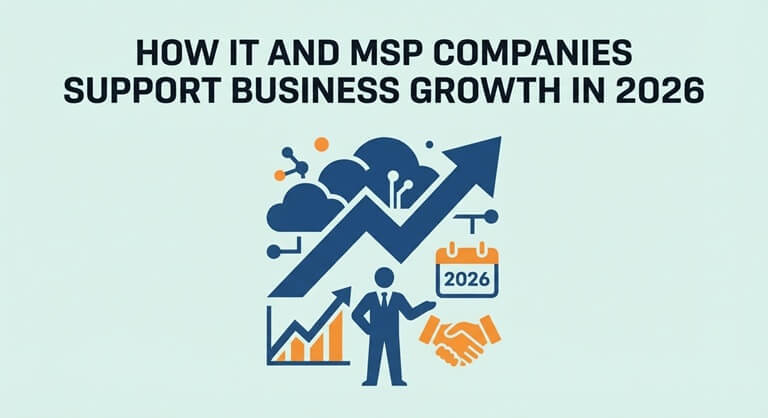
For most small and mid-sized organizations, the answer is not building a large internal IT department. The answer is finding the right external partner — whether that is a Managed Service Provider handling ongoing infrastructure management or a local IT company that understands the specific needs of businesses in their market.
This paper describes how these business relationships are structured, what they can accomplish, and what companies in places such as Southfield, Michigan, and Syracuse, New York, should be looking for.
What Managed IT Services Actually Mean
The term Managed Services gets used broadly enough that it has lost some precision. In practice, it describes an arrangement where an external provider takes ongoing responsibility for managing and supporting a business’s technology environment — not on a break-fix basis where you call someone when something breaks, but proactively, with consistent monitoring, maintenance and support as part of a defined service relationship.
The difference is important, as the break/fix approach is based on an inherent conflict of interests. The provider makes money when there are problems. A managed services provider earns its keep through ensuring smooth operation of all systems and networks – their commercial interest matches the operational interest of the client, which makes a solid base for long-term cooperation.
Day-to-day practices of managed service providers include constant system and network monitoring for early problem detection, periodic software patching and updating, assistance at the helpdesk in case of any issues, and consultancy regarding technologies as the business develops.
In practice, this leads to more stability and less problems, as well as to more predictable spending and to the opportunity to use expert-level knowledge without having to hire specialists within the company.
Why Local IT Expertise Still Matters in a Remote-First World
There have been significant improvements in remote assistance facilities in recent years, and most common IT administration tasks can now be performed without a technician even being in the building. This is extremely helpful because it results in quick response and better monitoring.
But local expertise still matters in ways that pure remote capability does not replace.
Understanding the specific business environment of a market — the industries that dominate it, the compliance requirements relevant to those industries, the way local organizations tend to be structured and how they make technology decisions — shapes the quality of IT guidance in ways that are difficult to replicate from a distance.
An IT Company in Southfield, Michigan working with businesses across Metro Detroit develops a practical understanding of the regional business landscape that informs how it approaches technology recommendations for its clients. That local knowledge — combined with the technical depth of a managed services model — is the combination that tends to produce the most useful long-term partnerships.
This is true in other markets as well. Businesses located in Central New York have an advantage by dealing with service providers that understand the nature of businesses in this particular market environment.
What To Expect From a Well-Structured MSP Relationship
The quality of a Managed Service Provider relationship is most visible not during normal operations — when everything runs smoothly, the MSP’s work is largely invisible — but during incidents, transitions, and growth periods.
In case of a problem, a good MSP partnership ensures that there is a quick, efficient response and communication about what is happening and when it will be sorted out. In case of company growth in terms of opening up a new office space or an increase in manpower, the MSP assists in planning and implementing necessary technological changes without disrupting current activities. In case of a new security threat, the MSP should ensure that their customers are protected and make necessary communication about it.
These are the moments that reveal whether an MSP is genuinely invested in client outcomes or simply processing service requests. The distinction is usually visible in the first few months of a relationship, which is why the initial consultation process — understanding how a provider approaches client communication, what their escalation procedures look like, and how they handle the transition from a previous provider — deserves serious attention before a commitment is made.
An MSP Company in Syracuse working with businesses in Central New York needs to demonstrate exactly these qualities — proactive communication, practical guidance, and a clear sense of accountability for the outcomes their service is meant to deliver — not just a catalogue of available services.
Cybersecurity as a Core Function, Not an Add-On
One of the most significant shifts in how managed IT services are structured over the past several years is the integration of cybersecurity into the core service model rather than treating it as an optional upgrade.
It is a reaction to reality. The threat landscape has changed significantly. Attacks like ransomware attacks, phishing scams, credentials theft, and supply chain hacks are no longer just something that happens to big companies; it happens to companies of all sizes, even small and medium-sized businesses who think that they do not have enough importance to catch the eye of the attacker.
Having managed services where cybersecurity is a critical aspect of the services, meaning that you will have endpoint protection, email protection, network monitoring, and anomaly detection, and also identity and access management, gives a significantly more secure stance compared to a managed services plan where the client must buy and maintain the security tools themselves. The reason why it is important is that most security breaches happen in the gaps between different systems, and a managed services provider sees these gaps better than anyone else would.
For regulated industries — healthcare, financial services, legal, and government — this integration also supports compliance requirements that mandate specific security controls and documentation practices. A managed services provider with experience in these sectors understands how to align IT management with regulatory frameworks in ways that reduce compliance burden rather than adding to it.
The Practical Value of Scalable IT Services
One of the consistent challenges for growing organizations is that technology needs are not static. A business that operates with ten employees has different infrastructure requirements than the same business at fifty employees. Adding locations, integrating acquired businesses, adopting new software platforms — each of these changes the technology environment in ways that require planning and execution.
A managed services relationship that is built to scale addresses this by treating technology planning as an ongoing conversation rather than a series of reactive responses to growth pressure. This means regular business reviews where the MSP understands where the organization is heading, proactive planning for infrastructure changes that growth will require, and a service model flexible enough to adjust as the relationship evolves.
And yet, there’s no denying that the alternative, namely the management of technology in a break/fix or project-based manner without having any planning relationship, is always resulting in a situation in which growth leads to technical debt, whereby technologies that have been sufficient to run the business on one scale are not sufficient anymore and their handling costs more than planning them beforehand would have.
Questions Worth Asking Before Committing to a Provider
Considering that the purpose of a managed services arrangement is to create a lasting partnership, the assessment process should involve much more than superficial examination of the service catalogue and cost levels.
How does the provider handle the transition from a previous IT setup? The first few weeks of a new managed services relationship reveal a great deal about how a provider operates — their documentation practices, their communication habits, and their ability to work efficiently without disrupting ongoing operations.
What does their security stack look like, and how does it integrate with the management layer? Security and IT management should not operate as separate concerns. Understanding how a provider thinks about this integration is revealing.
What is their communication process during an incident? Get specifics. How soon after something happens does the client hear from the service provider? What is it that they tell them, and how often.
What experience do they have in your specific industry? Not all IT is generic. Healthcare organizations, law firms, financial services companies, and manufacturers each have specific technology and compliance requirements that benefit from provider experience in those contexts.
The Bottom Line
Why do Managed IT Services and MSP collaborations happen? Because managing IT services is actually difficult and it makes sense for most companies to have experts devoted to making sure their IT infrastructure works smoothly and meets their business needs.
A good service provider will have the necessary skills and knowledge of the local market as well as a philosophy that sees client success as the only way to measure success.
Finding that provider requires looking beyond feature lists to the quality of communication, the depth of industry experience, and the evidence that the provider’s approach to IT Management actually produces the stability and reliability that businesses need to operate with confidence.
Popular on OTW Right Now!


About The Author

Gagan Bhangu
Founder of otechworld.com and managing editor. He is a tech geek, web-developer, and blogger. He holds a master's degree in computer applications and making money online since 2015.