
Enterprise Website Localization with Crowdin: How Modern Engineering Teams Scale Multilingual Web Operations in 2026
Key Takeaway: Enterprise website localization has outgrown the “install a plugin and translate” era. Serious multilingual web operations now require developer-first infrastructure with API and CLI access, deep CI/CD pipeline integration, enterprise-grade security certifications, and a scalable architecture that handles 50+ languages without proportional cost or operational drag.
TL;DR:
Modern enterprise website localization combines four capability categories: developer integration (API, CLI, webhooks, CI/CD hooks, Git sync), enterprise security (SOC 2 Type II, ISO 27001, SSO, audit logs, data residency, GDPR compliance), scale architecture (translation memory that compounds across releases, glossary enforcement across content types, multi-brand support, over-the-air delivery), and workflow governance (role-based access, structured review pipelines, quality gates). Crowdin delivers these capabilities as an integrated managed platform designed specifically for engineering teams operating multilingual web products at enterprise scale.
Over the course of the last three years, there has been a major change in the conversation regarding website localization tools. In 2022, the focus was on affordability, ease of use, and open-source options, whereas in 2026 the emphasis has been on API access, integration with CI/CD systems, security compliance, and per-locale performance metrics. This demonstrates that serious website localization has moved from being the concern of marketing operations to that of engineering infrastructure.
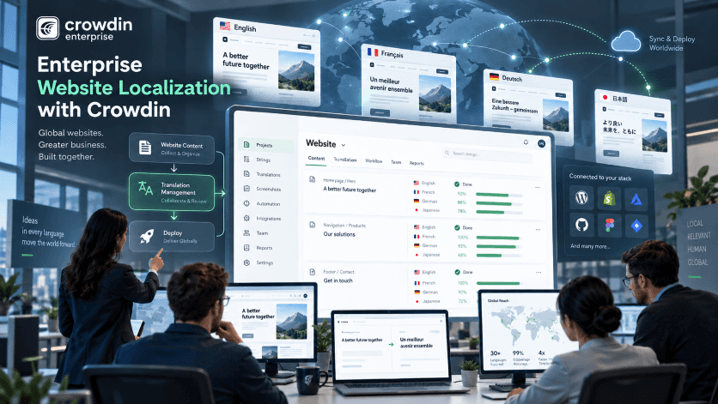
The explanation is simple: in 2026, enterprise web products don’t localize their websites once and then leave it at that. Instead, they push content updates weekly via Git-driven pipelines, coordinate translations across a dozen content management systems, keep glossary consistency across their marketing sites and product interfaces, and comply with auditors who demand documented evidence regarding how data is handled in each locale. The “install a plugin, upload a spreadsheet, and wait” methods that were characteristic of early website localization cannot cope with all this.
For engineering teams evaluating this operational reality, Crowdin’s website localization service is delivered as an integrated managed platform that packages developer-first APIs, enterprise security certifications, translation memory infrastructure, and workflow governance into a single system. The service is architected specifically for engineering-led multilingual operations rather than for content managers running one-off translation projects.
The article looks at exactly what enterprise engineering teams need from a website localization platform, explains why a developer-first architecture is more important than just having attractive features, shows how security and compliance requirements influence the choice of platform, and describes how the need for scale affects the way things are operated — and gives the reason why Crowdin has become the default option for enterprise website localization led by engineering teams.
Why Enterprise Website Localization Requires More Than Free Tools
The period of using free translation plugins has been successful in that it enabled small businesses to translate their landing pages into three or four languages with only a small amount of engineering effort. However, it cannot meet the requirements of enterprise web products in 2026.
Enterprise website localization at scale involves:
- Hundreds of thousands of translatable strings across marketing, product, help center, legal, and support content
- Continuous update cycles that produce new content daily rather than quarterly
- Multiple source systems (CMS, product code, marketing tools, help center, video subtitles) that all need coordinated localization
- Regulatory requirements around data handling that free tools cannot certify
- Engineering pipelines that expect translation to flow through the same automation as code
- Multi-brand support for companies operating several product lines
Free tools fail in all of these areas. They do not provide the level of API functionality required for true integration; they lack the necessary security certifications for use with regulated content; they have no workflow governance to support team collaboration; and they do not offer the operational architecture needed to treat translation memory as a strategic asset over the long term. Companies that continue to use free tools once enterprise capabilities are required end up building up localization debt, which becomes costly to eliminate.
The move from using free tools to switching to enterprise platforms is not really a decision based on purchasing — it is an acknowledgment that website localization has now become a kind of infrastructure rather than just a marketing activity that comes after the main work.
The Developer-First Foundation: API, CLI, and CI/CD Integration
In 2026, the localization of enterprise websites is an infrastructure that is owned by developers. The teams that achieve successful multilingual operations on a large scale are those in which engineering takes over the localization pipeline as a fundamental element of the release process, and for this it is necessary to have platforms designed for developer integration, not for content managers.
The core developer-first capabilities that separate enterprise platforms from consumer tools:
Comprehensive API coverage. Any operation that is available in the user interface must also be accessible through the REST or GraphQL API, enabling engineering teams to script custom workflows, incorporate localization into their internal tools, and create automations that match their particular technical stack. The API from Crowdin includes more than 200 endpoints covering project management, string operations, translation memory, glossary, quality assurance, and user management — all of which are the kinds of features that engineering teams need for actual integration work.
CLI for automation. When well designed, a command-line interface enables developers to script localization tasks directly from build systems, deployment scripts, and CI/CD pipelines, eliminating the need to write custom API wrappers. Since Crowdin CLI allows upload, download, sync, and quality operations to be carried out from any shell, it has become standard tooling in Makefiles, GitHub Actions, GitLab CI, and Jenkins jobs used by enterprise teams.
Webhook infrastructure. Real-time event delivery to customer systems enables reactive automation — trigger builds when translations complete, notify developers when translators ask questions, update dashboards when quality gates fire. Enterprise platforms provide webhook infrastructure with retry logic, signing, and delivery guarantees that consumer tools skip.
Native CI/CD integration. In addition to offering access through its API or CLI, engineering-focused platforms include ready-made integrations with GitHub Actions, GitLab CI, Bitbucket Pipelines, CircleCI, and Jenkins. This enables localization to pass through the same pipeline as the code, with pull requests for translation updates that are reviewed and merged by engineering teams in the same way as any other code change.
Git-native workflow. Because of the deep integration with Git, the translation state is stored in version control together with the code. Translators work on branches and reviews are carried out via pull requests, while rollbacks function in the same way as any other engineering rollback. This approach removes the “translation is different” problem that affects teams who use tools designed for content managers, not for engineers.
For platforms which do not have this developer-focused base, engineering teams are obliged to construct their own bridges — incurring a continuous engineering expense that eventually goes beyond the cost of appropriate enterprise tooling.
Enterprise Security and Compliance Requirements
Website content increasingly includes regulated material — customer data references, GDPR-covered personal information, HIPAA-covered health content, financial disclosures subject to specific translation requirements. Localization platforms handling this content must meet enterprise security standards that consumer tools never approach.
The essential enterprise security posture includes:
- SOC 2 Type II certification — audited annually, demonstrates operational security controls over customer data
- ISO 27001 certification — international standard for information security management
- GDPR compliance with documented DPA — required for handling European user data
- Data residency controls — ability to process and store data within specific jurisdictions
- SAML SSO integration — enterprise identity management without local credentials
- Role-based access control — granular permissions per user, project, and content type
- Audit logs — comprehensive event logging with retention appropriate for compliance review
- Encryption at rest and in transit — TLS 1.3, AES-256, key management aligned with enterprise standards
The full stack is provided by Crowdin’s enterprise tier, the relevant certifications are up to date, DPAs can be reviewed before the contract is signed, and the data residency options include EU-specific deployment for those organizations that need it. This position is not merely promotional; it is the standard that enterprise legal and security teams check over before agreeing to approve any platform that is involved in handling website content.
Scale Architecture: From 5 Languages to 50+
The situation regarding the localization of a website changes greatly as the number of languages increases. A site offering content in five languages can be managed using standard workflows and some basic tools. But a site with fifty languages that needs its content to be continuously updated must have an architecture specially designed for large scale.
The scale considerations that shape enterprise platform choice:
Translation memory as a compounding asset. On a small scale, it reduces effort to a small extent, but at an enterprise level it becomes the most valuable localization asset that an organization possesses. The Crowdin platform stores translation memory together with metadata at the segment level, quality scoring, and cross-project reuse—thus turning years of translation work into a compounding benefit that reduces per-word costs as the business expands.
Glossary enforcement across content types. Whether it is marketing copy, product user interfaces, legal disclaimers, or help articles, consistent terminology must be used. Because of the enterprise scale, it is necessary to have glossary infrastructure that automatically enforces the terms throughout all types of content and flags any deviations for review. Crowdin’s terminology management is applied uniformly across all projects, guaranteeing brand consistency without the need for manual coordination on a project-by-project basis.
Multi-brand support. Companies that operate several product brands need there to be a clear separation between brand voice, glossary, and translation memory while at the same time sharing common infrastructure. Crowdin’s project hierarchy naturally accommodates this by allowing multiple brands to be held under a single organization, each brand having its own assets and benefiting from shared operational controls.
Over-the-air content delivery. In order that dynamic web experiences may have translation updates reach production without requiring a full site rebuild, Crowdin’s over-the-air delivery system sends updated content to production websites almost in real time, which allows marketing teams to correct copy or update their campaigns for each market without the need for a deployment by engineering.
Performance analytics per locale. Enterprise localization decisions require per-market visibility — which languages drive conversion, which locales have quality gaps, which markets deserve deeper investment. Crowdin’s analytics surface per-locale metrics that feed into localization strategy decisions.
If enterprises carry out multilingual operations without having these scalable architectural features, then their costs increase linearly in proportion to the number of languages (which is the result of using ad hoc workflows), or they encounter quality limitations that harm performance in individual regions (which is the outcome of having platforms that are not adequately governed).
How Crowdin Delivers Enterprise Website Localization
The enterprise service offered by Crowdin brings together into one managed platform the developer-focused foundation, security and compliance position, and the scalable architecture previously described. By integrating these components, it eliminates the tedious work of assembling solutions when teams are trying to develop their multilingual capabilities from a number of different vendors.
The full enterprise capability set includes:
- Full REST API and CLI covering every operation
- Native integrations with GitHub, GitLab, Bitbucket, and Perforce
- Pre-built connectors for major CMS platforms (WordPress, Contentful, Sanity, Drupal)
- SOC 2 Type II, ISO 27001, GDPR compliance with documented DPA
- SAML SSO, role-based access, comprehensive audit logging
- Data residency options including EU-specific deployment
- Translation memory with segment-level quality scoring and cross-project reuse
- Glossary enforcement across projects and content types
- Multi-brand support with clear organizational hierarchy
- Over-the-air content delivery for dynamic sites
- Per-locale analytics and reporting
- Dedicated enterprise support with SLA guarantees
For engineering teams building or scaling multilingual web operations, this integrated capability set eliminates the vendor coordination overhead that traps teams using multiple point solutions.
Real-World Enterprise Use Cases
Enterprise website localization on Crowdin fits specific operational scenarios:
Global SaaS companies. Product marketing sites in 15+ languages coordinated with in-product string translation, both flowing through the same Git-based pipeline and sharing translation memory across product boundaries.
Multi-brand consumer companies. Multiple brand websites under one enterprise organization, with per-brand glossary and voice while sharing operational infrastructure and vendor relationships.
Regulated industry websites. Financial services, healthcare, and government-adjacent sites requiring documented data handling, GDPR compliance, and audit-ready workflows for every translation.
E-commerce at scale. Product catalogs, marketing pages, and support content in 20+ languages with continuous update cycles matching product catalog changes.
Documentation platforms. Technical documentation sites with high volume, continuous updates, and specialist translator requirements for accuracy.
Each scenario benefits from the integrated capability set rather than from any single feature. The value is in the platform coherence.
Frequently Asked Questions
What is enterprise website localization?
Enterprise website localization is the practice of adapting websites for multiple markets at organizational scale — typically 10+ languages with continuous update cycles, developer-owned infrastructure, security compliance requirements, and shared translation memory across brands and content types. For teams new to the fundamentals, the website localization guide walks through the discipline end to end, from technical foundations through cultural adaptation and continuous workflows.
What developer capabilities should an enterprise website localization platform provide?
A full REST or GraphQL API including all the essential operations, together with a well-developed command-line interface for use in automation, facilities for webhooks to support event-driven workflows, native integration with CI/CD systems, support for Git-native workflows, and ready-made connectors for the enterprise’s CMS and product code repositories; in the event that any of these are missing, engineering teams are obliged to develop and maintain custom bridges.
What security certifications matter for enterprise website localization?
The SOC 2 Type II standard is the fundamental one. ISO 27001 is the standard that large companies worldwide adhere to. In order to deal with data provided by users in Europe, compliance with the GDPR and the possession of documented Data Processing Agreements are required. Certifications specific to each industry—such as HIPAA in the case of healthcare, PCI DSS when it comes to payment information, and FedRAMP for government organizations—must be acquired according to the sector.
How does translation memory work at enterprise scale?
A translation memory records all past translations along with metadata including the project name, the type of content, the quality score, and the name of the translator. When new content arrives, the system looks for previous translations and displays both exact and fuzzy matches that can be reused. It is for this reason that translation memory has become the most valuable localization resource at an enterprise level, reducing per-word costs by 40 to 70 percent in the case of content that is highly repetitive.
How does Crowdin handle multiple brands under one enterprise?
The organizational structure of Crowdin allows multiple projects to be carried out under one enterprise account, with each project having its own translation memory, glossary, and workflow while at the same time sharing the same user management, billing, and reporting facilities. This arrangement enables enterprises to preserve separate brand voices at the same time as they carry out shared localization operations.
What is the difference between website localization and website translation?
Website translation involves converting text from one language to another, while website localization refers to the more comprehensive adaptation of the whole site for a particular market, covering translation, cultural adaptation, regional payment methods, locale-aware formatting, regulatory compliance, and the implementation of hreflang. All localization projects include translation, but not all translation projects constitute a full localization.
Conclusion
The discussion about website localization has gone beyond the question of “which free tool should I use” to focus on “which enterprise platform really satisfies our engineering, security, and scaling needs.” In 2026, companies that are running serious multilingual web products need developer-first infrastructure that includes real API and CI/CD integration, enterprise security certifications that meet the requirements of legal and compliance teams, and a scalable architecture that turns translation memory into a compounding strategic asset rather than a one-off cost.
The integrated set of capabilities offered by Crowdin’s enterprise platform is provided as a managed service, one that has been specifically designed to meet the needs of modern engineering teams in their day-to-day operations. The advantage here is not affordability or the fact that it is open source, but rather its suitability in terms of architecture for large-scale enterprise multilingual operations. Firms that understand this shift and choose a localization platform based on enterprise capabilities rather than superficial features can build strong international operations. On the other hand, companies that continue to use tools developed for an earlier period end up with technical debt, which eventually makes it necessary for them to migrate, and this migration takes place at a higher cost with missed opportunities.
Popular on OTW Right Now!




About The Author

Gagan Bhangu
Founder of otechworld.com and managing editor. He is a tech geek, web-developer, and blogger. He holds a master's degree in computer applications and making money online since 2015.