
The Tech Behind Live Esports: How a Match Turns Into Real-Time Data on Your Screen
When you open a results site mid-tournament and see a score updating round by round, a win probability ticking up and down, and player stats refreshing in near real time, it is easy to assume someone is typing it all in by hand. They are not. There’s a data pipeline that is doing serious work behind that live page and it’s an under-the-radar, yet it can be considered a very impressive corner of the esports world, and most fans wouldn’t think about it.
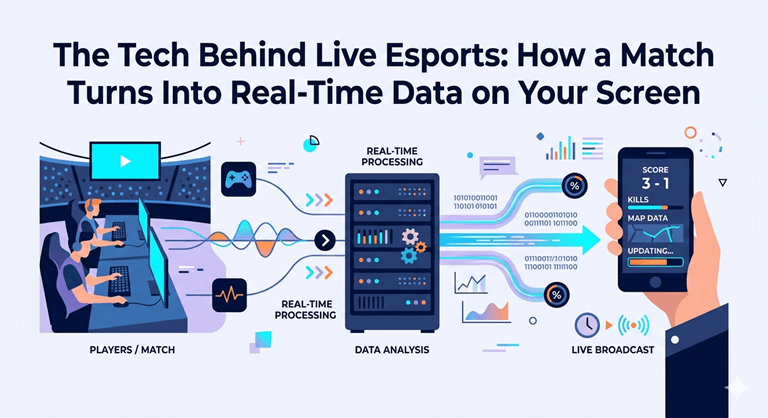
It’s a great example of what really makes up the “invisible infrastructure” that modern esports operates on. It’s the players and the highlights that you’re focused on, but you’re never the first one to see them, unless a layer of software passes the data from a game server to a screen on the far side of the world. Knowing about the layer doesn’t merely satisfy curiosity; it also helps to understand why some results sites come across as instant and trustworthy, while others lag and stutter through a large game.
From the game server to a number on a page
It begins within the game. Today’s competitive games reveal match telemetry, the raw flow of events that reveal what’s happening: Who has fired, who is dead, the economic situation, wand here the bomb is. That data is transmitted from the game server to providers that clean the data, organise it, and transform it into a format that other software can use. A live match is one that is a series of events with timestamps.
Then, specialist data companies repurpose the data and make it available to any developer wanting to add stats to a site or app as APIs. It is the most unseen layer by most fans, and most products require it silently.
Providers such as PandaScore collect and distribute live esports data across the major titles, handling the unglamorous work of normalizing dozens of different games into a consistent feed that developers can actually build on top of.
The hard part is speed
Anyone may exhibit an end score. The engineering challenge is to demonstrate it quickly and maintain the accuracy while it is changing. All of the live data must be moved from the game server into the provider’s systems and into your site’s systems—and then onto your screen in time for a round to be resolved. Each hop is a delay, and even if the results are all correct, a page that is 10 seconds late is broken.
But solutions involve smart caching of data, only fetching the data that has changed since the last update, and graceful degradation if a feed fails during a game. The amount of win probability you see change in a clutch is the public part of all the things you don’t see that the people who support you have accomplished to keep the latency low and the numbers honest.
Why it matters to the people watching
With good live data, a match will be different. The win-probability graph provides information on when an upset is about to break; it does not have to say so. Round-by-round economic data tells a story of a team that made a snapshot decision, which was a bit too much. Player stats allow you to solve the question of who’s really carrying. It is like reading the game along with the analysts with the data.
A results platform lives or dies on how well it handles all of this. EsportNow leans on this kind of pipeline to surface EsportNow live esports data across the major titles, pulling scores, fixtures, and match context into a single fast-loading view rather than making fans refresh a dozen separate feeds to follow a single tournament.
Overlays, observers, and keeping the data honest
Among the most prominent technologies in esports are those housed within the broadcast. The observer tools allow an extra operator to track the action and convey the positions, health, and economy of the production team to the match in real-time, and the overlays draw that information to create graphics on screen during a match. This is easy to do in the best broadcasts because it’s almost as if it happens naturally, which hides how much coordination is required to make this happen when the broadcast is live, and the game is chaotic.
The subtle prerequisite to all of this is accuracy. If the fans’ and the analysts’ stats feed is useless because it is not accurate, then the stats-feed provider will have to take measures to prevent dropped events, inconsistencies in the data, and corrections as the match takes place. The same structured data is also a springboard for a burgeoning third-party ecosystem, such as the analytics platforms teams use to analyze opponents to the apps that allow fans to explore numbers that aren’t displayed during the broadcast.
When a score is updated, the next time a round finishes, remember the whole system that brought it about. It is one of those technologies that can only be remarked upon when it fails – the best praise you can give to an infrastructure. When done well, it’s gone, and you get to view the game better than any fan did 10 years ago.
Popular on OTW Right Now!
-
 8 Top Enterprise CLM Platforms for Full-Lifecycle Contract Management in 2026
-
 Scaling E-commerce Apps for USA Markets: Performance, UX, and Infrastructure Challenges
-
 NetSuite For Construction Companies: How Better Job Costing And Billing Visibility Support Growth
-
 AI moderation in real time: practical playbook for sports and streaming communities




About The Author

Gagan Bhangu
Founder of otechworld.com and managing editor. He is a tech geek, web-developer, and blogger. He holds a master's degree in computer applications and making money online since 2015.