
How to Secure a Smart Home Setup the Right Way
You got a doorbell camera, and then you also bought some smart bulbs, a smart lock, and perhaps a plug that turns on the coffee maker at 6 a.m. As a result, there are now four separate apps on your phone, and one of them makes a buzzing sound each time a cat crosses the front step at 2 a.m.
The entire activity appears to be concerned with security, yet nothing actually reaches the real vulnerability. Although the camera receives all the attention, the router carries out the whole operation, with a password printed on a sticker below it.
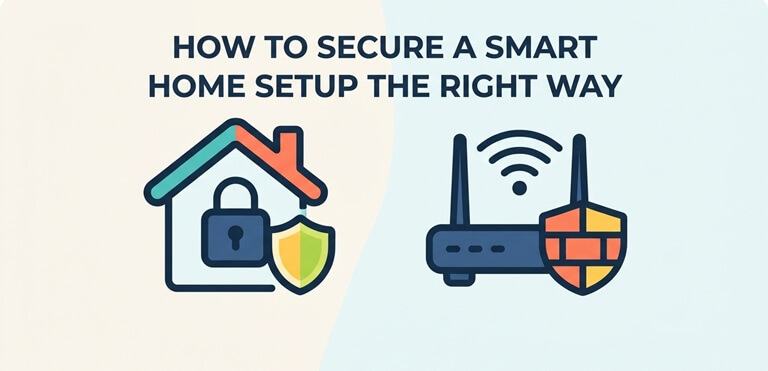
The attackers are aware of this, which is why they leave the hardened device and choose the softer one instead.
The correct way of setting up a secure smart home is as follows, in order to reduce the chances of being compromised.
Start With the Router, Not the Gadgets
The router is in control of all the smart devices in your home; it provides the connections, determines which devices communicate with which others, and acts as the link between your network and the public internet. You should regard it as the basis for all the other setups.
It is first necessary to change the admin password, as the admin login is separate from your Wi-Fi password and many people never do so. The default login details for most router models can be found in public lists that are easy for anyone to search.
Then turn on WPA3 if your router has this facility. WPA2 will still work alright, although any older models should be thrown away.
Lastly, turn off remote management; you probably don’t need to log into your router when you’re in a coffee shop, and leaving that option open will let unwanted traffic in.
Give Your Smart Devices Their Own Lane
Most routers provide the facility of having a guest network, so make use of it with all the smart devices that you own.
The laptop contains your tax documents and your password manager, whereas the smart bulb has nothing of value to steal. By keeping them on separate networks, the bulb cannot access the laptop if it has been compromised.
Network segmentation sounds like an enterprise term. Setting it up on a home router takes about four minutes. Privacy-minded readers already tinker with how their traffic gets routed, and oTechWorld has covered tools like PureVPN’s per-tab IP feature for that reason. Segmenting your home network follows the same logic: keep things that don’t need to talk to each other apart.
Where DIY Stops Making Sense
A network that is locked down can safeguard your data, but it offers no protection against a stranger being in your living room at 3 a.m.
Many people set up their own reliable system by installing cameras and adding window sensors, then connecting everything through an app. This arrangement is fine until a problem occurs while you’re asleep or when you’re traveling by plane.
A do-it-yourself system can send you a notification if you arrange it to do so. But somebody has to look at it, understand it, and then decide whether to ask for help. If your phone is lying face down and set to silent, no one will take any action.
With professionally monitored systems, a trained operator sees the alarm, verifies it, and dispatches emergency services whether you are awake or not. Providers like SafeStreets install ADT-monitored equipment and pair it with 24/7 monitoring, which turns your sensors into something that acts on its own instead of waiting on you.
Security systems are useful for people who travel, those who work night shifts, or individuals who live alone; the hardware in a do-it-yourself kit is usually the same, which means that the money you’re spending is simply for having someone watch the property when you’re unable to.
The Alert Fatigue Problem
Suppose you arranged for motion detection and then received 40 notifications each day from a tree branch and a local cat, after which you turned off the app; once you’ve done that, the app becomes essentially useless.
Instead, adjust the zones. Most camera applications allow you to draw in an area where activity will be detected so that the driveway sets off the alerts, but the sidewalk does not. Increase the sensitivity threshold and then switch off the notifications for the devices that are rarely important, such as the hallway sensor that goes off every time the dog moves.
A system that you actually pay attention to is better than one that you have come to ignore.
Firmware Updates Are the Boring Fix That Works
There’s no desire on anyone’s part to log into a camera app in order to check for a firmware update; nevertheless, you can do it or enable automatic updates and then ignore the matter.
The manufacturers fix the actual faults in these versions; a device using two-year-old firmware has all the flaws that have been discovered since it was released.
Cheap cameras from unknown brands often cease to get updates after a year, making them a permanent burden when left on your wall. The $25 you save by choosing an unfamiliar brand ends up with a device that has an unknown update policy, an app whose origin is unknown, and a cloud server that you can’t find on a map.
It is better to buy less of your equipment from companies that will still be in business in three years.
Know What You Are Actually Buying
The FCC now runs a voluntary labeling program called the U.S. Cyber Trust Mark, which puts a shield logo and a QR code on consumer smart products that meet baseline security standards. The program works roughly like Energy Star, except it rates security instead of power draw.
Scan the code before making your purchase, as it shows whether the manufacturer promises to provide updates and for how long, and it’s that one detail that will determine if you trust the device in 2029 or if you unplug it after eight months.
Your Phone Is Part of the Attack Surface
All the intelligent home apps on your phone act as keys to your house, so if your phone is stolen or left unlocked, someone will have access to your door lock, your camera feeds, and your alarm codes.
Secure it using biometrics and make sure that two-factor authentication is turned on for the security app, even if you don’t use it in other apps. Whenever necessary, check the app permissions, since some smart home apps request access to your location and microphone, which they have no right to hold.
What Changes in the Next Few Years
The Matter interoperability standard, which is supported by Apple, Google, Amazon, and Samsung, is continually growing. It enables devices made by different manufacturers to communicate without the need for a large number of separate hubs and apps, and this simplification has a positive effect on security since there are fewer apps and fewer cloud accounts, which in turn means there are fewer places where credentials can leak.
The other area worth paying attention to is local processing. Instead of sending every frame to a server, more cameras are now processing the footage on the device itself, which means your video remains in your house and your exposure of personal information decreases.
Then what are you supposed to do today?
Act towards that future at the present time. Purchase equipment that has publicly stated update commitments, segment your network, and genuinely decide if you prefer a system that alerts you or one that takes action on your behalf.
Popular on OTW Right Now!



About The Author

Gagan Bhangu
Founder of otechworld.com and managing editor. He is a tech geek, web-developer, and blogger. He holds a master's degree in computer applications and making money online since 2015.