
Generative AI Is Transforming Cybersecurity Skills for a New Digital Era
Cyber threats are evolving faster than traditional defences can keep up. Attackers are using AI to craft smarter phishing emails, generate polymorphic malware, and probe systems at machine speed. Meanwhile, the cybersecurity industry faces a global shortfall of over 4 million skilled professionals.
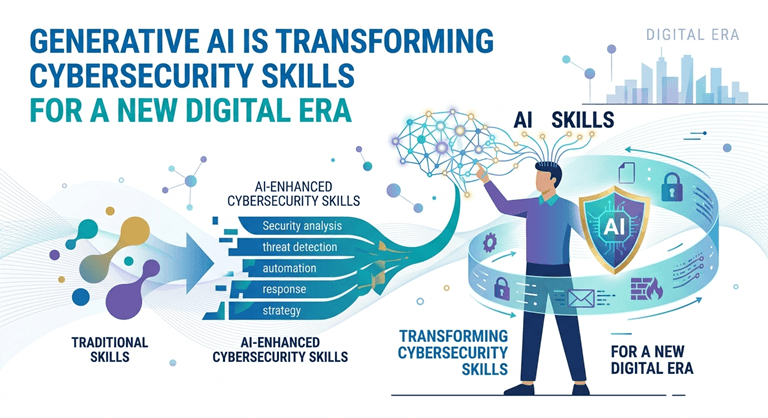
Generative AI is the industry’s most powerful response, but only in the hands of professionals who know how to use it. This article breaks down what generative AI means for cybersecurity, which skills now matter most, how job roles are changing, and what you need to do to stay relevant.
What Is Generative AI in Cybersecurity?
Generative AI refers to AI systems capable of producing outputs such as text, code, analysis, and recommendations based on patterns learned from large datasets. In cybersecurity, these systems don’t just flag anomalies; they interpret them, explain them, and suggest what to do next.
The Core Generative AI Technologies
Listed below are the core technologies in Generative AI.
- Large Language Models(LLMs)
- AI Copilots
- Automated Detection Systems
A structured Generative AI Course helps professionals develop expertise in these technologies and understand how they can be applied across modern security operations and cyber defence environments. Let us examine each of those in detail.
Large Language Models (LLMs)
LLMs, such as OpenAI’s GPT-4 and Google’s Gemini, can read security logs, summarise incident reports, explain vulnerabilities in plain language, and assist with threat hunting queries. They understand context, not just keywords, which makes them far more useful than traditional search-based tools for security analysis.
AI Copilots
These are LLMs that are integrated into security platforms. For instance, Microsoft Security Copilot integrates with Microsoft Sentinel and Defender to enable analysts to query across their entire security environment using natural language.
Automated Detection Systems
They leverage machine learning to set behavioural baselines at endpoints, users, and network traffic, and highlight deviations from the baseline that may suggest compromise. These models are able to learn from time to time and discover an attack pattern that has never been observed before, unlike rule-based systems.
What Generative AI Actually Does in Operations
Here are the major functions of Generative AI.
- Threat analysis: Ingests logs, alerts, and threat feeds to identify attack patterns and TTPs (tactics, techniques, and procedures) mapped to frameworks like MITRE ATT&CK
- Vulnerability management: Scans code and infrastructure, flags weaknesses, suggests patches, and generates remediation documentation.
- Incident response: Correlates indicators of compromise, reconstructs attack timelines, and recommends containment steps in near real time
- Security reporting: Drafts post-incident reports, compliance summaries, and executive briefings automatically from raw event data
Why Generative AI Is Reshaping the Cybersecurity Skills Landscape?
Three reasons why Generative AI is changing cybersecurity skills include:
1. Attacks are now AI-powered
AI is currently being exploited by threat actors to automatically compose phishing emails, create malicious software, and automatically search for vulnerabilities. To defend against attacks by AI, one must be aware of how to attack with AI.
2. There aren’t enough security professionals.
The world’s job market for cybersecurity positions is more than 4 million short. Organisations are unable to recruit quickly enough. AI is a force multiplier, meaning that a few highly trained analysts equipped with AI tools can work as many as several analysts without AI. That means being AI fluent is no longer a nice-to-have skill, but a must-have skill.
3. Speed is everything
The longer the breach remains undetected, the more it costs, not only in terms of data and money, but also in terms of trust. With AI, detection is reduced from days to minutes. However, this is only effective if the professionals understand how to set up, understand, and react to the information that the AI brings to the surface.
Key point: AI is enhancing the skills of security professionals, not replacing them. Human judgment will be very important for strategic decisions, novel threat scenarios, and anything that needs ethical and/or legal accountability.
The Skills That Matter Most in the Generative AI Era
These are the six skills that define a capable security professional in the generative AI era.
- AI Literacy
- Prompt Engineering
- AI-Assisted Threat Intelligence
- Security Automation
- Data Governance
- Adversarial AI Defence
Let us examine these skills in detail. Professionals looking to build these competencies often enrol in a specialised Cybersecurity Training that combines security fundamentals with AI-driven threat detection, automation, and governance practices
1. AI Literacy
Understand the working and limitations of AI. The AI models only make probable predictions, not correct ones. They tend to hallucinate, which means that they give correct, but incorrect, answers. If an attack is new, there are blind spots in a model created with old data.
In practice, this means:
- Always validate AI outputs before acting on them
- Know what data the tool was trained on and when
- Understand when AI should assist a decision vs. make one autonomously
2. Prompt Engineering
There is more to asking AI than meets the eye. A general question will yield a general answer. Actionable intelligence is provided by a precise prompt that contains a time period, data source, and what to find. This is true for threat hunting, log review, and code review.
Simple rule: Sharp prompts get sharp results. Poor prompts get hallucinations and wasted time.
3. AI-Assisted Threat Intelligence
AI is able to identify patterns. What it means is understood by humans.
AI can be able to scan thousands of indicators, including IP addresses, file hashes, and behavioural signatures, in seconds. It can also identify suspicious activity if there are no known rules that match the value.
The human skill: Understanding what AI-surfaced intelligence means for your organisation’s specific risk, and deciding what to do about it.
4. Security Automation (SOAR)
Set up an automatic response for AI detection. SOAR workflows can quarantine a threat, quarantine an endpoint, block an IP, or create a ticket even before an analyst sees the alert if AI identifies a threat.
Key skills: Building response playbooks, integrating AI with existing tools, and defining which actions need human approval before triggering.
5. Data Governance
Be aware of the data you feed into your AI, and what it entails. Log data can be leaked into sensitive logs and into the cloud-based AI tools via vendor infrastructure. There’s a need for security professionals to determine what kind of data AI can touch and evaluate the risks from vendors, as well as safeguard AI models from data poisoning attacks.
Reference framework: NIST’s AI Risk Management Framework (AI RMF).
6. Adversarial AI Defence
AI tools are attack surfaces, as well. Attackers are creating methods to target AI systems as organisations start to use AI in their security operations. As AI becomes part of organisations’ security, attackers are working on methods that target the AI systems. These are the 3 most important threats to be aware of:
- Prompt injection: Emails or documents contain malicious content to manipulate the AI’s behaviour.
- Model manipulation: Corrupting training data so AI learns to ignore certain attacks.
- AI red teaming: Using AI to actively test for vulnerabilities in AI systems before they can be exploited by others.
The same AI capabilities that help defenders detect threats faster are also changing how organizations validate their own defenses. Automated penetration testing uses AI to simulate real attacker behavior continuously, mapping an organization’s attack surface, identifying exploitable weaknesses, and re-testing as environments change, rather than waiting for the next scheduled engagement. This matters because attack surfaces shift constantly. New cloud assets, updated code, and third-party integrations all open windows that a once-a-year pentest can miss. Security teams that pair automated, continuous testing with periodic human-led assessments get a more accurate, up-to-date picture of where they’re actually exposed. This approach, often called Adversarial Exposure Validation, gives security professionals a way to prioritize AI red teaming and adversarial defense work around real, verified risk instead of guesswork.
Microsoft, Google, and OpenAI all have their own AI red teams. The same is expected for Enterprise security functions.
How Cybersecurity Job Roles Are Evolving with Generative AI?
AI is not taking the place of cybersecurity jobs; it’s improving them. All major roles within a security team are moving away from repetitive and manual tasks into roles that call for judgment, strategy, and oversight. Here’s how that will play out in reality.
- Security analysts take the place of alert responders in the role of AI supervisors. AI noise filters prioritize the noise, and analysts can concentrate on incidents that require human attention and decision-making.
- Threat Intelligence Specialists get to spend more time interpreting data than collecting. The threat feeds, dark web data, and attacker profiles are processed at scale with A specialists, and I am free to interpret the intelligence for the business.
- SOC teams are evolving to become AI management units. Now their focus is more on model configuration, validating AI results, and maintaining the human element in all crucial security decisions.
- Security Engineers are now responsible for securing the AI systems in addition to the infrastructure they are with, including the evaluation of vendor risk and safely integrating tools, as well as establishing the proper governance and audit controls.
- Cybersecurity Consultants are expanding into AI-related advisory work. There is a need for assistance in identifying risk, creating governance structures, and training teams to establish a robust demand for consultants with both security and artificial intelligence expertise in organisations turning to AI.
The pattern is the same for all positions. Routine, manual work is moving to AI. Human effort is rising towards oversight, interpretation,n and decisions that demand context and accountability.
New roles are already emerging. The combination of AI and cybersecurity has resulted in new job roles that were nonexistent 5 years ago and are in high demand.
- AI Security Analyst: Keep an eye on AI security tools, review results, and oversee the performance of models.
- AI Governance Specialist: Ensures AI deployments meet policy, regulatory, and ethical standards
- AI Risk Manager: Recognizes and reduces AI’s risks as tools and as targets.
- AI Security Architect: Designs Secure Infrastructure for integration of AI, DaGovernancee rn, ance and Access Controls.
Human expertise isn’t going anywhere. AI is great at scaling, pattern matching, and structured automation. What it can’t do is to apply contextual judgment, think through new and very unusual dangers, or be held ethically and legally responsible. The future is going to be for the professionals who can direct, validate, and extend what these AI tools can do, whilst having a strong grounding in security fundamentals.
Benefits of Generative AI for Cybersecurity Teams
The argument for using AI in security operations is not hypothetical – it is happening as teams are quicker to detect threats, are better equipped to deal with their workload, and are able to build talent more effectively. It is there that the real benefits are being realized.
Faster Incident Response
AI matches attack patterns, maps out the way the attack went, and suggests containment measures in minutes. Tools such as Microsoft Security Copilot can surface in seconds, which can be the difference between time to detect an incident and time to mitigate the damage for experienced analysts who might take a couple of hours to put it together.
Better Threat Detection
Low and slow attacks are not covered by rule-based systems, since there is not enough noise to raise an alarm. AI provides a behavioural baseline analysis that views thousands of endpoints at once and uncovers the subtle variations that humans, at human pace, can’t.
Reduced Analyst Burnout
The majority of analysts’ time is spent on handling irrelevant “alarms”. Bad, inefficient not only, but also degrades the judgment, kills the morale, and causes turnover. AI can sort through the high volume, low-value triage so analysts can focus on investigations that really require their attention.
Scalable Coverage
A single analyst with great AI abilities could handle what a complete team of analysts would typically be responsible for. In a sector that is depleted by 4 million employees, it’s how organisations survive.
Better Knowledge Sharing
AI can extract relevant data from historical incident reports, playbooks, and threat intelligence to provide the right information to junior analysts on the fly. This will speed up development and minimize the risk of important knowledge being confined within a few senior individuals.
Risks and Challenges to Manage in Generative AI
While AI has its merits, it also poses potential risks that security teams must be aware of when implementing these capabilities. Do not ignore them; you will not get rid of them, and they will appear at the wrong time. Look out for these key risks and challenges when using Generative AI.
AI Hallucinations
AI does not present information based on facts, but patterns. It can make threat assessments or remediation proposals that may appear to be authoritative, yet are simply incorrect. In a live incident, performing an action based on a hallucination may take time, put one’s life at risk, or both. All outputs from AI must be validated by people prior to action.
Prompt Injection Attacks
AI assistants can be vulnerable to malicious code in emails, documents, or web pages, which can alter their behavior, such as ignoring threats, revealing information, or acting unintentionally. Systems should be regularly tested for this vulnerability, inputs validated, and AI tools should be sandboxed.
Data Privacy and Leakage
The majority of the AI security solutions exist on the cloud. This can include passing and storing sensitive log information, network telemetry, and incident information to third-party infrastructure. Before any sensitive data is input into an AI tool, it’s crucial to ensure clear data policies, review vendor agreements, and implement strong technical controls.
Bias and Reliability
The way AI models work is that they are based on the data they were trained on. Patterns in one kind of network environment may not be present in another, and thus a model developed in one environment may fail to capture patterns found in the other environment. As a threat actor evolves in its behaviour, so too do models. Outside of having to monitor performance, it’s not an option – it’s maintenance.
Regulatory Compliance
Regulatory requirements are emerging quickly from the EU AI Act, the US Federal Guidelines on AI, and specific sectoral regulations. Security teams must also have the right level of regulatory acumen to identify risks and engage compliance teams before deploying AI tools, not in the wake of an audit identifying a problem.
Conclusion
Generative AI isn’t some upcoming trend in cybersecurity; it’s actually something that is already happening. As of now, attacks are already made with the help of AI. Defences too ought to be too.
They are the security experts who have mastered the core security principles and are equally proficient in AI literacy, prompt engineering, governance, and have the confidence to guide and validate AI tools in critical scenarios.
The organisations and professionals that make AI-ready security skills today will be well-equipped to fend off security threats already being created for tomorrow.
Frequently Asked Questions
How is generative AI used in cybersecurity?
Generative AI can be used to automate threat detection, analyse security data, assist with incident response, generate reports, and identify threats from vast amounts of data.
Will generative AI replace cybersecurity professionals?
AI can enhance productivity and assist with repetitive tasks, but there is still a need for human expertise in decision-making, problem-solving, and addressing new threats.
What cybersecurity skills are most important in the AI era?
The required skills are AI literacy, prompt engineering, threat intelligence, security automation, data governance, and AI security testing.
What are the biggest risks of using generative AI in cybersecurity?
Key threats are inappropriate AI output, prompt injection attacks, data leaks, biased outcomes, and new compliance regulations.
How can I start building AI cybersecurity skills?
Get practical experience with AI security tools, learn about AI security frameworks, participate in AI-specific training courses, and apply AI security testing strategies.
What new job roles is AI creating in cybersecurity?
New positions are becoming available, such as AI Security Architect, AI Risk Manager, AI Governance Specialist, and AI Security Analyst. The roles are an amalgamation of cybersecurity skills and AI knowledge.
About the Author
About the Author
Tausifali Saiyed is a Generative AI Expert, Full-Stack Developer, and Corporate Trainer with over 10 years of experience in software development and technology education. He specializes in Generative AI, Python, Java, Android, Flutter, MERN Stack, and full-stack web application development, helping professionals and organizations adopt emerging technologies for innovation and growth.
Holding an M.Sc. in Computer Science from the University of Greenwich, London, Tausifali has delivered training programs across AI, software engineering, and digital technologies. He is particularly interested in the evolving role of Generative AI in areas such as cybersecurity, automation, and digital transformation, enabling professionals to leverage AI effectively in modern technology environments.
Popular on OTW Right Now!


About The Author

Gagan Bhangu
Founder of otechworld.com and managing editor. He is a tech geek, web-developer, and blogger. He holds a master's degree in computer applications and making money online since 2015.