
Custom Software Development vs Off-the-Shelf Software: Which Is Better?
People often frame the debate between developing custom software and using off-the-shelf software as a technical evaluation. The decision involves establishing a business strategy that will impact your business operations for an extended period. The decision determines your capital allocation methods and your business’s capability to adapt, and your business capacity to grow, and your technology will function as a competitive advantage or a common resource. The situation usually originates from people who need to decide between building a custom software development company in USA or purchasing an existing solution.
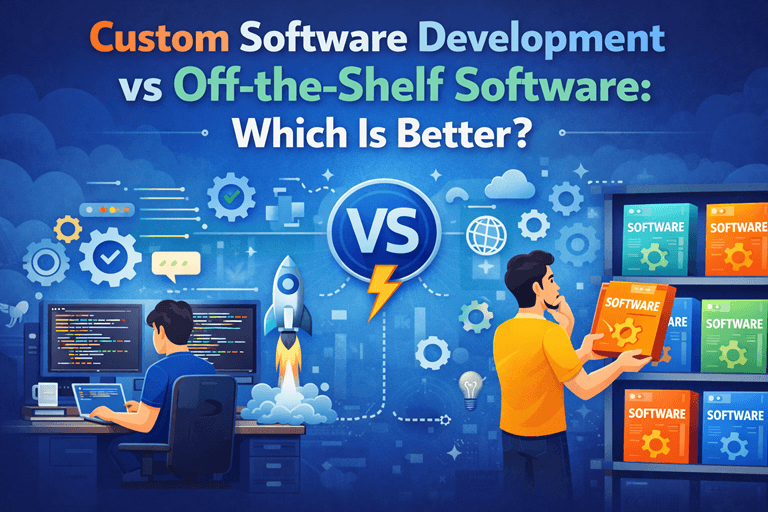
The decision-makers at every scaling company reach their first critical choice. The organization must decide between developing an internal system or obtaining an existing solution through licensing.
Organizations face serious consequences when they select the wrong option. Off-the-shelf systems with inflexible structures create boundaries that restrict your ability to develop new solutions. An organization can face budget overruns and project delays when it attempts to create an excessive custom-built software system. The leadership team must evaluate specific factors before making a binding decision.
What Is Custom Software Development?
Organizations typically pursue custom software development when their operational workflows are complex or strategically unique. For example, fintech firms often require proprietary risk scoring systems. In these cases, working with a custom software development company in the USA can help address compliance standards, data protection requirements, and scalable infrastructure planning.
The custom enterprise software development company establishes business objectives through workflow documentation, user persona identification, and compliance requirement explanation. The phase demands complete concentration from the team. Poor discovery work leads to budget increases during later project stages.
Design and Prototyping
Stakeholders conduct assessments of initial concepts to confirm their usability and functional requirements before the development process starts. The process detects operational issues at an early stage, which helps to reduce expenses and time requirements.
Engineering and Integration
Developers construct frontend interfaces together with backend logic, API connections, and database design. The team executes the process of connecting external services, which include payment processing systems and analytics platforms.
Testing and Quality Assurance
The system undergoes testing for security and performance, and edge case scenarios to confirm its dependable operation in actual operating conditions.
Deployment and Continuous Improvement
The product development process continues after the initial product launch. The system uses feedback loops to improve features and enhance performance, and handle increased demand.
What Is Off-the-Shelf Software?
The software functions as pre-packaged software, which enables multiple businesses to use its common functions. You begin using the platform immediately after you acquire a license or subscription instead of creating your own solution.
The model provides organizations with an ideal solution.
Most commercial custom enterprise software development companies follow one of two pricing structures: Perpetual licensing requires customers to pay a full amount at the beginning, which results in additional costs for future updates. SaaS subscription requires customers to pay a monthly or yearly fee, which depends on how many users they have and which features they need.
The current solution in the market is SaaS software. The products are based on a multi-tenant design that allows more than one customer to use the same underlying system, with their data being isolated logically.
The system attains cost savings by having common infrastructure resources. The system facilitates automatic installation of updates to the system by the vendors without customers going through manual installation processes.
Several widely adopted platforms demonstrate how powerful standardization can be:
Salesforce
Shopify
QuickBooks
Microsoft 365
Cost Comparison: Upfront Investment vs Total Cost of Ownership
Cost is usually the first question leadership teams ask. It should not be the only one. The real comparison is not just initial price. It is total cost of ownership over time.
CapEx vs OpEx
Custom software development typically falls under capital expenditure. There are high initial investments in architecture, engineering, testing, and deployment. Following the launch, maintenance, infrastructure, and incremental improvements costs are ongoing.
Off-the-shelf software is basically used as operational expenditure. The initial cost of the subscription seems comfortable. A reasonable monthly charge of ten users appears cheap.
But renew that subscription over five or seven years. Scale up the usage with the expansion of your team. scale up to superior feature levels. All of a sudden, cumulative costs may compete or even surpass the price of a well-thought-out custom build.
This is why long-term modeling matters.
Hidden Costs on Both Sides
Many businesses underestimate indirect expenses.
For off-the-shelf software, hidden costs often include:
- Integration fees for connecting external systems.
- Premium feature add-ons.
- Scaling tiers that increase as usage grows.
- Per-user pricing increases as headcount expands.
For custom software development, hidden costs tend to include:
- Ongoing maintenance and bug fixes.
- Cloud hosting and infrastructure scaling.
- Security audits and compliance updates.
- Continuous feature enhancements.
The cost of maintenance by itself can consume 15 to 25 percent of the original cost of development on an annual basis. Many executives are surprised at that number.
The distinction is apparent. It goes without saying that subscription fees are applied. More thought needs to be done on infrastructure and maintenance costs.
When Custom Software Development Makes Strategic Sense
Not all organizations are supposed to start afresh. Nevertheless, in some situations, the development of custom software is not only advantageous. It is necessary.
Complex Operational Workflows
The multi-layered workflows that your business operations produce do not fit standardized tools. This is problematic to the level that organizations attempt to apply their preexisting processes using typical software.
A logistics firm has its routing algorithm, whereas a healthcare provider is required to fulfill a set of compliance requirements. Such operations cannot be easily fitted in pre built templates.
Your business architecture can be configured to execute based on the real business activities rather than based on vendor assumptions through custom software development.
Highly Regulated Industries
The controlled industry of fintech, healthcare, and insurance has to comply with the high standards of regulatory compliance. Based on business laws, organizations need to meet the requirements of data encryption, audit trail specifications, reporting requirements, and privacy requirements.
An enterprise software development firm that follows a custom approach may build compliance in the system at the beginning of the project. This is in contrast to the process of enforcing regulatory requirements by installing third-party addons and software patches.
The compliance requirements implemented in the architectural system form a basis to reduce future risks.
Differentiation Through Technology
Technology does not constitute support infrastructure for some companies. It is the product.
Amazon does not operate with the typical fulfillment programs but rather with its own logistics programs. Uber is not applying off-the-shelf dispatch tools to match the ride. They have their competitive advantage in proprietary systems.
The use of unique performance characteristics, automated processes, and customer experience development is considered to be your growth strategy when custom software development is deployed and becomes a strategic investment in your business.
Long-Term Scalability
The preliminary phases of architectural development prove to be vital to the organization that envisions its business to undergo rapid growth and extend into new markets, and create new ways of service delivery within the next three to five years.
The custom systems allow organizations to expand their operations because, at the same time, they can add several new modules as their systems adapt to the business needs.
When Off-the-Shelf Software Is the Smarter Choice
Custom solutions offer control and flexibility. But they are not automatically the right answer.
Standardized Business Functions
There are business functions that are very universal. The standard systems are needed in payroll processing, HR management, accounting, and document collaboration that work in all of their functions.
Such processes are already processed efficiently and safely in established platforms. The internal evolution of these systems leads to additional costs that do not generate a competitive advantage of any kind.
Off-the-shelf software will allow your team to focus its energy on the most important activities since it is a whole solution.
Limited Budgets or Smaller Teams
Tailor-made software development requires an initial investment as well as ongoing maintenance of the system. Subscriptions can be used to spread costs over time to startups or small businesses that have limited resources.
Forecastable monthly payments are easier to manage a business’s finances compared to paying a large amount of money initially.
Need for Rapid Deployment
Off-the-shelf software ensures that customers have a working system in weeks when there is a need to have it. The configuration process takes a shorter duration compared to what the engineers take in their entire engineering process.
Quick performance is necessary at the time of the first company growth and transition.
Proven Reliability and Support Ecosystems
Commercial platforms are fully documented and have a security policy and or community of users. The ecosystem offers companies a lower level of risk as they do not possess specialized technical expertise.
There are occasions when simplicity is not a conflict. It is a strategic decision.
Decision Framework
The decision between custom software development and off-the-shelf software should be evaluated in a structured manner.
Custom builds are flexible, owned, and differentiated.
Off-the-shelf software is fast, cheaper in initial outlay, and has dependability.
Both alternatives are not always better.
Compare the development, maintenance, and hosting costs plus upgrade to long-term subscription fees.
Finally, the operational agility and strategic positioning are influenced by software decisions. Select and decide the alternative that enhances long-term competitiveness advantage as opposed to the short-term convenience.
When you are considering your next step, you might consider engaging a bespoke enterprise software development firm such as AppZoro to assist you in developing a solution that is in line with your growth strategy and technical vision.
Popular on OTW Right Now!


About The Author

Gagan Bhangu
Founder of otechworld.com and managing editor. He is a tech geek, web-developer, and blogger. He holds a master's degree in computer applications and making money online since 2015.