
Professional Photo Restoration vs AI Apps: Which Should You Choose?
Old photographs are more than images. They are family histories, personal memories, and visual connections to people and moments that can never be recreated. As technology advances, restoring damaged photos has become easier than ever. Today, anyone can upload a faded picture to an AI-powered restoration app and receive an enhanced version within seconds.
At the same time, professional photo restoration services continue to thrive, offering handcrafted restoration performed by experienced artists and photo editors.
This raises an important question: Should you use an AI restoration app or hire a professional photo restoration expert?
The answer depends on the condition of the photograph, your expectations, and the importance of preserving authenticity. While AI restoration tools offer speed and convenience, professional restorers provide accuracy, judgment, and attention to detail that automated systems often cannot match.
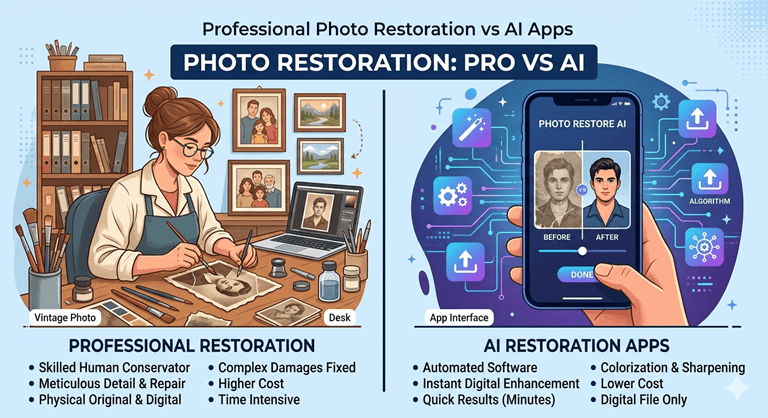
This guide explores the differences between professional photo restoration and AI apps, helping you make the right choice for your treasured images.
Quick Comparison: Professional Restoration vs AI Apps
| Factor | Professional Photo Restoration | AI Restoration Apps |
| Speed | Hours to days | Seconds to minutes |
| Cost | Higher | Free or low-cost |
| Accuracy | Very high | Varies significantly |
| Facial Preservation | Excellent | Can alter identities |
| Historical Accuracy | Strong | Limited |
| Complex Damage Repair | Excellent | Often struggles |
| Human Judgment | Yes | No |
| Emotional Preservation | High | Limited |
| Custom Requests | Fully customizable | Minimal customization |
| Best For | Valuable, damaged, or historical photos | Quick enhancements and minor repairs |
Understanding AI Photo Restoration Apps
AI photo restoration apps use machine learning algorithms trained on millions of images. These systems analyze damaged photographs and predict what missing or degraded areas should look like.
Popular AI tools typically perform tasks such as:
- Scratch removal
- Noise reduction
- Face enhancement
- Colorization
- Upscaling
- Sharpness improvement
- Damage reconstruction
The appeal is obvious.
Users can upload a photo, wait a few seconds, and receive an enhanced image without any editing experience.
For casual users, AI restoration represents a major breakthrough in accessibility.
However, convenience does not always equal accuracy.
How Professional Photo Restoration Works
Unlike automated tools that rely on prediction models, Online photo restoration artists focus on preserving original details through careful analysis, manual reconstruction, and personalized editing decisions.
Professional restoration is fundamentally different.
Rather than relying solely on automated predictions, human artists carefully analyze every aspect of an image before making restoration decisions.
A professional restorer typically:
- Studies facial features
- Examines damaged areas
- Research historical details
- Reconstructs missing elements manually
- Preserves original photographic characteristics
- Adjusts restoration based on client feedback
The process combines technical expertise, artistic skill, and historical understanding.
Unlike AI, professional restorers do not simply guess what belongs in missing sections. They evaluate context and make informed decisions.
Speed: AI Wins, But There Is a Trade-Off
When speed is the primary concern, AI apps are difficult to beat.
Most AI restoration tools can process photographs in under a minute.
This makes them ideal for:
- Social media sharing
- Quick previews
- Casual family photos
- Bulk image enhancement
However, it takes much longer to professionally restore.
An expert photographer can devote hours or days to work on a seriously damaged photograph.
But it’s the extra time that can make for better results.
Expert restorers take the time to review all the details; they do not automatically assume.
Verdict
AI apps are best for speed. Professional restoration is best for quality.
Accuracy: Where Human Expertise Makes the Difference
One of the major differences between professional restoration and AI restoration is that accuracy plays a significant role in the process.
AI systems are predictive systems.
If the information is missing, the software estimates the missing information based on the probabilities it learns from the training data.
This can result in great-looking photos, but there’s also the possibility that it will introduce errors.
Common AI restoration mistakes include:
- Altered facial structures
- Incorrect eye shapes
- Artificial skin textures
- Distorted hands
- Invented clothing details
- Unnatural backgrounds
In some instances, the AI-generated restorations are not representative of the original individual, but they still appear appealing.
Proficient artists do something else.
They don’t give out new information; instead, they recreate images based on observation, experience,e and context.
They don’t simply want to improve; they want to preserve.
Verdict
Professional restoration provides a much higher degree of accuracy, especially with historic photos and family photos that are important.
Facial Preservation: The Most Important Test
Restoration to many is the most crucial element of preserving the appearance of a loved one.
This is where AI tools often face difficulties.
Many AI systems will boldly enhance facial details and recreate the lost parts of the face. The results might seem more pristine, but with labels like these, small differences can make a huge difference when it comes to identification.
Examples include:
- Changing the shape of the yes
- Modifying smiles
- Altering facial proportions
- Smoothing unique features
- Creating unrealistic symmetry
Though small, these changes can have a big effect on loved ones’ recognition of family members.
Professional restorers know that authenticity is more important than perfection.
They strive to maintain unique characteristics and not replace them with algorithmic approximations.
Verdict
Professional restoration is the clear winner when preserving family identity and facial authenticity.
Handling Severe Damage
In many cases, whether or not AI restoration works depends on the state of the photo.
AI Performs Well With:
- Minor fading
- Small scratches
- Moderate blur
- Low levels of damage
AI Often Struggles With:
- Torn photographs
- Missing sections
- Water damage
- Mold damage
- Burn marks
- Severely faded portraits
- Historical photographs
AI systems often make up information in instances where significant sections of the image are lost.
If a restoration job is damaged, it can be reconstructed by the professional restorer by means of reference materials, artistic methods, and context analysis.
Verdict
For severely damaged photographs, professional restoration remains the superior choice.
Historical Accuracy and Authenticity
The technical enhancement is not enough for historical photographs.
They require understanding.
Professional restorers often research:
- Clothing styles
- Military uniforms
- Jewelry
- Hairstyles
- Photography methods
- Cultural details
This research helps to preserve the historic authenticity of restorations.
AI systems don’t have this context in mind.
May inadvertently add modern elements or details to old images.
Authenticity is key for museums, archives, genealogic projects, and historical collections.
Verdict
Professional restoration provides far greater historical reliability.
Emotional Value Cannot Be Automated.
A restored photo could be the last picture of a grandparent, parent, or historic family member.
These photos may be very significant to one’s emotional life.
Human restorers are aware of the responsibility.
Many professionals communicate directly with clients to understand:
- Family history
- Important identifying features
- Desired restoration goals
- Historical context
AI apps are unable to interpret the importance of emotion.
They process pixels, not memories.
Verdict
AI can’t replicate the level of care and personalization that is available from a professional restoration service.
Cost: AI’s Biggest Advantage
Cost is where AI restoration apps excel.
Many tools offer:
- Free versions
- Low-cost subscriptions
- Unlimited processing
- Instant results
The professional restoration services will cost more as the job requires both skilled labour and a considerable amount of time.
Pricing often depends on:
- Damage severity
- Resolution requirements
- Restoration complexity
- Turnaround time
But this is to be judged by the worth of the photograph.
When it comes to irreplaceable family heirlooms, cut-throat cost savings may pale compared to the accuracy.
Verdict
AI apps provide better affordability, while professional restoration provides better value for important photographs.
The Rise of Hybrid Restoration Workflows
Note that the discussion is no longer just about AI vs. humans.
Artificial intelligence is now a part of the toolkit of many professional restoration artists.
A modern restoration process may include:
- AI-assisted cleanup
- Automated scratch removal
- Resolution enhancement
- Manual corrections
- Artistic reconstruction
- Authenticity review
This blend of AI and human expertise offers a powerful way to harness the best of both worlds.
This yields a better outcome than either can on its own.
When Should You Use an AI Restoration App?
AI restoration is often sufficient when:
- The photo has minimal damage
- You need quick results
- You are restoring images for casual use
- Budget is a major concern
- Historical accuracy is not critical
- You want to preview restoration possibilities
When Should You Hire a Professional Restorer?
Professional restoration is usually the better option when:
- The photograph is irreplaceable
- Significant damage exists
- Historical accuracy matters
- Faces are heavily damaged
- Family heritage is involved
- You need museum-quality results
- The image will be printed or archived
Final Verdict: Professional Photo Restoration vs AI Apps
AI photo restoration apps have revolutionized the process of photo restoration, making it faster, more affordable, and more accessible than ever before. They can create great photos in just a few seconds for small repairs and regular photography.
But where accuracy, authenticity, and emotional preservation are of paramount importance, professional photo restoration remains unmatched by AI.
This will depend on the value of the photograph. If you are dealing with a casual photo, then an AI application might be all you need! However, when the photo holds special significance, such as a family heritage, historical artifact, or a priceless memory, it’s the professional restoration that’s the best choice.
With the ongoing advancement of technology, the future of restoration will likely be a mix of AI and human skills, creating hybrid restoration workflows. Professional artists will continue to be the key to capturing the stories contained within our most cherished photographs until AI can interpret the context, history, and emotion of these snapshots.
Popular on OTW Right Now!


About The Author

Gagan Bhangu
Founder of otechworld.com and managing editor. He is a tech geek, web-developer, and blogger. He holds a master's degree in computer applications and making money online since 2015.