
What Are Wireless Networking Services and How Do They Work?
Wireless networks have taken over the mainstay of contemporary world communications, as every house or station is dominated by a wireless network that drives both residential and business homes and establishments.
However, what then are wireless networking services, and how do they work? It is divided by this blog in a simple and practical manner.
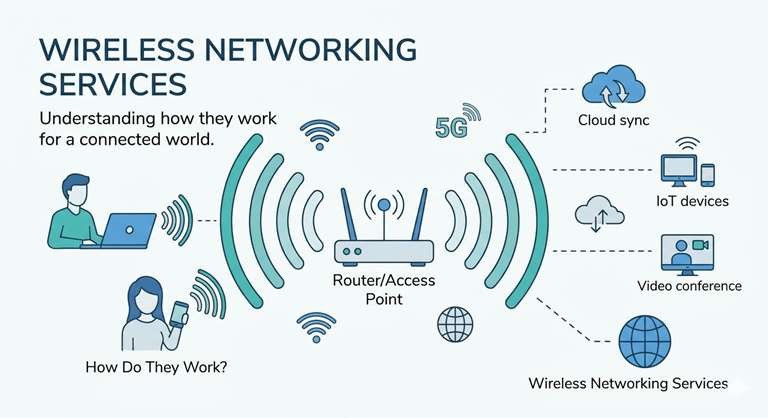
What are Wireless Networking services?
Wireless network services are the installation, operations, and maintenance of networks where the connections between devices are made by use of wireless channels. These services can be used to make devices like laptops, smartphones, printers, and IoT devices to communicate via radio signals and not a wired connection.
A typical configuration of a wireless network consists of devices such as routers, access points,s and controllers working to share an internet connection to a specific area. IT providers normally provide these services to allow a smooth, safe, fast,e and high-performance network connectivity.
Important Elements of a Wireless Network.
To learn the functionality of wireless networking services, it is convenient to know the key elements involved:
1. Wireless Router
The router is where the internet interrelates with your network. It broadcasts the wirelessly connected devices on the internet.
2. Access Points (APs)
Access points increase the range of wireless coverage. Several APs are installed in large premises such as offices to provide good connectivity in the building.
3. Network Switches
Even though routes to the wireless networks are not dependent on end device cable usage, routers and access points are connected in the infrastructure by the use of switches.
4. Wireless Controllers
Controllers in enterprise architecture regulate many ports of entry, making sure they have transparency, safety, economy, and efficiency.
5. End Devices
These are laptops, smartphones, tab, lets and other devices that are attached to the network.
How Do Wireless Networking Services Work?
Wireless networking involves the transmission of data with the use of radio waves as opposed to the use of cables.
The following is a step-by-step description, which is simplified:
Step 1: Internet Connection
The internet service provider (ISP) provides access to a router through an internet connection via a wired connection.
Step 2: Signal Distribution
This internet data is transformed into radio signals and sent out by the router with the help of antennas.
Step 3: Device Connection
Devices in the vicinity pick up the wireless signal and establish a connection with the credentials, such as a password.
Step 4: Data Transmission
When a device transmits data or receives the data (eg, accessing a website), the data is sent via radio waves to the router, which communicates with the internet.
Step 5: Seamless Roaming
With bigger networks, there is more than one access point that guarantees connectivity throughout an outage. Users can move with their devices without experiencing a loss since their devices automatically change access points.
Types of Wireless Networking Services
The services of wireless networking might differ depending on the scale and needs:
1. Home Wireless Networks
Simple mechanisms employing only one router are appropriate in a small area.
2. Business Wireless Networks
More developed networks that have multiple access points, more reliability, and increased bandwidth.
3. Enterprise Wireless Solutions
Massive implementations with central control, enhanced security measures, and network surveillance.
4. Managed Wireless Services
The third-party deals with installations, monitoring, troubleshooting, and upgrades, and businesses are only left with operations.
Typical Problems and Solutions
Although the use of wireless networks is very convenient, they have had their difficulties:
1. Signal Interference
Signal can be interfered with by walls, electronic devices, and other networks.
Solution: Placing access points strategically and playing with high-frequency bands.
2. Security Risks
Data can be compromised due to unauthorised access.
Resolution: Encryption: Encryption protocols such as WPA3 are to be used, and secure authentication is to be done.
3. Network Congestion
An excessive number of devices may slow down the network.
Remedy: Add load balancing and access points with high capacity.
4. Coverage Issues
In big areas, there can be dead zones.
Resolution: Carry out site surveys and install new access points.
Professional wireless networking services in Ontario, offered by Pexo , can be an important gain to businesses that want to increase their connection with the world. Trustworthy vendors will carry out appropriate network design, a smooth installation process, nd even provide support during maintenance to ensure optimal performance and security.
Conclusion
Wireless networking services are essential in facilitating contemporary communications and business activities. They are flexible, scalable, and efficient by eliminating the use of physical cables. Whether it is a simple home installation or an elaborate network within enterprises, knowing how these networks operate can assist you in making better choices whenever planning or upgrading your connectivity.
Popular on OTW Right Now!




About The Author

Gagan Bhangu
Founder of otechworld.com and managing editor. He is a tech geek, web-developer, and blogger. He holds a master's degree in computer applications and making money online since 2015.