
The Competitive Advantage of Integrating Organic and Paid Search on Shopify
Shopify makes it deceptively easy to launch a store—and surprisingly hard to win sustained search visibility once you’re competing with marketplaces, resellers, and a flood of lookalike brands. That’s why the most resilient growth on Shopify rarely comes from “SEO vs PPC” debates. It comes from treating organic and paid search as two levers on the same machine: one builds durable demand capture, the other accelerates learning and revenue now.
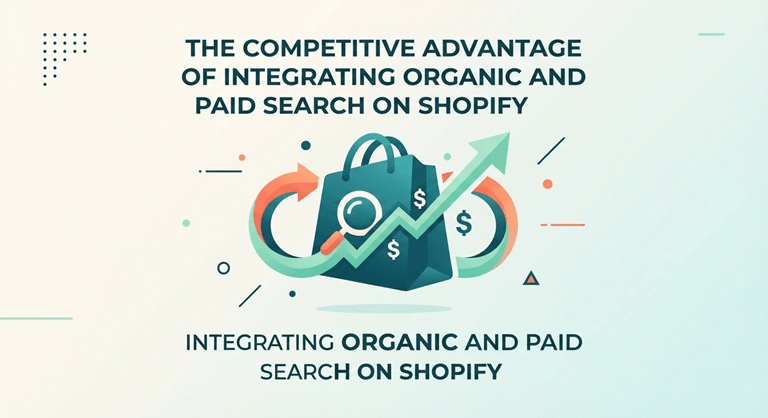
Run them separately, and you’ll still grow, but you’ll leak efficiency. You’ll bid on keywords you could own organically, ignore queries your ads reveal, and build content that doesn’t map to how people actually shop. Integrate them, and you gain something compounding: faster insight, better targeting, stronger landing pages, and a cleaner story about what really drives sales.
Why organic and paid search are stronger together
Paid search is the quickest method to gauge intent. Over time, the trust and the marginal acquisition cost can be compounded, increasing through the medium of ‘organic search’. It’s a practical benefit for Shopify merchants: they make fewer guesses.
In the real world, integration is this. Paid search allows you to discover what kind of queries are converting—and not just being clicked on. After that, you create content and collection structure that revolves around those themes. In the other sense, you identify from organic rankings where paid traffic supports weak pages and where you can decrease your bid because your organic strategy is doing the job.
This integrated approach is often described under the umbrella of performance marketing for Shopify stores—not as a channel, but as a way of managing search around outcomes (revenue, margin, customer quality) instead of vanity metrics.
Build a shared keyword and intent map.
Without a common language for intent between SEO and PPC teams, there will be overlaps in some areas and a lack of it in others. The solution is a single map of keywords which is shared by both channels and is associated with certain page types on Shopify.
Segment by intent, not just volume
On Shopify, intent alignment matters most, since page templates are opinionated. A blog post can’t replace a collection page, and a product page won’t answer wide-ranging informational queries.
A simple segmentation that works well:
- Non-brand discovery (e.g., “best vitamin C serum for sensitive skin”): usually content-led, sometimes supported by upper-funnel search campaigns.
- Category/collection intent (e.g., “vitamin C serum”): collection pages, filtered navigation, strong internal linking.
- Product-specific intent (e.g., “Brand X vitamin C serum 30ml”): product pages, rich snippets, Merchant Center support.
- Brand intent (e.g., your brand name + product): defend with paid, strengthen with sitelinks and optimized SERP real estate.
You can avoid the Shopify pitfall of putting “category intent” traffic on a homepage, or a blog post that never got a chance to convert with that one classification.
Use paid search as your research engine.
PPC gives you signal density SEO can’t match quickly. In days—not months—you can learn:
- Which modifiers raise conversion rate (e.g., “fragrance-free,” “refill,” “gift set”)
- Which audiences buy at higher AOV (e.g., “starter kit” vs “travel size”)
- Which promises trigger refunds or low-quality orders (yes, negative learnings matter)
Update collection copy, on-page FAQs, even product names, to incorporate that into organic. If your customers are always looking for “bundle” but your store offers “kit,” you have a mismatch in both channels, and it is costing you.
Shopify-specific execution that makes integration pay off
Shopify’s features – quick setup, app marketplace, and the templated structure also have predictable problems with search. It’s best to work on those basics if you want to integrate.
Align landing pages to query patterns.
With paid search, you can create very niche PPC campaigns. Google, in the case of SEO, wants a page with a definite goal and purpose. The overlap area is your chance.
As an example, don’t show ads for “linen shirt men short sleeve” to a generic category of “Men’s Shirts” if that’s not where visitors are landing most well. For instance, if paid data suggests that “linen shirt men short sleeve” is converting well, don’t target the generic “Men’s Shirts” category and hope filters will do the work. Develop (or compile) a collection that:
- Leads with the exact product subset
- Includes concise copy that mirrors the query language
- Links to related variants (long sleeve, white linen, sets)
- Loads fast and stays stable (avoid heavy filter apps that bloat DOM size)
The SEO benefit: increased topical relevance and engagement figures. The PPC benefit is that they will have a greater Quality Score and less CPC pressure.
Make your Merchant Center and SEO talk to each other
Product feed health isn’t a “PPC” thing. Titles and descriptions, GTINs and product types affect Shopping performance—and often these are similar to what the organic search needs for rich results.
If you’re changing product titles for SEO purposes, then make sure to change your feed language too. Incorporate the Shopping attribute into structured product data and page content if Shopping queries indicate that what’s important is the attribute. The fewer steps it takes for a customer to click to checkout, the less friction you will experience when both channels are describing the same product.
Measurement: where most integration efforts break
It’s not about the strategy; it’s about attribution and decision-making. When considering last-click ROAS, paid search will seem to “win” over organic as it may be the last touch point. In the end, take a look at the rankings, and SEO will appear the hero; when paid makes the learning.
Focus on incrementality, not credit.
A practical approach for Shopify teams is controlled testing:
- Pause or reduce bids on a set of non-brand keywords where you rank top 3 organically, and measure total revenue change (not just paid revenue).
- Run the inverse test on keywords where you rank poorly but convert well in paid, then invest in SEO assets to see if paid dependence drops over time.
You’re trying to answer: “Does this spend create new customers, or just shift where the sale gets counted?”
Budget allocation based on margins and lifecycle
Integration really begins to work when you budget based on product economics rather than channel tradition. If you rank high organically, but for some reason the margin on your hero product is high enough, you might consider paid support, as you’re purchasing market share and taking up SERP real estate. Low-margin products may need to be more SEO and email retention based, and paid could be used sparingly.
Common pitfalls (and how to avoid them)
Most Shopify stores miss the advantage for predictable reasons:
- Running separate landing pages for SEO and PPC that compete with each other instead of consolidating authority.
- Ignoring search terms reports after “setting and forgetting” campaigns—losing the best language customers use.
- Letting apps slow down pages, quietly depressing both Quality Score and organic rankings.
- Overbidding on brand terms without checking whether organic sitelinks already dominate the SERP.
The takeaway: integration buys you speed and staying power
On Shopify, the brands that are winning search results are doing it in both ways, and they’re working on creating a feedback loop. For your paid marketing, you purchase learning velocity. All of those learnings become long-term assets once they result in an organic search. When combined with common intent mapping, disciplined landing pages, and measurement with a sense of incrementality, they’ll stop you paying twice for the same insight and help you to capture more demand with each iteration.
Popular on OTW Right Now!


About The Author

Gagan Bhangu
Founder of otechworld.com and managing editor. He is a tech geek, web-developer, and blogger. He holds a master's degree in computer applications and making money online since 2015.