
Morse Code: What It Is and Why It Still Works
People say Morse code is dead. They are wrong.
A system from 1837 does not need the internet. Does not need satellites. Does not need working cell towers. That makes it useful in 2026. Not because it is nostalgic. Because it is simple.
I wrote that line. Then I stopped. Because most articles like this start with a big promise. Then they deliver nothing. I will not do that.
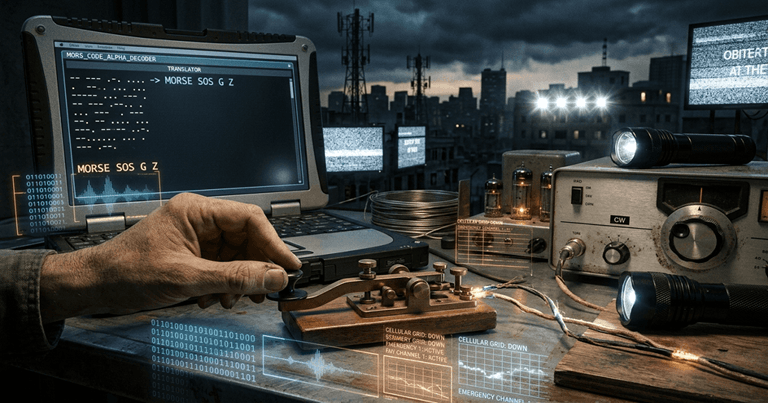
Let me tell you where Morse code still lives, the reason why it’s important to developers, and how you can experience Morse code in two minutes using only a browser.
What Morse Code Actually Is
Two symbols. A dot and dash.
Timing separates them. Dot represents 1 unit. A dash is 3 units long. The spacing between the dots and dashes within a letter is 1 unit. There is a three-unit pause between letters. The pause between words is 7 units.
No alphabet. No written characters. Just duration.
It was invented for the electric telegraph by Samuel Morse and Alfred Vail in the 1830s. In 1844, the first message was sent from Washington to Baltimore, “What hath God wrought? Four words. On average, four dots with a dash per letter. It worked.
Since then, there have been a few changes in the code. The first one was intended to include some punctuation. The modern Morse code used internationally simplified a couple of the letters. The fundamental principle remained unchanged, however. A short signal. A long signal. Peace to part them.
It’s not something that you need to learn by heart to comprehend its significance. Just make two patterns. SOS is a series of dots and dashes, namely dot dot dot dash dash dash dot dot dot. No spaces between letters. The pattern was selected because it’s simple and difficult to confuse with other patterns. A is a dot dash. N is dash dot. Combine them, and you’ll get AN.
That’s the whole system! Two signals. Some silence. After approximately forty hours of practice, a human ear can be taught to hear words at 20 words per minute. That’s slower than speaking. But quicker than typing with one thumb on a phone.
How to Try It Without Any Equipment
You do not need a radio. Do not need a license. Do not need a telegraph key.
Open a browser.
The easiest way to start is through a free Morse converter, type any text, and hear the signal immediately. Tap along with your finger. See if your ear catches the rhythm.
Most of these tools also allow you to flash the screen or vibrate your cell phone. No hardware required.
Let’s take a simple exercise. Use the computer to type your name for 5 minutes. Then your street. Next, a sentence that you recall. Take note of the beeps. Eventually, you will begin to hear letters themselves rather than the dots and dashes. A is not a dot-dash. It is a single sound. Up. Down. That’s the speed of hearing of the operators.
Try the reverse. Most translators include a button that will play a random letter. You guessed it. Then check. Repeat for 10 minutes each day. You will recognize half of the alphabet after one week. Within two weeks, you will know it all.
Don’t need to be fast. 5 words per minute is acceptable. That’s a moderate pace that one can count on their fingers. However, with a little knowledge about the letters changes the way you look at the world. The airport beacon will be heard, and the ID will be known. You’ll tap SOS on the table without a moment’s thought.
Morse is not the only place where short patterns do useful things. Your phone has secret codes too. Dial *#06#, and it shows your IMEI number. Tap *#*#4636#*#* and you get phone info. oTechWorld has a full list of Android secret codes. Same idea as Morse. Short patterns. Big results.
Where Morse Code Still Shows Up Today
Let me give you a list of the places. Not three. Not a pretty number. The world as it is today, but with real, live people using Morse code at the very places they do.

Amateur radio. About 700,000 U.S.-licensed operators. The worldwide total is nearly 3 million. Of these, not all are Morse. However, there is a large minority that does do. Why? A simple tone that will pierce through noise better than a voice. A Morse signal can be heard at -10 dB. Repeat that with a person who is talking.
In 2007, the FCC eliminated the Morse test for amateur licenses. The code was destined by many to die within 10 years. It did not. The clubs continued to teach it. The games continued. A few thousand new operators learn Morse each year simply to find out if they can.
Aviation. VORs and NDBs are navigational beacons that transmit a two or three-letter identifier in Morse code. The “MIA” for Miami is a series of tones for the pilots to hear. Most of the time, they do not actively decode it. The rhythm is automatic. In the event that the identifier must change, something is amiss.
Military. Morse is occasionally used by special operations units with an infrared strobe or flashlight. Silent transmission. No RF that can be triangulated. With a laser pointer, the same process applies. Face it to a window. Blink out a short message. It is not intercepted unless it is in the direct beam.
Accessibility tools. You can blink Morse code with an eye tracking system. One blink for a dot. Two double blinks for a dash. Or one of the chops that you press with your chin. This is something that people with ALS and other mobility impairments use every day. It is not fast. But it works when the other things don’t.
Emergency signaling. A mirror. A flashlight. Banging on a pipe. Three short, three long, three short. This pattern is known to search and rescue teams throughout the world. No license is required. Don’t require training. Just remember SOS.
Maritime. Morse is still listed as a backup option on the Global Maritime Distress and Safety System. Identifiers are sent through a radio beacon on the buoys in Morse code. On the bridge of old ships, signal lamps are still found. Not out of a sense of sentimentality in the captain. The lamp is not breakable.
I could keep going. But you get the idea. Morse code is not a “museum code.” It’s a tool that individuals use when the other tools are not working.
Why Developers and Tech Enthusiasts Find It Interesting
Here is a question for the OTechWorld audience.
How long was the last time you successfully debugged something without any errors? No logs. No stack traces. A single bit received from a noisy channel.
Morse is that.
Pattern recognition. The code is a challenge to think about in time and limit. A dot is one unit. A dash is equal to 3 units. Delimiters are spaces between letters. That’s not something from the past. That’s a lesson in designing any protocol.
Think about it. There are sequence numbers in TCP. HTTP has headers. Morse has silence. The silence lets you know the start of one letter and the end of the next. Same problem. Same solution. Different century.
Encoding logic. A dot is one bit. A dash is three bits long. Separators are between letters. The separator between words is a longer space. It’s a variable-length encoding. Huffman coding is based on the same concept. Abbreviated forms for familiar letters. E is dot. T is dash. Patterns for the less common letters are longer. The dots are “Q”. That is not random. It was designed.
Signal to noise. If the voice is merely static, a Morse signal can be heard. A call sign can be heard in the midst of hiss and crackle. No machine learning. No error correction. Nothing more than a well-trained human mind. This is OK as the signal is binary and the timing is predictable. Because the same principle applies to a barcode that is half scratched off!
Low bandwidth. Morse 20 words per minute is approximately 100 bits per minute. That is slow. Embarrassingly slow. However, it can be used over distances that will cause a cell call to drop off. Morse code can be transmitted over an ocean by a 5-watt radio and a wire antenna. Try it with a Zoom meeting!
Hardware simplicity. A few transistors can be used to construct a Morse transmitter. Or a spark gap. Or a flashlight. The receiver is a piece of wire, a diode, and a pair of headphones. The cost of all components is less than $10. A 9-volt battery’s total power.
Sounds like something you would like: Raspberry Pi and Arduino. Small systems. Big results.
I know of developers who learned Morse only as a by-product of being able to read logs. Sounds strange. However, logs are only patterns. Dots and dashes. Except that you get timestamps and status codes. Same skill.
Is It Worth Learning?
It depends on what you’re looking for.
Memory training. Morse works. A 2022 study found that those who learned Morse code were compared with people who did crossword puzzles. The Morse group had an improvement of approximately fifteen percent in their auditory processing speed. Not huge. But measurable.
Emergency preparedness. A whistle or a flashlight can be used to send an SOS. This could prove useful for you one day. Not likely. But it is possible.
Radio hobby. Most bands are licensed in the United States. The Technician test is not difficult. Thirty five questions. Morse is no longer required, but can be used. However, there are still some operators who prefer it. It’s claimed that it feels like a conversation. Less of a broadcast.
Cost. One hour per week for 30 weeks. This is the average age at which kids learn the alphabet and numbers at 5 words per minute. No money required. It’s as simple as an app for your phone or a browser.
Opportunity cost. An hour a week might be used to learn Python. Or Spanish. Or welding. I don’t mean to imply that Morse is the best use of your time. I am saying it is not a waste, but I said it was not a waste.
It is not practical; it is the real value. It is perspective.
You learn Morse. When you then see how little information you really need to communicate. A single bit. On or off. Long or short. This is enough to send words over an ocean. At least to warrant calling for help. Good enough to say hello to a stranger across the globe.
That alters your perspective on all other communications systems you employ. The gigabit fiber line is the fastest of the fastest. The 5G tower. The satellite constellation. They’re all essentially fancy versions of a switch opening and closing.
Conclusion
Old tech never dies, it just goes away.
Morse code continues to be used because it functions at the edges. In low signal conditions. While the power is running out. When the digital world is silent.
It’s unlikely you’ll become a Morse operator. Most will not, though. Having known its existence and why it still matters is different from how you view communication.
The web is a wonderful thing. I use it without fail on an hour-by-hour basis. The internet says no at times, though. No signal. No tower. No server. During those times, a 1837 system still responds with a yes.
This is the actual secret. Not replacing new tech with old tech. To have something that works when everything else fails.
Popular on OTW Right Now!




About The Author

Gagan Bhangu
Founder of otechworld.com and managing editor. He is a tech geek, web-developer, and blogger. He holds a master's degree in computer applications and making money online since 2015.