
AI Image Tools Are Changing Digital Art and Character Design
Previously, digital artists would take weeks to complete one character design and had to draw, ink and colour all the details by hand. The process was slow and frequently costly for small teams. Today, it’s quite different. AI image tools are altering the way people produce art since they enable creators to turn their ideas into images in a much shorter time. You don’t have to have a degree in fine arts in order to produce something beautiful; all you need is a clear vision and the appropriate software.
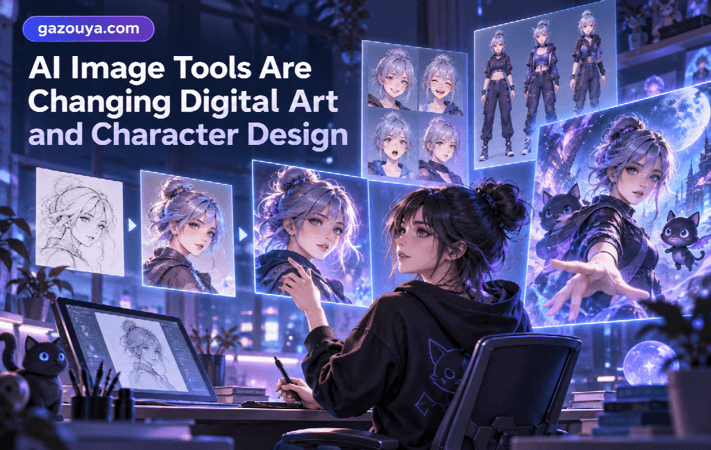
Small developers often struggle to find enough art for their projects. They might use a 立ち絵メーカー to create consistent character portraits for their games. The tool enables them to generate a number of different poses and expressions without having to hire a full art department. It aids in maintaining a uniform visual style throughout hundreds of different assets. This is a great advantage for those who want to tell stories but do not have the budget to employ custom illustrations.
Marketing experts and social media influencers also find these tools useful. They use AI画像編集 to enhance their photos and create unique branding materials. Rather than spending hours working in complicated photo editing software, they are able to alter the backgrounds or adjust the lighting by making just a few clicks. The ability to work so quickly enables them to post more frequently and helps to keep their audience engaged. As a result, people with either a smartphone or a computer can now access professional-quality visuals.
Real World Scenario 1: Indie Game Development
When people who make indie games come to the issue of art, they usually encounter a great obstacle. For example, a standard visual novel or role-playing game requires dozens of characters, each of whom needs different clothes, facial expressions and postures. Previously, this involved hiring an artist to produce hundreds of individual drawings, a process which could cost thousands of dollars and take many months to finish.
A solo developer can produce a basic character design in just a few minutes using AI tools. They can then use those same tools to generate different versions. For example, if a character is supposed to appear happy in one situation and sad in another, the AI can carry out that change. This enables the developer to concentrate on the story and the coding. It therefore puts small studios on a level footing with larger ones, since they can now make games that look just as good as those created by much bigger companies.
The fact that these tools offer consistent results is also a big advantage. If you give the AI a particular art style it will adhere to it. This stops the game from appearing as a haphazard assortment of different art pieces and instead gives it a refined and professional appearance that players appreciate.
Real World Scenario 2: Social Media and Personal Branding
Since the digital space is so crowded, content creators have to find ways to stand out and using stock photos any longer works because everybody else is doing the same. As a result, they are now employing AI in order to establish a distinctive visual identity; this allows them to produce custom avatars which perfectly represent their brand and also to create themed backgrounds for their videos or posts that suit their particular niche.
For instance, if a technology reviewer wanted a futuristic office background they could create one using AI rather than constructing a physical set. When the lighting in a photograph is poor, the reviewer can use AI to correct it. This avoids the need for expensive equipment and thus saves both time and money. It also enables greater creativity since the creator can place themselves in any setting they can imagine. The fact that they have this kind of flexibility helps them to keep their content new and interesting for their followers.
This technology also makes it possible to carry out quick tests. A creator can experiment with five different styles for a thumbnail in just a few minutes and then see which one looks the best before deciding on a final version. By using a data-driven method when it comes to artwork, they are able to speed up the growth of their channel.
Real World Scenario 3: Concept Art for Writers and Storytellers
It is common for writers to have clear images of their worlds in their minds yet find it difficult to convey them to others. Concept art plays an important role when trying to sell a book or a movie script. Previously, writers were forced to depend solely on written descriptions. Today, however, they can make use of AI to bring their worlds to life by generating landscapes, cities, and creatures that fit their descriptions.
This is particularly useful in the early phase of a project. The writer can produce twenty different designs of a dragon in order to decide which one suits their story best and then show these images to editors or producers so that they can get a better understanding of the intended vision. The pitch thus becomes much more convincing and it also helps the writer to remain inspired since seeing a character come to life on screen can lead to new ideas for the plot.
Tabletop gamers also make use of this for their campaigns. The Dungeon Master can produce a map of a frightening forest or a portrait of a mysterious villain. As a result, the game becomes more immersive for the players and transforms what would otherwise be a simple pen and paper game into a visual experience.
Benefits per Scenario
All of these situations illustrate the way in which AI addresses particular problems; the advantages involve more than just speed since they also consist in extending the range of things that a single individual can achieve.
| Scenario | Primary Benefit | Impact on User |
| Indie Games | Asset Volume | Allows small teams to build large games. |
| Social Media | Visual Identity | Helps creators stand out with unique art. |
| Storytelling | Visualization | Turns abstract ideas into clear concepts. |
For independent developers the main advantage is the ability to scale since they can produce a game featuring fifty characters rather than just five and this gives the world a greater sense of size and vitality. For people who use social media the advantage lies in the professional quality which enables them to compete with large brands even though they have a small budget. For writers the benefit is clarity as it allows them to communicate their ideas more effectively either to their audience or to their team.
Practical Workflow for AI Character Design
It’s not merely a matter of pressing a button to use AI for character design; instead, a particular method has to be followed if you want the best results. You have to know exactly what you want and also how you want it to look.
To begin with, you need a detailed prompt in which you describe the character’s age, the colour of their hair, what they are wearing, and their personality. You could also state the type of art style you want, for example oil painting or digital vector art. The AI will then provide you with a number of options and you select the one that best matches your vision.
Next, you adjust the image. Most AI programs give you the option of making minor modifications. For example, you may wish to alter the colour of the eyes or the shape of the hat. You can make these kinds of changes using particular editing features without having to alter the entire image. It is in this stage that your creative control is exercised. You act as the director and the AI functions as the artist.
Next, you finish off the asset; this could include increasing the image’s resolution to a higher one. It may also be necessary to eliminate the background so that the character can be used in a game or on a website. The last step is usually a manual inspection, at which point you could use a standard photo editing program to correct any small mistakes the AI had made. This combined method ensures the highest quality.
Comparison of Traditional and AI Workflows
It is helpful to see how much things have changed by comparing the old way to the new way.
| Task | Traditional Workflow | AI-Enhanced Workflow |
| Initial Concept | Manual sketching for hours | Text to image in seconds |
| Revisions | Redrawing parts of the image | Adjusting prompts or using masks |
| Style Matching | Requires high level skill | Controlled by style settings |
| Final Polish | Manual shading and lighting | Automated enhancement tools |
The traditional workflow is still valuable for learning the basics of art. However, the AI workflow is much more efficient for production. It allows you to spend more time on the big picture and less time on repetitive tasks.
The Future of Creative Tools
AI image tools aren’t going to replace artists; rather, they are providing artists with new methods of working. They’re similar to the shift from using paintbrushes to digital tablets. This represents just another stage in the evolution of creativity, and those people who adopt these tools will discover that they are able to do more than at any previous time.
There is now a change in the way things are viewed whereby the concept matters more than the technical aspect. Once you had a good story to tell, you didn’t have to rely on someone else to draw it for you; you can take control of the visual part of your project yourself. As a result, there is greater diversity of voices in the art and gaming fields.
The more advanced these tools become, the easier they will be to use. There will be greater integration among different kinds of software. It will be possible for a writer to produce an entire comic book from a script in just one afternoon. The potential opportunities are limitless. All you need to do is begin experimenting and see what you can make.
In the end, AI serves as a partner to your imagination. It handles the more demanding aspects of the creative process, which in turn enables you to investigate new ideas and extend the limits of what can be achieved. No matter whether you’re developing a game, establishing a brand, or writing a story, AI tools are available to assist you in your success. The age of digital creativity is undergoing change, and it is an exciting period to be a creator.
Popular on OTW Right Now!


About The Author

Gagan Bhangu
Founder of otechworld.com and managing editor. He is a tech geek, web-developer, and blogger. He holds a master's degree in computer applications and making money online since 2015.