
How AI Is Changing Micro-drama Production
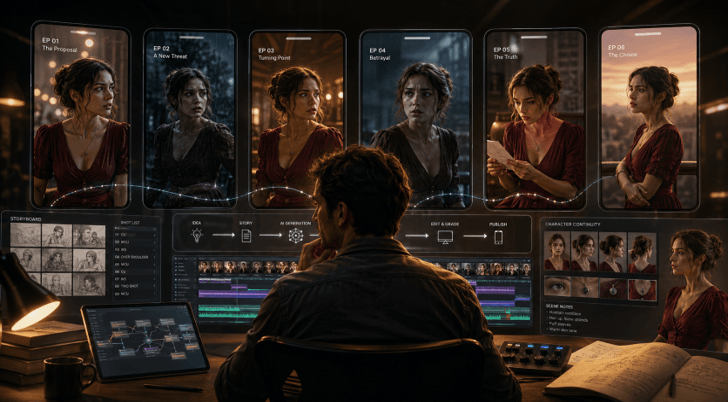
AI Micro-drama production is moving beyond isolated clip generation. A stronger workflow connects writing, visual planning, character continuity, scene creation, audio, and editing around one season plan, so creators can make more episodes without rebuilding the same creative decisions every time.
That’s important as the short drama app audience is expanding rapidly, growing by 115% YoY to reach $2.98 billion in in-app purchase revenue in 2025. There’s a huge opportunity here, but the stories have to be in series, with consistent characters, a consistent pace, and a familiar world.
But when used as a component of a filmmaking workflow, rather than as a clip machine, AI can be helpful. The best solution is to “lock” the story world, establish common terminology, segment the production into specific tasks, select models for each shot, and have humans sign off at each key decision point.
Why AI Micro-drama Production Is Changing
Microdramas are a quick way to make dramas. Episodes typically last between 1 and 2 minutes, are generally shot vertically for phones, and are shot quickly from some opening hook to an emotional shift and a cliffhanger.
AI does not remove those storytelling rules. It changes how a small team can execute them. A connected production workflow can help creators:
- Break a season into episodes, scenes, beats, and shots.
- Build cast and location references before final generation.
- Carry wardrobe, props, lighting, and spatial details across scenes.
- Create several takes for important moments so editors have choices.
- Coordinate voice, music, effects, and picture around the same episode plan.
It’s a simple concept. A season is NOT a random list of prompts. It’s one story world composed of linked decisions, and the production system must keep track of those decisions.
Start With a Locked Show Bible
The show bible ought to be the show’s truth. It can specify the premise, character relations, episode duration, frequented locations, visual style, clothing logic, and situation facts that must remain constant.
In AI Micro-drama, it’s important to lock these elements early to separate the creative process from execution. Writers and directors can set up the season in advance of the start of the large number of shots.
What to lock before generation
- Character appearance, clothing, expressions, and relationship notes.
- Recurring locations and how they look from key angles.
- Camera language, lighting direction, color treatment, and framing.
- Episode structure, including the hook, central turn, and cliffhanger.
- Planned story changes such as injuries, costume changes, or altered locations.
After a character sheet is approved, it should be used as a reference for any time that character is used. If the story alters the character’s look, save that as another approved state; don’t let visual changes occur when you don’t mean them.
Build Continuity Before Generating Episodes
One of the biggest challenges in serialized AI video is maintaining consistency across all the videos. One of the major problems in serialized AI video is that of keeping consistency throughout the videos. Even if the script doesn’t specify a change, a face can transform, a room can change shape, or a costume item can disappear.
The problem is solved in practice by adopting the concept of continuity as a production system. Lock and freeze cast views, locations, props, and visual rules, and create new scenes from the approved cast.
The Invideo agent-based workflow is demonstrated with a product like Invideo Agent. Its filmmaking method ensures that scripts, character sheets, locations, and creative concepts stay in the project context, allowing various production roles to work from the same memory. This makes the system relevant when multiple episodes require the same cast and world to stay consistent.
Along with a deeper filmmaking guide on how to use AI agents to produce microdramas, it also demonstrates how a season could be seen as a single interconnected film.
How to make Microdramas with AI Agents (Filmmaking Guide)
Track story states carefully
Continuity doesn’t mean keeping everything the same. When a lead takes a jacket, gets a scar, or changes their hair, record and agree that it is their new state! This allows AI Micro-drama production to be produced logically, and the director to determine the times at which the visual truth is changed.
Run an AI Micro-drama Production Crew
AI agents become more useful when each one has a focused responsibility, such as season planning, casting, scene breakdowns, cinematography, or editing.
Invideo Agent follows this crew-style approach. Its microdrama workflow lets several agents work from shared project memory while the director reviews the season episode by episode.
For an AI Microdrama, this means that the idea, scripts, show bible, cast, locations, and visual rules can remain linked with various agents working on the separate aspects of the casting, world building, shot planning, and episode production concurrently. This shared context keeps the cast, story world, and overall look consistent throughout the entire cut.
The newly released Invideo Agent two is a serious creative work frontier intelligence agent. It provides deeper project memory, expert agents to share updates, and the ability to read scripts, PDFs, videos, and reference documents to provide a new specialist agent with more context upon joining the project.
A practical crew structure might include:
- Showrunner: Holds season arcs, tone, and locked decisions.
- Episode director: Owns pacing and coverage for one episode.
- Casting role: Maintains approved character references and story states.
- Cinematography role: Plans lighting, camera behavior, and model choice.
- Editor: Checks pacing, continuity, sound, and cliffhanger timing.
What remains is up to the director’s discretion. The benefits are increased efficiency in lifting heavier loads in the same creative setting.
Route Models and Edit for Vertical
Video model requirements vary by scene. The different strengths of generations may be required for emotional closeups, action shots, longer shots, shots in reference mode, and complex movement.
For instance, Invideo Agent can upload videos to more than 200 models of pictures, video, audio, and music based on the shot’s requirements. When the director requires a specific model for a specific scene, they can select the behavior or appearance they want to achieve.
Seedance 2.5 supports a single pass from a single sentence to a 30-second 4K video. An AI Micro-drama scene can have up to 50 references, which can be used to keep characters, costumes, props, and/or location scenes steady over a longer dramatic beat.
Important shots should be covered so that the editor can select them and not have to edit around a poor performance. Before approving a shot, check:
- Does the character still match the approved reference?
- Does the location feel like the same space?
- Is the performance right for this story moment?
- Can the shot cut naturally with the surrounding footage?
- Do voice, ambiance, music, and effects support the intended emotion?
Vertical editing is used to create the episode for viewing on mobile devices. There’s more emphasis on faces in a tight frame, the reaction timing is important, and the cliffhanger should be preplanned. For AI Micro-drama, the edit is the point where created content turns into a storybook.
Conclusion: What Changes for Creators
Don’t forget that AI Micro-drama doesn’t replace the necessity of good characters, story structure, visual flair, or a strong and intriguing ending. What is the production capacity of a small team to coordinate?
A reliable workflow allows the show bible to be locked, a continuity build before large runs in generation, clear jobs for specialist roles, and automatic shot routing and editing of each episode as part of the same season. The greatest value of AI agents is to aid in recalling the project and organizing the work, while leaving story, taste, and final approval to the creators.
It would be useful to cast one episode with a locked world, then try the system in episode two to see whether it carried over. What would be your first choice to have AI take care of in your microdrama workflow?
FAQs About AI Micro-drama Production
What is an AI Micro-drama?
AI Micro-drama is a short episodic drama created using some or all aspects of generative video and other AI tools. Episodes typically are shorter and play best on mobile devices in a vertical orientation, and may last as little as a minute or two. The creation of a script, storyboards, character references, shots, voice, sound, effects, and editing can be aided by AI, but the creator still has the final say on the story and creative decisions.
How long should each episode be?
Many episodes can be 60-120 seconds long, due to the format’s single, focused dramatic beat. The length of the run time should still adhere to the story. The first couple of minutes should be filled with a level of tension or some change or a quick reveal, and the end should be set with a clear question, interruption, reversal, or an emotional decision that solicits the next episode.
How do AI tools keep characters consistent?
References are best done if creators approve prior to creating final scenes. Those references may be the front, side, facial, wardrobe, and expression views. Later episodes can then draw upon the approved source because it is a shared context. If a character’s appearance changes in the story, record a new state, and then the other scenes will proceed with that change, rather than with random shifts.
Can a small team produce a season?
Yes. There are several tasks that are happening concurrently, and a small team can break the work into repeatable tasks. One could control the season bible, another could run the review episodes,s while the rest of the workflow continues for scene generation. While AI agents can reduce the need for repeated briefing, the team still needs approvals, organized assets, continuity checks, and editorial judgment to ensure the finished season is coherent.
Which AI video model is best?
There is no single right answer. There are several types of shots, each having their own advantages and disadvantages when it comes to emotion, movement, reference continuity, and longer dramatic takes. Creators should choose based on the shot they are aiming for, character stability, character movement, camera control, audio requirements, reference assistance, and natural placement within the shots.
Does AI replace the director?
While AI can assist with planning, offer suggestions, monitor project progress, and manage production duties, human oversight remains crucial in directing the project. The director determines who the story is about, how the show should be experienced, which visual “rules” matter, and what belongs in the cut. AI can be most effective when it increases production capacity without sacrificing creativity.
Popular on OTW Right Now!


About The Author

Gagan Bhangu
Founder of otechworld.com and managing editor. He is a tech geek, web-developer, and blogger. He holds a master's degree in computer applications and making money online since 2015.