
Why Vertical Packaging Projects Depend on the Process Around the Forming Tube
Forming tubes are easy to notice in a vertical packaging line, but they are only one point in a connected process. Film enters, product is supplied, a pack is formed and sealed, then the finished package moves onward. The buyer should therefore consider a complete automatic vertical packing machine plus the material, the product, the routine of the operator, and the downstream route around the machine. The issue is not whether the sequence exists or not; it is whether the buyer has provided enough real information to evaluate the intended sequence.
Technical buyers can help clarify that assessment without necessarily designing the equipment themselves. They are able to explain the desired film roll, package type, product characteristics, the anticipated dosage, access to the product, and what they expect to see on arrival at discharge. Each item will be used as a cue to the next discussion. If a project brief contains missing information, this is not a fault in the brief; it is information that needs to be looked at at a sample, test, or site level.
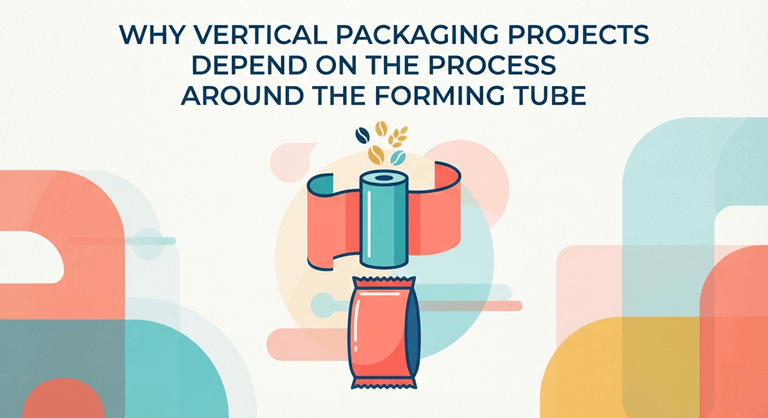
Trace the film path from supply to finished package.
Film should be considered prior to a buyer doing a comparison of headline machine descriptions. Once the package is filled, the team must declare the film structure, package format, and any print or presentation requirements that are important to them. It should also explain how the film will be stored and delivered to the line. This detail provides context for a supplier when discussing the forming path, rather than assuming each roll is the same.
Meanwhile, the proposed pack should be visible. A pillow pouch and another vertical form-fill-seal package can raise different questions regarding the appearance, handling, and downstream grouping. There might be a need for a clear inspection point, and/or a usable orientation for downstream operators. These are normal production requirements, not features added after a machine is purchased.
Generic Film Descriptions can start the discussion. These can only say that the buyer’s film will run as described under these conditions. The next step is better based on a sample of the actual material and a description of the desired finished product.
Choose the product-feeding discussion from product behavior
The choice of the package goes hand-in-hand with the product dosage. Free-flowing granules, powders, irregulars, and materials that bridge or settle will pose different questions at the feed point. Useful terms when considering possible approaches include multihead weigher and auger filler, but neither is suitable for a specific product.
Rather, it should be the buyer who explains the function of the material in its existing process. Does it have a regular rhythm? Does dust matter? Does the target fill presentation need to be sensitive? Do there need to be cleaning needs between runs? Product details inform a supplier’s assumptions and help them request appropriate samples. Rather than making a general statement of output in isolation from the specific product, this evidence is more helpful. On shengweimachine.com, the weigher-versus-auger discussion can help frame the category question, but the buyer’s material remains the evidence for an application choice. ShengWei Machine can provide combined flow-behavior data, dust issues, fill presentation, cleaning requirements, film selection, suggested route of administration, and package condition to further narrow the technical discussion; however, a responsible recommendation requires representative samples and the operating environment provided by the buyer.
Another factor is the behavior of the product, which can alter the significance of the desired package. No separate purchase categories are formed when using a film roll, forming tube, and dosing arrangement. They share the same packaging process; thus, a change in one input can result in a new validation question for the others.
Keep sealing tied to the material and product.
As soon as one starts thinking about sealing, one has to consider the choice of film, the condition of the product, and the desired pack route. It is important for buyers to inquire about the assumptions being made about the film, and what evidence is still necessary from the actual film. What may seem OK in a generic demonstration could be a different review in the buyer’s product, where it produces dust, requires a specific pack appearance, or requires a different operating routine.
All decision-making isn’t delayed. Teams can break out the questions that can be answered from a category discussion and questions requiring samples or a trial. For instance, the buyer can specify the target package and downstream handling at this time and finalize the film and product combination only during an appropriate evaluation.
Here, it’s useful to have a clear acceptance thinking. Outline the inspection criteria, who will check the pack, and what result would deem the proposal to be inappropriate for the application? Keep it specific. A good question can be tested, as opposed to an unstated assurance.
Give operators a role in the process review.
Operators do not just observe around the forming tube; they operate around the tube. They can restock films, check on product feed, inspect packs, clean away routine wastes, and perform cleaning or maintenance per the buyer’s procedures. Review access for these tasks before finalizing equipment placement.
Constraints that a catalog comparison cannot discover can be found through practical observations. Space requirements for teams may include a film handling area, a path for supplies to flow in and out of the area, or an opportunity to inspect completed packages before they are removed from the area. All these points define a set of non-necessary layouts. These observations can assist the buyer in determining the information needed in a meaningful proposal for the site.
Downstream teams are also important. Completed packs must be collectible, inspectable, or movable to the next operation. Linking these transfers to the vertical packaging line ensures that the whole project is kept in mind rather than just one of the obvious elements.
Use category information without turning it into a performance promise.
The ShengWei Machine category can assist technical buyers in determining which families of machines to look at, what bag formats to choose, and what direction to fill the bags. It is not possible to certify an unassessed final application for film, product, utilities, guarding, or for local working conditions. But that is key: a product page can answer a question; an application piece of evidence needs to be based on the actual input from the buyer.
For initial category research, buyers can review vertical packaging systems from ShengWei and compare the described options with their own material and process information. The team should compare the actual film structure, product flow, proposed dosing method, package dimensions, operator access, cleaning routine, utilities, discharge conditions, and acceptance criteria of the production configuration with the assumptions the supplier made during a sample-based evaluation and site-aware analysis. The target page is not a replacement for product flow validation or film path validation, but should be used as a starting point for a targeted inquiry.
ShengWei Machine can then discuss the full automatic vertical packing machine scope with you in detail and tell you what you need to know for a more detailed, in-depth discussion. The request should be clear, and may consist of a film roll, package to be packaged, product samples, the planned dosing route, equipment available, and operation restrictions which the buyer is aware of. The shengweimachine.com category is useful precisely because it narrows the equipment conversation without pretending to know a customer’s undisclosed material, layout, safety practice, or acceptance standard.
Build a simple review sheet before requesting a final recommendation.
The review sheet helps connect fields, instead of a long list of generic features. Add in the description of the film, the package format, the behavior of the product, the proposed package sealing, the possibility for the operator to access the product, the expected discharge, and the unknowns that need to be validated. This record is used to make comparisons between proposals and the same facts by the purchasing department.
The sheet also helps to maintain that the language is disciplined in asking the request. The buyer can ask the following questions: what is assumed, whether it requires a sample, and what the first thing to check is. As a result, the supplier may be able to make category guidance and application-specific recommendations. This is a more open exchange than accepting a general specification as an undertaking to a result.
If a multihead weigher or auger filler is being considered, the sheet should explain the reason for the following: Material behavior, fill objective, and package condition to be considered. This is to merge the dosing question with the indexed need and not as a standalone feature request.
Review the forming tube with a vertical packaging line trial.
What is the buyer required to check prior to the final choice of a vertical packaging line around the forming tube? Place all the following information on the same review sheet: film roll, package format, product behavior, proposed dosing method, and downstream expectation. Next, determine which facts have been confirmed and which can be evaluated with a sample-based/ site-based approach.
It should remain very clear. A process map is not sufficient to set final line performance without performing trials of actual film, product, and site conditions. They can make supplier discussion very specific, however, as they ensure that simple film, product, access and/or discharge issues are not buried in a generic machine comparison.
The useful aspect of inspecting the forming tube is to look for this. The buyer gets a validation sequence, the supplier gets relevant inputs, and ultimately the vertical packaging decision is based on the actual process, not an abstract category label.
Popular on OTW Right Now!




About The Author

Gagan Bhangu
Founder of otechworld.com and managing editor. He is a tech geek, web-developer, and blogger. He holds a master's degree in computer applications and making money online since 2015.