
Drum Practice Basics: Building Steady Time With a Click
Good drumming isn’t all about fast fills and all sorts of complex patterns. One of the most important things you can do as a drummer is to keep time. If you’ve got good time then your band can play with confidence.
This is where practicing with a click can be useful because it helps you hear when you are speeding up or slowing down. It may feel difficult at first, but regular practice with an online metronome will make your grooves more controlled and comfortable.
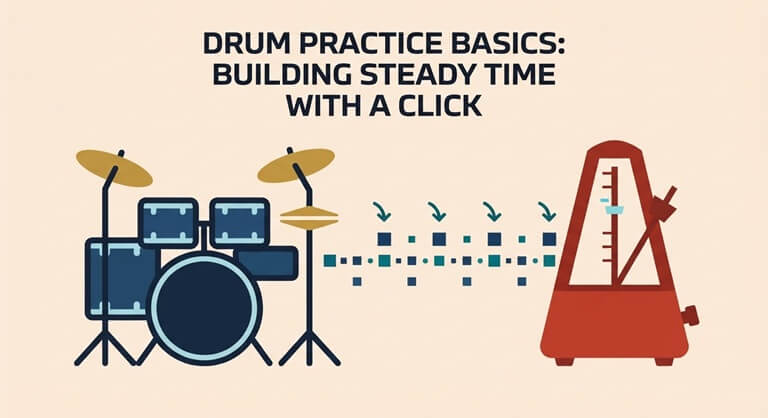
What Does Practicing With a Click Mean?
A click is a steady sound that marks the beat. It’s generally the sound of a metronome, a music app, a DAW or an electronic drum kit.
The speed of the click is in beats per minute. At 60 BPM you’ll hear one click per second. At 120 BPM the clicks are coming in double the speed.
When you’re practicing with a click, try and line each drum hit up with the steady pulse. Don’t wait to react to the sound. As you get into it you’ll start to anticipate the next beat and play with it, which is the way you build up your internal sense of time.
Why Is Steady Time Important for Drummers?
The drummer provides the band with the rhythmic bed. The rest of the band (bassist, guitarist, keyboard player and singer) will often be relying on the drums to know where the beat is.
If the drummer is speeding up in a chorus or slowing down in a tricky fill the whole band may well follow. Small tempo changes can be intentional of course, but they should be musical choices rather than accidents.
Start With a Comfortable Tempo
Beginners tend to set the click too fast as slow practice looks far too easy. In fact slow tempos can be more difficult as there’s more space between the beats.
Start at around 60 to 80 BPM. Find a speed at which you can play without feeling tense or confused.
You can open an online metronome, pick your tempo and just listen for a few seconds before you start playing. Count out loud with the clicks:
“One, two, three, four.”
Next play quarter notes on the hi-hat (one note to each click) and leave the kick and snare out for now.
Listen carefully. Are your notes on the click, or are they a bit early or a bit late?
Build a Basic Groove Step by Step
Once your hi-hat feels steady, add the other parts of a simple rock groove.
Use this order:
- Play quarter notes on the hi-hat.
- Add the bass drum on beats one and three.
- Add the snare drum on beats two and four.
- Continue for one or two minutes without stopping.
Keep the groove simple to make every beat feel even.
If you lose the click then just stop and listen again. Count out one full bar before you start playing. Don’t try to play any faster or any louder to make up for it.
Move From Quarter Notes to Eighth Notes
Once you’re comfortable with quarter notes, try dividing each beat into two equal parts.
Count:
“One and two and three and four and.”
Play the hi-hat on both the number and the word ‘and’. Bass drum on one and three, snare on two and four.
The click still defines the main beats. Try and space the extra hi-hat notes evenly between each click.
This exercise is about subdivision and that’s important because a lot of drum grooves and fills will have notes that fall between the main beats.
Practise Without Hiding the Click
It’s so easy to drown out the metronome with a lot of drumming, you can’t actually check your timing if you can’t hear the metronome.
Play quietly enough so you can actually hear both your drums and the click. Good isolation headphones will help considerably, particularly if you’re using an acoustic kit. Protect your hearing and keep the click at a safe level.
Electronic drum kits make volume control a lot easier as you can hear the kit and metronome through the same pair of headphones. Many of them will also have a built in click.
Try to get the sound balanced so the metronome is audible but not too loud.
Learn to Make the Click Disappear
When your timing is spot on, your drum hit and the click can effectively become one sound. Some drummers refer to this as getting the click to disappear.
This doesn’t mean the metronome has stopped, it just means your note is so close to the click that the two sounds are effectively overlapping.
Try it first on the snare. Go slow and play one snare hit with each click. Listen to see if you can hear two distinct sounds.
Add Fills Without Changing the Tempo
Lots of novice drummers can maintain a solid groove but will invariably speed up in the fills. This is usually down to them focusing on the pattern and losing all sense of the beat.
Play 3 bars of a simple groove followed by 1 bar of a basic fill and then back to the groove on beat one.
Keep the fill simple. E.g. play eighth notes around the snare and toms. The whole point is to get back to the groove on time.
If you’re coming in early or late, try a simpler fill or just slow the tempo. A simple fill played in time is far better than a complicated fill which will throw the song completely off.
Use Short Click Exercises
You do not need to spend your full practice session with a metronome. Ten focused minutes with a simple routine can be enough:
- two minutes of quarter notes;
- two minutes of eighth notes;
- three minutes of a basic groove;
- three minutes of grooves with simple fills.
Stay at one tempo until the exercises feel comfortable. Then increase the speed by two to five BPM.
Small increases allow your technique to develop without losing control.
Final Thoughts
Practicing with a click helps the beginner drummer to develop a good sense of time, better grooves and more reliable fills. Begin with simple patterns, listen carefully and gradually increase the tempo.
With regular metronome practice, you’ll build a stronger internal pulse and feel more confident playing with others. Don’t worry if following the click is tough at first. Your timing will get better the more you practice.
Popular on OTW Right Now!



About The Author

Gagan Bhangu
Founder of otechworld.com and managing editor. He is a tech geek, web-developer, and blogger. He holds a master's degree in computer applications and making money online since 2015.