
Why Traditional Risk Management Fails Modern Businesses and How to Fix It
In 1973, safety engineers studying industrial fires found a strange human weakness: when business owners assess physical hazards, they address obvious risks such as theft or broken glass while ignoring unlikely but high-impact disasters. The reason for sudden and severe losses is seldom a failure to be careful, but rather an error in calculating how physical assets will recover following a disruption.
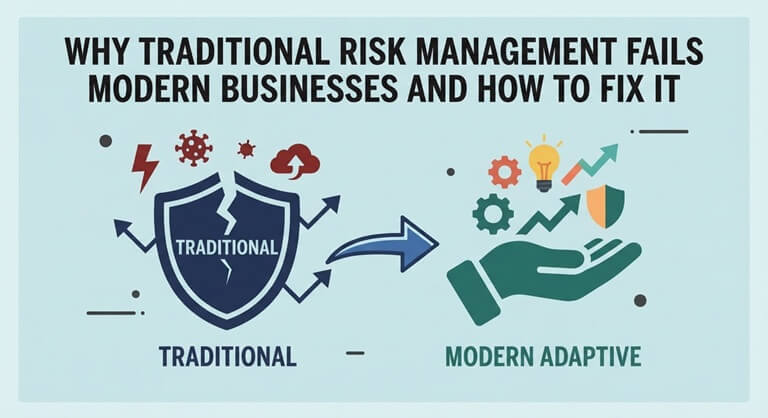
When operating a physical workplace or retail venue, protecting your infrastructure requires more than basic precautions. Securing tailored Commercial Property Insurance allows enterprise owners to safeguard real estate, machinery, and inventory against unexpected operational halts, turning a passive safety strategy into an active financial buffer.
The Misleading Comfort of Book Value
It is commonly believed by executives that determining asset coverage by referring to historic purchase prices or the accounting book value is a sensible and conservative method. The reasoning seems reasonable in that if a piece of machinery cost fifty thousand dollars three years ago, then that amount appears to be a dependable basis for financial protection. In reality, though, this belief leads to a hazardous valuation gap.
After a major event has taken place, you won’t base asset replacements on last year’s prices. Supply chain inflation, special shipping rates, and today’s installation costs usually mean that the actual cost of replacing assets is between twenty and thirty per cent higher than the historical accounting figures. If you insure according to past balance sheets rather than using current market replacement rates, your business will find itself unexpectedly short of funds when a major recovery occurs.
The Hidden Illusion of Deductibles
When choosing policy parameters, there is usually a trade-off that standard guides do not explain very well. Most of the advice out there is to select the lowest possible deductible in order to minimize the amount you have to pay out of pocket if a claim is made. However, in practice, setting a deductible that is too low increases your fixed monthly costs, tying up capital which could instead act as a flexible operating buffer.
The key to a more intelligent financial position is your liquidity reserves rather than emotional comfort. Since your business has a healthy working capital buffer, choosing a higher deductible will result in considerably lower fixed premiums over time. You keep your capital during ordinary operating years and use the savings thus obtained to build up real operational resilience rather than paying extra for protection against small claims.
Applying the Reinstatement Margin Rule
In order to avoid expensive coverage gaps without having to pay too much in premiums, use a structured decision framework when assessing your physical plant and equipment. Instead of making a guess about your exposure, apply the reinstatement margin rule:
- Each year, audit the costs of replacing the equipment by using current quotes from vendors instead of the depreciation schedules shown on the balance sheet.
- Work out the longest period that your business could go without your main operating facility while it is undergoing a major rebuild.
- Set your policy’s indemnity limits so that they include coverage for replacing physical assets as well as for the ongoing fixed operating expenses during that period of downtime.
Accounting for Consequential Business Interruption
A frequent mistake made by companies that are expanding is to regard physical damage as a one-off occurrence. Although inventory loss from water damage may initially seem like only a small part of the overall economic damage, the bigger problem is the ongoing loss of revenue while operations remain halted.
Effective physical asset protection has to take into consideration the wide-ranging consequences of operational downtime. It can take six months or more to rebuild a facility or to obtain specialized replacement hardware. When a risk plan protects physical structures but fails to address ongoing payroll costs, lease obligations, and vendor contracts during an outage, a temporary disruption can lead to permanent insolvency.
Aligning Asset Protection with Growth
A protection strategy must never be regarded as a static document stored in a filing cabinet; instead, your risk profile changes dynamically as the business grows, opens new physical locations, or upgrades its technology stack.
Checking your operational footprint regularly lets you include on your balance sheet any assets you have recently acquired, tenant improvements, and specialized equipment. If you match your physical security measures with the present economic conditions, you can guarantee that your capital will stay safe even in the face of unexpected disruptions.
If you go beyond standard policy forms, managing physical exposure is not about dreading the worst-case scenarios; it’s about understanding the real cost of continuity and building a business that can absorb shocks. Once you substitute outmoded assumptions with definite evaluation rules, you turn asset protection into a steady source of long-term stability.
Popular on OTW Right Now!


About The Author

Gagan Bhangu
Founder of otechworld.com and managing editor. He is a tech geek, web-developer, and blogger. He holds a master's degree in computer applications and making money online since 2015.