
Why Agentic Workflow Systems Are Becoming the Next Evolution of Business Automation
For years, automation promised efficiency.
Businesses adopted:
- workflow tools
- task automation software
- CRMs
- AI assistants,
- integrations,
- analytics, and dashboards
The expectation was simple:
More automation would create smoother operations.
In reality, many organizations ended up building fragmented systems that still required constant human coordination.
Tasks became automated.
Decision-making did not.
Workflows moved faster.
Operational complexity increased alongside them.
This is why a new operational model is beginning to gain attention across startups, SaaS companies, and modern growth teams:
Agentic workflow systems.
Unlike traditional automation, agentic workflows are designed not only to execute predefined actions but to operate with contextual awareness, adaptive logic, and autonomous decision-making capabilities across connected operational environments.
And increasingly, businesses are realizing that this shift may fundamentally reshape how modern operations are structured.
Traditional Automation Was Built Around Static Logic
Most automation systems today still operate on fixed triggers.
If X happens, do Y.
For example:
- If a lead fills out a form, send an email
- If a payment is received, update the CRM
- If a support ticket appears, assign it to a team member
These workflows improve efficiency, but they remain dependent on rigid conditions and human oversight.
As the business becomes more complex, the static system starts to put limitations:
- fragmented execution
- disconnected tools
- workflow bottlenecks
- operational blind spots
- repetitive human coordination
The problem is not automation itself.
The issue is that many workflows don’t have any operational intelligence.
What Makes Agentic Workflows Different
Agentic workflow systems have a new way of operating.
These systems are becoming more and more designed to:
- interpret context
- adapt workflows dynamically
- coordinate across multiple systems
- Prioritize actions intelligently
- assist with decision-making
- execute operational tasks autonomously
This distinction matters.
Traditional workflows automate tasks.
Agentic workflows orchestrate operational processes.
That may seem like a small change, but it’s a huge change from an operational perspective.
An agentic workflow can:
- Evaluate incoming data
- determine next-best actions
- coordinate multiple tools simultaneously
- adjust outputs dynamically based on changing conditions
without any constant human intervention.
This means much more operational flexibility than that of static automation chains.
Why Businesses Are Moving Beyond Basic Automation
In today’s world, the context of business organizations is:
- multi-platform
- AI-assisted
- remote-first
- data-heavy
- increasingly asynchronous
The number of moving parts has increased significantly over the past few years.
A start-up now may have to deal with the following:
- CRM systems
- customer support platforms
- AI content workflows
- analytics dashboards
- sales pipelines
- communication systems
- onboarding workflows
- campaign attribution infrastructure
It’s not that they don’t have software.
The problem is how to coordinate the operations of the systems.
That’s one of the reasons agentic workflow architecture is becoming a hot topic for modern businesses.
Enterprises are starting to see that orchestration is now a key factor in their operational scalability, not automation.
The Shift From Tool Stacking to Workflow Intelligence
For years, startups solved operational inefficiencies by adding more tools.
Need better communication?
Add another platform.
Need reporting?
Add another dashboard.
Need automation?
Add another integration.
Over time, many organisations developed operational ecosystems that were too disjointed, with teams spending more time wrangling software than doing something worthwhile.
That’s where workflow intelligence comes in handy.
Agentic systems save the need for frequent manual coordination by embedding adaptive operational logic in the workflows.
Agentic workflows are different from the tools you find in isolation—they provide a dynamic environment for operation, with information and actions passing back and forth among workflows.
This helps to minimize friction and ensure consistent execution.
Operational Speed Alone Is No Longer Enough
For years, startup culture emphasized speed above everything else.
Move faster.
Ship faster.
Automate faster.
However, it’s important not to rush into things without some operational clarity; there will be greater inefficiencies down the road.
However, a new challenge is at hand for many businesses;
Ensuring the quality of execution in scaling up the complexity of operations.
In this respect, agentic workflow systems can prove very useful.
This doesn’t just mean automating repetitive tasks.
The objective is to create operational ‘ecosystems’ that can:
- adaptive execution
- intelligent coordination
- scalable orchestration
- workflow optimization
- contextual decision support
This will result in much more robust operating systems.
Why AI Is Accelerating the Rise of Agentic Systems
Previously, large teams were necessary for tasks that could be supported or automated with AI systems.
AI doesn’t necessarily lead to operational intelligence.
When there is no structured workflow orchestration:
- AI outputs remain fragmented
- Operational visibility weakens
- Teams still manually coordinate processes
- execution becomes inconsistent
That’s why workflows that involve agents are becoming more and more significant.
They develop working systems in which AI-based systems can dynamically engage with processes, rather than being used as stand-alone productivity devices.
This is becoming more and more meaningful on the following levels:
- SaaS operations
- customer support
- marketing automation
- internal business systems
- onboarding processes
- reporting infrastructure
AI usage is expected to be most successful when the businesses using it are doing so strategically rather than tactually, in their operational systems.
The Rise of Autonomous Operational Infrastructure
Among the most notable trends in today’s startups is the trend towards an autonomous operational infrastructure that is autonomous.
Businesses are increasingly designing systems capable of:
- self-routing workflows
- prioritizing operational actions
- adapting to incoming conditions
- coordinating cross-platform execution
- reducing repetitive administrative oversight
This will cut down on the operating drag considerably.
While teams continue to work, the workflow automatically becomes more operationally intelligent, instead of teams spending time on manual process management.
Organizations implementing scalable agentic workflows are increasingly improving execution consistency while reducing operational fragmentation across complex business environments.
The long-term value is not just productivity.
It is the ability to change. It is the adaptability of operation.
Agentic Workflows Will Change How Teams Scale
Traditionally, that meant hiring more people!
As businesses expanded, there was a need for:
- more managers
- more coordinators
- more administrators
- more operational oversight
This can radically change if the agents are able to take over that role.
Intelligent workflow orchestration empowers lean teams to work much more effectively.
Rather than simply tackling a headcount increase to handle increased operational complexity, businesses can increasingly create a workflow that can:
- autonomous coordination
- dynamic prioritization
- contextual execution
- operational visibility
Don’t worry about human teams; this doesn’t get rid of them.
It alters the focus of men.
Teams can spend more time on: Rather than repetitive coordination work, teams can focus on:
- strategy
- creativity
- decision-making
- customer relationships
- innovation
Why Operational Intelligence May Become the Next Competitive Advantage
With the increasing penetration of AI, having access to the tools will no longer give a sense of differentiation.
Eventually, most companies will be equipped with such software.
The competitive advantage may instead shift toward operational intelligence.
How effectively can a business:
- coordinate workflows
- reduce friction
- adapt processes dynamically
- integrate AI operationally
- scale execution efficiently
This is where agentic systems create strategic value.
Businesses operating with intelligent workflows may gain advantages in:
- execution speed
- operational consistency
- scalability
- resource efficiency
- organizational clarity
Over time, these operational advantages compound significantly.
The Future of Business Operations Is Becoming System-Driven
The expression “modern operations” will undoubtedly be very different than the old model of operations management.
Businesses are moving toward environments where:
- workflows adapt dynamically
- AI coordinates execution
- Systems communicate contextually
- Operational visibility becomes centralized
- Repetitive coordination decreases
This transformation is nascent, but it’s picking up speed in all technology, SaaS, startup, and enterprise arenas.
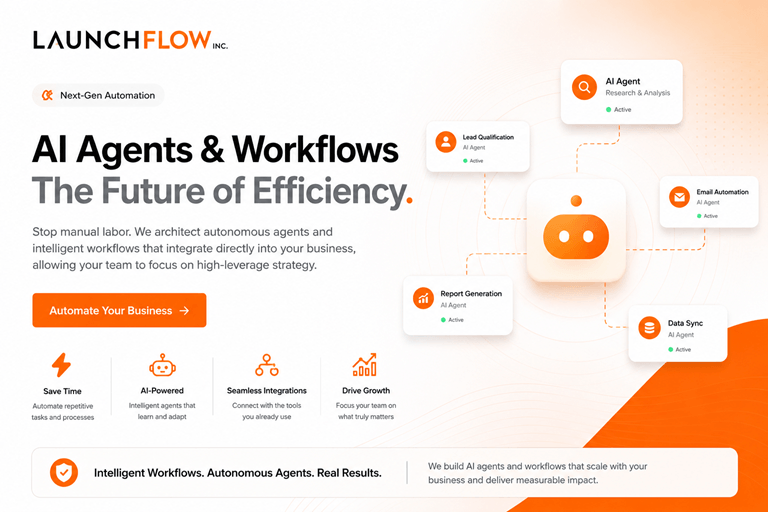
Organizations like Launch Flow Inc reflect this broader transition toward operationally intelligent business infrastructure, where AI agents, workflow orchestration, and adaptive systems work together to support scalable execution.
Because increasingly, the companies that scale most effectively may not be the ones with the largest teams or the most software.
They could have the most intelligent workflows of anyone.
Popular on OTW Right Now!
-
 GDPR Article 27 EU Representative Services for Australian and Indian Entrepreneurs – 2026 Guide
-
 What Makes Overdraft Loans a Smart Choice for Small Businesses?
-
 Why Reliable IT Support Matters More Than Ever for Modern Businesses
-
How to Know When Your Business Has Outgrown Bookkeeping and Needs a Fractional CFO



About The Author

Gagan Bhangu
Founder of otechworld.com and managing editor. He is a tech geek, web-developer, and blogger. He holds a master's degree in computer applications and making money online since 2015.