
How RPA in Manufacturing Is Quietly Changing Factory Operations
Manufacturing has always worked under pressure. Timelines are tight, margins are tighter, and every delay has a way of showing up somewhere else, whether that is on the shop floor, in procurement, in inventory, or in customer delivery.
When people talk about automation in manufacturing, the conversation usually goes straight to robots, sensors, connected machines, and smart factories. Those matters, of course. But a lot of the everyday friction manufacturers deal with is not happening inside the machine. It is happening around the process.
There is an outstanding purchase order to be created. An invoice should be matched with the receipt. Stock updates have to be entered in two places. The quality report must have information from 3 systems. One person must download a spreadsheet, clean it up, and email it, and repeat the process every week.
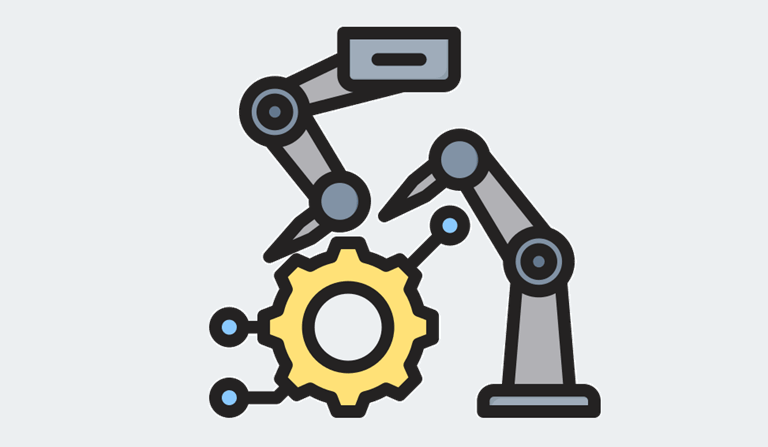
That’s where manufacturing RPA can help.
Automated Rules-Based Tasks Across ERP, MES, QMS, Warehouse, Finance, Procurement & Compliance Using RPA. It does not require manufacturers to switch to different systems that they already rely upon. It spans over them, eliminating manual work that slowly enters daily life.
What RPA Really Means in Manufacturing
RPA is often confused with physical robots on a production line, but that is not what we are talking about here.
RPA in the manufacturing industry refers to software automation. It uses bots to carry out repetitive tasks that people usually perform inside business systems. A bot can log into an application, extract information, enter data, move a file, generate a report, send a notification, or trigger the next step in a workflow.
To the manufacturers, this is a major issue since most plants operate on more than one integrated system. Typically, there’s an ERP at the heart of all things, a warehouse system for inventory, a QMS for quality, a CMMS for maintenance, perhaps a procurement tool, a finance system, a supplier portal, a customer portal, and a ton of spreadsheets in between.
If these systems do not communicate effectively, then individuals are a “bridge”. They duplicate the data, review it, upload it, reconcile it, follow up, and repeat it each day.
RPA reduces dependency. It provides a useful “automation abstraction mechanism” between systems, particularly where an entire system integration might be prohibitively costly, slow, or simply not worthwhile for the task at hand.
Where RPA Removes the Friction
Here are the top areas where RPA can reduce manual effort and improve day-to-day manufacturing workflows.
Procurement and Supplier Management
Each new supplier is accompanied by documents. Business registrations, tax information, bank details, certificates, approval documents, compliance records, and contract information.
A lot of this is still manually checked and entered into many manufacturing companies. This will also cause delays, re-checking, and an increased risk of something being missed.
Your procurement team can do so much more than validate address fields or follow up on missing attachments.
RPA bots can be used to capture supplier information from documents that are submitted, flag missing information, validate information against internal rules, and add supplier profiles to the ERP. Purchase Orders and Contracts can also be created from templates and sent for review.
This is not to take away from procurement judgment. It eliminates the tedious administrative tasks enveloped in it, which leaves procurement professionals free to concentrate on supplier performance, sourcing pricing, supplier risk, and negotiations.
Inventory and Warehouse Operations
Issues with inventory tend to escalate in a stealth manner.
A day late delivery note is created. An adjustment to the stock that is not made. One system displays a number that has not been reflected in another system. There is no reporting of stock being down, and so a replenishment request is delayed.
Once the issue is in the planning/ production phase, there’s already a cost involved.
RPA bots can utilize OCR to read delivery documents, get the right details, and update inventory systems more quickly. They can be integrated with warehouse, ERP, and inventory applications, alert flagged records, and send replenishment requests when predetermined levels are met.
This leads to more visibility, fewer blind spots, and less time spent firefighting inventory problems that might have been identified earlier.
Accounts Payable and Invoice Processing
Consideration should be given to what occurs between the arrival of the supplier’s invoice and payment.
Someone opens it. They confirm the PO number. They can search for the purchase order in the ERP. They are responsible for confirming the goods receipt. If the numbers are the same, they send it for approval. If they don’t, then they send an email to someone, wait for an answer, and then repeat the process again.
Now times that by all suppliers, freight, utility bills, service charges, and recurring payments.
This is what can consume your finance team, but they’re capable of more.
RPA bots can extract information from invoices, categorize the documents, perform two-way or three-way matching, and send exceptions to the correct user with the correct context. Invoices are automatically processed when they are clean. Exceptions still go to people, but with the work done already.
This minimizes the double payment, late approvals, vendor follow-up, and manual finance reconciliation process.
Quality Assurance and Compliance Reporting
It’s important that quality teams act on reports, rather than spending hours creating them.
The inspection results can be stored in the QMS. Production data can be provided in MES. Batch records can be stored in ERP. Supporting documents can be lost in email folders, shared drives, or spreadsheets.
It’s someone who has to assemble all of that, clean it, format it, check it, and send it out to create one report. The following cycle is then the same work is repeated.
RPA can do that reporting in an automated way.
Bots can gather data from the proper systems, fill in authorized templates, arrange regular reports, and deliver them to the suitable regulatory or internal groups on time.
This is even more important for regulated manufacturers. Consistency, traceability, and minimal manual work for reporting make audit readiness easier to maintain.
Equipment Maintenance Coordination
Downtime should be managed, but the management of scheduled downtime can also be a burden if it is not coordinated manually.
Work orders need to be created. Preventive activities must be timetabled. Technicians need reminders. Work completed should be documented. Priority requests must be directed towards the appropriate individual.
There’s no need for great engineering skill for this, but it does take time. Failure to follow these steps will manifest itself in the performance of the equipment, compliance records, and reliability of products.
The RPA bots can create work orders, schedule maintenance jobs, send reminders, update maintenance records in the CMMS, and prioritize work requests based on the rules set.
The technical decisions are still up to the maintenance teams. They just have to deal with the paperwork of the work less.
Order Management
As the volume of orders increases, the manual work that goes into order management increases as well.
So there has to be someone who has to check order details, price with the contract, inventory, update the order management system, inform the production team, and confirm with the customer.
Even seasoned teams can run into trouble when orders are received simultaneously via emails, PDFs, portals, EDI files, and customer forms.
The first level of processing can be achieved by RPA. Customer order processing is possible with bots, which can read in the orders, take out the necessary data, validate the information against the terms of the contract, update the system, and provide confirmations.
If it doesn’t match, it will be sent to someone to be looked at. Standard orders are faster than normal orders. People look at exceptions, talk to customers, and consider context.
When Standard RPA Is Not Enough
Traditional RPA is suitable for processes that are predictable and the inputs are regular. Clearly follows rules and is useful for repeatable manufacturing processes.
Production methods can’t always be so neat.
Emails in which suppliers communicate with you differ from one another. Each customer’s order comes in a different format. Free-text comments are considered quality notes. Requests for maintenance may be incomplete. If the input doesn’t follow the rules, a rules-based bot can have trouble.
That’s where agentic automation comes in handy.
Agentic automation is a combination of RPA and AI that enables systems to interpret unstructured information, understand context, make recommendations, and make decisions in a defined set of guardrails.
A regular bot is mapped in a specific map. An agentic system can be used to deal with incomplete maps.
When suppliers, customers, documents, or plants vary significantly, it opens the door for an automation opportunity that is not always possible to capture with RPA.
Is not an RPA alternative. It takes automation to the next level when the rigid rules are stretched to their limits.
What Manufacturers Often Get Wrong
While RPA can take a considerable amount of the drag from operations, it’s not a magic bullet. One of the prime causes of underdelivery of automation projects is treating it like one.
Automating a Broken Process
Automation won’t solve a non-standard or poorly-documented workflow. It will just perform the same inconsistencies at a higher speed.
Manufacturers should standardize the process, establish the desired route, and record what to do in case of exception before introducing bots.
Underestimating Legacy System Complexity
There are still many manufacturing operations that rely on legacy ERP, MES, AS/400, or custom systems. These environments are compatible with RPA, but some custom connectors, middleware, screen-level automation, or workflow design might be needed.
Before signing on to deadlines or ROI promises, it is crucial to get a realistic estimate of the existing landscape.
Skipping Change Management
When the teams are aware of what changes are occurring and why, it’s easier to implement RPA.
Employees should view automation as eliminating repetitive tasks, rather than as a threat to their jobs. The best implementations are typically those in which team members are engaged from a very early stage, know why you’re doing it, and are aware of what you’ll be doing on bots.
Treating Governance as Optional
Bots need ownership. They also require monitoring, maintenance, and review as the systems, business rules, and compliance requirements evolve.
If it is not managed, automation can easily be another form of technical debt.
How to Start Without Getting It Wrong
The first choice should be the platform and not the decision.
First, before deciding on using UiPath, Automation Anywhere, Blue Prism, Microsoft Power Automate, or any other tool, manufacturers should ask themselves a much more basic question: what is manual work slowing teams down the most?
Use a systematic process assessment for procurement, finance, inventory, quality, maintenance, and order management. Identify areas where manual actions cause delays, where mistakes occur frequently, and where there is a definite impact on operations if automated.
Once these workflows are mapped, prioritize them based on the business impact and the stability of the workflows. High-volume workflows, rules-based with known inputs and business value, are typically the best place to start.
Begin with a single contained workflow. Prove the value. Learn from it. Then scale.
Fastest movers do not necessarily reap the biggest benefits from RPA. They are the ones who take the first step – getting clean, and creating automation around the way the business actually works.
For manufacturers ready to move from assessment to implementation, working with the right Robotic Process Automation Service Provider can help identify the highest-impact opportunities, avoid common pitfalls, and build a phased roadmap that improves operations without disrupting the systems the business depends on.
Popular on OTW Right Now!


About The Author

Gagan Bhangu
Founder of otechworld.com and managing editor. He is a tech geek, web-developer, and blogger. He holds a master's degree in computer applications and making money online since 2015.