
How Local Businesses Can Prepare Their Websites for AI Search
A practical guide to clearer business information, stronger local pages, structured data, and useful first-hand content
The way people search for local businesses is changing.
Customers still type searches such as “plumber near me” or “accountant in Orange County,” but many now ask longer and more specific questions. They may ask which plumber offers emergency service, which accountant works with small businesses, or which local contractor can complete a project within a certain timeframe.
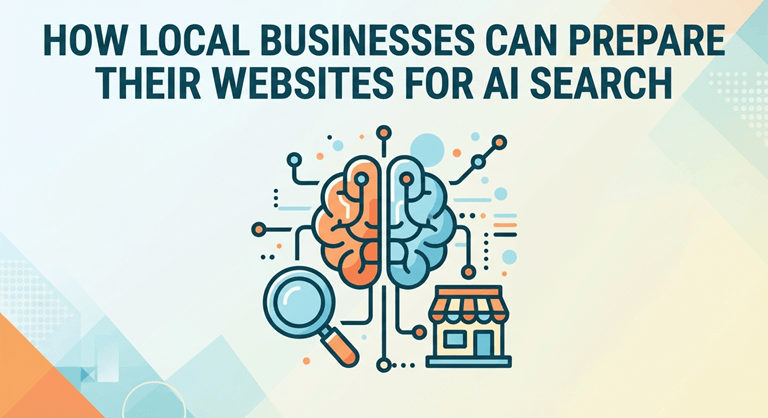
AI-powered search tools try to answer these questions by gathering information from websites, business profiles, directories, reviews, and other online sources. This means local businesses need to do more than mention a few target keywords on their websites.
Search systems must be able to understand who the business is, what it offers, where it operates, and why customers should trust it.
Preparing for AI search does not require rebuilding your entire website or following every new optimization trend. In most cases, it means making your existing information clearer, more complete, and easier to verify.
Start With Clear Business Information
Many local business websites use broad statements such as:
“We provide high-quality solutions tailored to your needs.”
That may sound professional, but it does not explain what the company actually does.
A better introduction would be:
“We provide website design, SEO, paid advertising, and business automation services for small businesses in Orange County.”
The second version gives both visitors and search systems useful information. It explains the services, target customers, and geographic area in one clear sentence.
Your website should make the following details easy to find:
- Official business name
- Main services
- Phone number
- Email or contact method
- Physical location, when applicable
- Areas served
- Business hours
- Professional licenses or certifications
- Types of customers served
These details should appear consistently on your homepage, contact page, about page, service pages, website footer, and business listings.
Google also recommends providing accurate business information through tools such as Google Business Profile so it can better understand and display a company across Search and Maps. Google Search guidance
Avoid forcing users to search through several pages just to understand what you offer. Your main business information should be obvious within a few seconds of reaching the website.
Give Each Important Service Its Own Page
A common mistake is placing every service on a single page with only one or two sentences about each one.
This may be enough for a visitor to see a basic list, but it does not provide much information for someone trying to make a decision. It also limits the number of specific questions your website can answer.
Each important service should have a dedicated page explaining:
- What the service is
- Who it is intended for
- What problems it solves
- What is included
- How the process works
- How long it may take
- What affects the price
- Which areas are served
- What the customer should do next
For example, a digital agency offering web design, SEO, Google Ads, and workflow automation should create a useful page for each service rather than discussing all four in a few short paragraphs.
A complete service page makes it easier for an AI search system to connect that page with a detailed customer question. It also gives potential customers enough information to decide whether the business is a good fit.
Businesses that need help planning and organizing these pages can work with an experienced provider such as Web Solutions CA, especially when the website needs to support search visibility, clear messaging, and lead generation.
Do not create dozens of nearly identical pages by changing only a service name or city. Every page should contain information that is genuinely useful for the people in that area.
Create Helpful Location and Service-Area Pages
Location pages can help search systems understand where a company operates, but only when the pages provide real information.
A page should not simply repeat the same paragraph while replacing “Irvine” with “Costa Mesa,” “Santa Ana,” or another city.
A useful location page might include:
- Services available in the area
- Neighborhoods or nearby communities served
- Typical response or travel times
- Local project examples
- Photos from work completed nearby
- Customer testimonials from the area
- Common local problems
- Local regulations or permit considerations
- Answers to location-specific questions
For example, an HVAC company could explain which cooling problems are common in the area, whether same-day appointments are available, and which nearby communities its technicians visit.
Businesses should also distinguish between a physical location and a service area.
A physical-location page represents an actual office, storefront, or branch. A service-area page represents a city or region where the company travels to customers. A business should never create fake office pages or imply that it has staffed locations where none exist.
Use Structured Data Accurately
Structured data is code that labels information on a webpage in a format search engines can understand more easily.
For a local company, Local Business or Organization structured data may identify details such as:
- Business name
- Website address
- Phone number
- Physical address
- Business hours
- Logo
- Service area
- Social profiles
Google explains that Local Business structured data can provide information about a company’s location, hours, departments, and other business details. Local business structured data documentation
However, structured data should confirm information that is already visible on the page. It should not be used to invent or exaggerate details.
Do not add:
- A false business address
- Services that are not actually offered
- Unsupported review ratings
- Areas the company does not serve
- Misleading business categories
Google recommends JSON-LD as a structured data format and advises businesses to validate their markup before publishing it. Structured data policies
It is also important to understand that there is no special AI schema that guarantees inclusion in an AI-generated answer. Accurate markup can support a broader SEO strategy, but it cannot replace useful content or trustworthy business information.
Answer Questions Real Customers Ask
FAQ sections can be useful for AI search, but only when they address genuine customer concerns.
Avoid filling a page with vague questions such as “Why are we the best?” or “Why should you choose us?” Instead, answer the questions customers ask before making contact.
A contractor might answer:
- Do you provide free estimates?
- Are permits included?
- How long does the project usually take?
- Do you work on occupied homes?
- Which cities do you serve?
An accountant might answer:
- Do you work with new businesses?
- Can you help with overdue tax returns?
- What documents should I bring?
- Do you offer remote appointments?
- How does your pricing work?
Give the direct answer first. Additional details can follow afterward.
“Yes, we offer remote consultations for clients throughout California. Documents can be uploaded securely before the appointment.”
This is more helpful than a long introduction that makes the reader search for the answer. FAQ content should be written for customers first. Adding FAQ schema does not guarantee that the questions will receive a special appearance in search results.
Keep Your Business Identity Consistent
AI systems may find information about a business from many different sources. These can include the company’s website, Google Business Profile, Bing Places, social media accounts, professional directories, licensing websites, and local publications.
If these sources contain conflicting information, it becomes harder to identify the correct business.
Review the following details across your online profiles:
- Business name
- Address
- Phone number
- Website URL
- Business category
- Services
- Hours
- Service areas
- Founder or professional names
- Credentials
Small variations are not always a serious problem, but major differences should be corrected.
For example, a business should not describe itself as a marketing agency on one platform, a software company on another, and a web designer somewhere else unless those descriptions accurately reflect its services.
Google notes that Organization structured data can help clarify and distinguish a company’s identity. Organization structured data documentation
Consistency does not mean creating profiles on every directory you can find. Focus on trusted platforms that are relevant to your location and industry.
Make Important Pages Easy to Access
Even the best content cannot appear in search if search engines cannot access it.
Important service and location pages should:
- Load successfully
- Be linked from other pages
- Appear in the XML sitemap
- Avoid accidental noindex tags
- Use the correct canonical address
- Contain descriptive titles and headings
- Be readable on mobile devices
- Include important content in the rendered page
Pages generally need to be indexed and eligible to appear in regular search before they can be used in AI-powered search experiences.
This does not mean every small business owner needs to become a technical SEO expert. It does mean that major website changes, redesigns, and migrations should be checked carefully.
A missing internal link, incorrect redirect, or no index setting can quietly remove an important page from search.
Publish Information Based on Real Experience
Generic content is becoming less useful because the same basic advice can already be found on thousands of websites.
Local businesses have an advantage: they possess first-hand knowledge that larger general websites often do not have.
Useful original content may include:
- Before-and-after project examples
- Original photos
- Customer case studies
- Common problems seen during actual jobs
- Local pricing factors
- Mistakes customers frequently make
- Project timelines
- Local regulations
- Checklists created from experience
- Advice from licensed professionals
Compare these two statements:
“Website speed is important for improving conversions.”
“After reducing a local contractor’s quote form from 11 fields to five, more visitors completed the form while the sales team still received the information it needed.”
The second example is more useful because it contains a real situation, a specific change, and a practical result.
Whenever possible, identify the person who created or reviewed the content. Include a name, role, relevant experience, and professional credentials when they matter to the subject.
Organize Pages Around Customer Decisions
A strong page should follow the questions a customer naturally asks.
Most local customers want to know:
- Do you provide the service I need?
- Do you serve my location?
- Can you handle my specific situation?
- How does the process work?
- How much might it cost?
- Why should I trust you?
- What should I do next?
Organize the page so these answers are easy to find.
Use descriptive headings, short paragraphs, examples, and clear calls to action. Avoid unnecessarily complicated language or oversized blocks of text.
There is no need to divide every sentence into artificial “AI-friendly chunks.” Clear organization and genuinely useful answers are more important than unsupported formatting tricks.
Continue Using Traditional SEO
AI search has created new terms such as answer engine optimization and generative engine optimization. These terms can describe how content is prepared for direct answers and AI-generated results.
However, they should not replace traditional SEO.
A local website still needs:
- Strong technical performance
- Descriptive page titles
- Clear headings
- Internal links
- Helpful content
- Accurate business listings
- Mobile-friendly design
- Local relevance
- Trusted links and mentions
- A clear conversion path
AI search features are still closely connected to traditional crawling, indexing, ranking, and quality systems. Businesses should therefore improve their SEO foundation rather than chase shortcuts.
A provider offering website design and SEO services can help connect site structure, content, technical performance, and conversion tracking instead of treating each part as a separate project.
Be careful with anyone promising guaranteed AI citations through secret markup, paid mentions, keyword formulas, or special files. No single tactic can guarantee that a business will be included in an AI-generated result.
Measure More Than Rankings
Traditional keyword positions still provide useful information, but they no longer tell the whole story.
Local businesses should also monitor:
- Organic impressions
- Branded searches
- Google Business Profile activity
- Phone calls
- Contact-form submissions
- Appointment requests
- Referral traffic
- Pages appearing in AI citations
- Leads assisted by organic search
The goal is not simply to collect AI mentions. A citation has limited value when the linked page is confusing, outdated, or unable to turn visitors into customers.
Review which pages receive visibility, what questions they answer, and whether visitors can easily take the next step.
Final AI-Search Readiness Checklist
A local business does not need to chase every new optimization trend. It should start with the fundamentals:
- Clearly explain what the business does.
- State where it operates.
- Create complete service pages.
- Publish genuinely useful location pages.
- Keep business details consistent.
- Use accurate structured data.
- Answer real customer questions.
- Make important pages crawlable.
- Publish first-hand examples and insights.
- Continue investing in traditional SEO.
- Measure calls, leads, and conversions—not just visibility.
AI search does not remove the need for a useful website. It makes clarity, accuracy, experience, and trust even more important.
Local businesses that clearly document their services, locations, processes, and expertise will be better prepared for traditional search results, maps, AI-generated answers, and whatever search experience comes next.
Popular on OTW Right Now!



About The Author

Gagan Bhangu
Founder of otechworld.com and managing editor. He is a tech geek, web-developer, and blogger. He holds a master's degree in computer applications and making money online since 2015.