
Why Industrial Component Shortages Still Matter in 2026
Global headlines about semiconductor and material shortages may feel quieter now than they did a few years ago. But on the factory floor, the reality is starkly different.
Many manufacturers still face hidden, persistent supply risks.
Being engineers, we frequently watch complete production lines reduced to a standstill due to the lack of some seemingly insignificant part. The absence of a part of an industry can slow down or put on hold repairs to a machine or even derail a project of expanding a plant. The supply chain has been stabilized on the macro level, but at the micro level, in terms of procurement of the particular industrial hardware, the plant managers and integrators have to face it on a daily basis.

What Counts as an Industrial Component?
Before diagnosing the supply chain, we need to define the hardware. When we discuss critical shortages in our field, we are rarely talking about raw materials. We are dealing with specialized, logic-driven, or precise power-handling hardware.
| Component Category | Primary Factory Function | Replacement Complexity |
| PLC Modules | Central logic and machine control execution. | High (Requires exact firmware/hardware match) |
| HMIs | Operator interfacing and process visualization. | Medium (Often requires panel retrofitting) |
| Drives and Inverters | Motor speed, torque control, and power regulation. | High (Tied to specific motor parameters) |
| Sensors | Environmental and physical data collection (proximity, pressure, temp). | Low to Medium (Standardized protocols exist) |
| Relays | Electromechanical or solid-state circuit switching. | Low (Highly interchangeable) |
| Power Supplies | Voltage conversion and stable power delivery. | Medium (Depends on footprint and output ripple) |
| Communication Cards | Network bridging (EtherNet/IP, PROFINET, Modbus). | High (Network topology dependent) |
Sourcing reliable industrial automation spare parts has shifted from a routine purchasing task to a core engineering strategy. This is why specialized distributors have become critical partners. Their value lies not just in having stock, but in maintaining deep inventories of specific hardware categories—especially legacy revisions—acting as an operational insurance policy to keep production lines running when OEM channels dry up.
Why Shortages Have Not Fully Disappeared
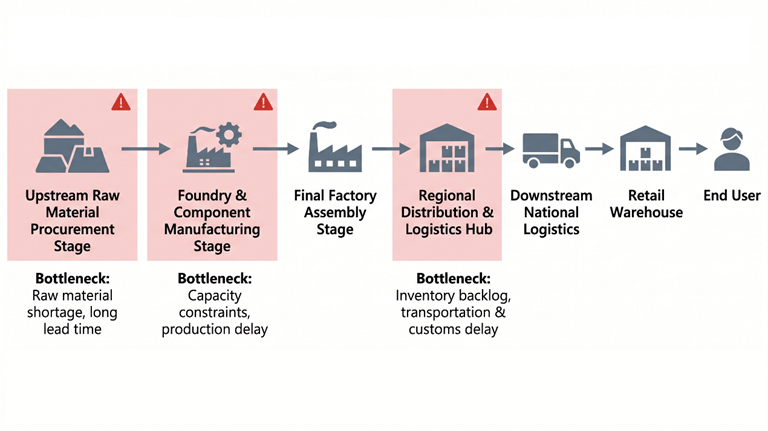
Long Manufacturing Cycles
Specialized components often require longer lead times than consumer electronics. A custom silicon package designed to withstand high industrial temperatures or heavy vibration cannot be rushed through a standard foundry.
Legacy System Dependence
In any manufacturing facility, you will find that the equipment was installed ten years ago- or even more. Numerous factories use equipment that is no longer in use or is outdated. The available replacements continue to reduce with the phasing out of older lines by OEMs.
Uneven Global Demand
The market is very fragmented. Some industries decelerate, and those that jump up without warning, taking over the component distributions in a violent manner (eg, renewable energy infrastructure, EVs).
Logistics Volatility
Still, shipping routes, customs hold-ups, and local inconveniences count. A part in a busy port is actually as useless as a not-yet-made part.
The Real Cost of One Missing Part
The invoice cost of a component is not often its real cost. The economic blowback.
Production Downtime
The machines are kept idle awaiting replacement. All lost throughput hurts the bottom line of the facility and it affects the schedule of the shifts.
Expensive Emergency Buying
In case of a downward line, normal procurement procedures are usually evaded. The buyers can be willing to pay colossal prices to get urgent inventory, expedited delivery or unverified brokerage costs simply to get things going again.
Maintenance Backlogs
The urgent crisis causes repair teams to delay important, scheduled preventative work to manage the crisis at hand. This method of firefighting reduces the general equipment reliability in the long run.
Customer Delivery Delays
Downstream customers are impacted by manufacturing delays. Any missed delivery due to a lost drive unit can readily hurt the long-term relationships that the vendor has with the company and result in a penalty on the contract.
Why PLC Modules Are Especially Critical
The brain of contemporary manufacturing is Programmable Logic Controllers. They can be the focus of machine control logic, that is, a processor failure causes the whole process involved to stop instantly.
Replacement typically requires exact compatibility.
There is no way to just replace one brand or even a single revision of firmware with another without rewriting the logic. Reprogramming options may take time and pose drastic risks of operational bugs when commissioning.
As engineers, we understand that replacing a processor is hardly ever a hardware replacement and is a software integration project. The surest and fastest road to recovery is always to get the physical match.
This reality is why accessing a deep, verified PLC modules inventory remains a non-negotiable requirement for facility managers aiming to minimize costly downtime.
How Companies Are Responding in 2026
Multi-Supplier Sourcing
Minimize channel reliance. Facilities also have an active risk mitigation strategy through the maintenance of established relationships with various independent distributors and authorized channels. It has resulted in a rediscovery of dependency on known, niche distributors such as Iainventory that focus on long-tail industrial parts and can work the global market to find even discontinued parts.
Strategic Spare Stock
The violent just-in-time inventory model has been adapted to the factory floor. The plants now store important stuff on the shelf, just in case of a failure.
Lifecycle Planning
Reactive maintenance is slowly being phased out. The engineering objective is to inspect the existing installations and upgrade old systems during planned closures, way before the crisis strikes.
Better Inventory Visibility
Use asset tracking and forecasting tools. Being able to know what is on your shelf–and what exactly is in your cabinets–helps to avoid frantic searches in the middle of your shift.
Warning Signs Buyers Should Watch
- Catching a supply issue early gives your engineering team time to pivot. Watch your supply chain closely for these indicators:
- Lead times suddenly increase: What used to take two weeks is now quoted at eight to twelve weeks.
- Frequent backorders: Standard catalog items are consistently marked out of stock by primary vendors.
- Price spikes: Sudden, unexplained increases in the base cost of routine hardware.
- Limited repair options: Refurbishment centers stop accepting certain models due to a lack of internal sub-components.
- Vendor end-of-life notices: The official, final signal that a hardware migration plan is required.
FAQ
Are shortages over in 2026?
Not completely. The overall semiconductor crisis has subsided, but risk can be tremendously different depending on component type and region. Special-purpose industrial silicon is susceptible to local failures.
Which parts are hardest to replace?
Targeted safety stock can be prudent on critical parts. It is a working insurance policy. The holding cost of a spare VFD will nearly always be less than the cost of three days of unplanned downtime.
Should companies stock more inventory?
Targeted safety stock can be prudent on critical parts. It is a working insurance policy. The holding cost of a spare VFD will nearly always be less than the cost of three days of unplanned downtime.
The story of shortage has not died; it has gone through a transformation. Industrial procurement involves the dynamics that should be carefully monitored. When the hardware failure is unavoidable, those companies that have planned, monitored their assets, and have resilient sourcing networks tend to recover more quickly and perform smoother operations.
Popular on OTW Right Now!
-
 Robotic Laser Welding Cell Safety: Class 4 Guarding, Interlocks, Viewing Windows & LSO Requirements
-
 Fiber Laser Engravers for Small Business ROI and Setup 2026
-
Building Safer and More Comfortable Properties with Modern Insulation in Valencia
-
 How Branded Laptop & Tablet Sleeves Improve Corporate Event Identity


About The Author

Gagan Bhangu
Founder of otechworld.com and managing editor. He is a tech geek, web-developer, and blogger. He holds a master's degree in computer applications and making money online since 2015.