
Top 7 Physical Therapist Software Solutions Clinics Are Switching To in 2026
According to the Physical Therapy Software Market Report by Transparency Market Research (2026), the global physical therapy software market was valued at $1.3 billion in 2024 and is forecast to reach $3.4 billion by 2035 – a signal that clinics worldwide are no longer treating technology as optional. The conversion is more than digital; it is about the tools that make the most impact on patient care, administrative effectiveness, and revenue.
That pressure is real. Research published in the Journal of Orthopaedic & Sports Physical Therapy (JOSPT, 2022) found that digital rehabilitation platforms significantly improve exercise adherence compared to non-digital approaches; yet a large share of clinics still rely on fragmented, disconnected systems that cost them time and patients alike.
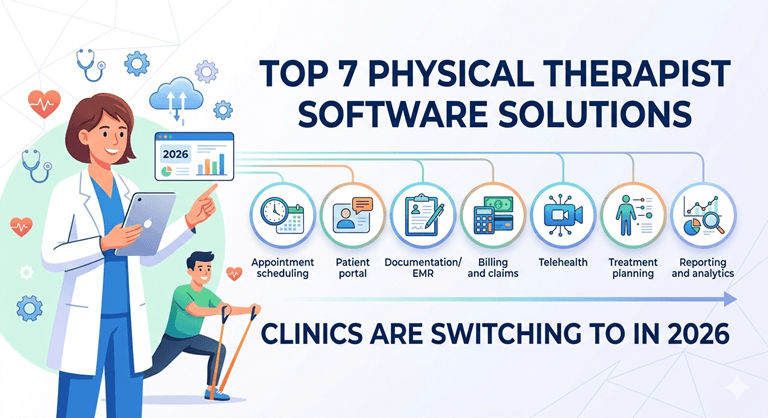
Which software for physical therapists should be given extra consideration? Here’s a look at the seven most impactful types – and the tools on which clinics are really moving in 2026.
Top 7 Physical Therapist Software Solutions
Home Exercise Program and Patient Engagement Platforms
This is the category most directly tied to clinical outcomes, and the one where the gap between good and poor software is most visible. Home exercise program (HEP) platforms enable therapists to create a structured exercise program, provide it to patients digitally, and monitor adherence remotely, rather than the print-out model used to be done in the past, which research has shown is unsuccessful.
Physitrack is one of the most widely adopted platforms in this category globally, used by over 110,000 practitioners across 174 countries. With a library of 17,000+ clinically validated exercise videos, a patient app,p and integrated outcome tracking, it’s a practical option for practices of all sizes, from solo to large hospital networks. It also enables Remote Therapeutic Monitoring (RTM) workflows, which are highly relevant to US clinics dealing with the CMS reimbursement policies.
What separates strong HEP platforms from weaker ones:
- Exercise library depth and clinical validation: generic fitness content isn’t sufficient for post-surgical rehab or neurological conditions.
- Patient app quality: notification systems, video playback, and feedback loops are all key factors in whether or not patients finish their programs.
- Outcome measure integration: standardized tools like GROC, WOSI, and condition-specific questionnaires should be built in, not bolted on.
- EHR compatibility: data captured in the HEP platform should flow into the clinical record without manual re-entry.
Physical Therapy EMR and Documentation Software
While the generic, hospital-based electronic medical record (EMR) systems struggle with the documentation processes used in physical therapy, purpose-built systems for physical therapy do a much better job of managing progress notes, functional assessments, treatment plan documentation, and documentation of clinical reasoning for each visit.
In this category, WebPT and Raintree Systems are often mentioned. The right EMR will lower documentation time per visit, provide defensible billing, and maintain a structured patient record for outcome analysis. The real question for clinics considering what they might do is which fits in with their existing scheduling, billing,g and HEP systems.
Some of the most frequent causes of revenue loss in PT practices include billing errors and claim denials. There are solutions that can help with this, such as billing software that automates claim scrubbing, has payer-specific rule sets, denial management workflows, and real-time eligibility verification.
The complexity of insurance workflows and the financial consequences of getting it wrong are driving the billing and revenue cycle management software functionality category to be the fastest-growing software functionality category for PT clinics, according to the Toward Healthcare Physical Therapy Back Office Software Market Report (2026).
| Software Category | Primary Function | Key Metric Impact |
| HEP & Patient Engagement | Exercise prescription, remote adherence tracking | Patient retention, clinical outcomes |
| EMR & Documentation | Clinical notes, treatment plans, and records | Documentation time per visit |
| Billing & RCM | Claims, coding, and denial management | Revenue capture rate, days in AR |
| Scheduling | Appointment management, waitlists | No-show rate, capacity utilization |
| Telehealth | Video consultations, remote care delivery | Geographic reach, patient access |
| Outcome Tracking | Standardized measures, progress reporting | Payer reporting, value-based contracts |
| Practice Analytics | Operational and clinical dashboards | Business decisions, staff performance |
Scheduling and Practice Management Software
Physical therapy scheduling software is more than just an appointment scheduling program. The more capable platforms can do insurance verification at the time of scheduling, dynamically manage waitlists, automate reminder emails to minimize no-shows, and provide the front desk team with a real-time update on therapist availability.
No-show rates for outpatient PT clinics are usually between 5–20% of appointments, and lost revenue is a missed opportunity for the continuity of patient care. The solution to both problems is scheduling software that automates reminders and allows for easy rescheduling of appointments for patients.
Telehealth Platforms Built for Rehabilitation
So, a general-purpose video platform—such as Zoom—was not built for clinical applications. As a physical therapy-specific platform, it has everything a physical therapist could want, such as HIPAA-compliant video, sharing of exercise programs during sessions, asynchronous messaging, and integration with clinical records.
But the good of it is more than just compliance: clinical quality. The therapist who can open the patient’s exercise program on a screen to view his form, adjust it,t and then send it to another therapist to whom the patient can send it back without having to switch applications or reopen the exercise program, is offering better care than the therapist trying to open the program four times and trying to keep four applications open.
Outcome Measurement and Reporting Tools
Clinics need to show results, not just services, to meet the direction of US payers, which are making the shift to value-based care models. Outcome measurement platforms offer standard questionnaires, automated at defined intervals, visualization of progress, and aggregate reporting based on payer contract or quality improvement program.
The best software for physical therapists in this category is not one that is a box to be checked off. It returns outcome information to clinical decision making, identifying patients that aren’t progressing as desired, which protocols are working best, and provides evidence to support clinical directors in making decisions to change care pathways.
Practice Analytics and Business Intelligence Tools
Most PT clinic owners have an idea of what’s going on in their business. There area few people who have granular data with which to be confident in acting on it. Practice analytics systems can combine clinical and operational data (visits/therapist, referral source performance, payer mix, discharge rates, outcomes by diagnosis, etc.) and present this information in dashboards that can help with real-world decision making.
The difference that matters: Analytics will only be as powerful as the data that is being fed into them. Usually, a disconnected system for each of the elements – scheduling, billing, HEPs – means there’s a lack of data coordination and a lot of manual work to reconcile data before it can be analysed. Platforms that draw on the same source of data for the clinical, operational, and financial data give far more accurate insights.
How to Evaluate the Best Software for Physical Therapists: A Step-by-Step Approach
- Audit your current workflow gaps. Before assessing any platform, it is important to record time wasters, the most common error areas, and the least engaged patient touch points. You need to have software solutions that will address specific issues, and you need to identify the issues first.
- Prioritize integration over feature count. It’s better to have a platform with 80% of the features you need that seamlessly integrates with your EMR and billing system than a best-in-class platform that creates a new data silo.
- Evaluate patient-facing experience separately. Log in as a patient! Download the app. Complete the onboarding process. Both the clinical team experience and the patient experience are real, nd bad patient UX directly impacts adherence and retention to the clinical team.
- Check compliance credentials specifically. HIPAA Compliance, SOC 2, and Data residency are not synonymous. Check out the vendor’s certification, not what he/she advertises.
- Request outcome data, not just case studies. Request outcome measures from vendors for similar types of clinics. It’s something that platforms that are truly and effectively results-oriented have. Those who don’t will do so with a story.
- Run a structured pilot before committing. A 30-60 day pilot of a specific subset of patients and therapists is much more likely to generate a meaningful signal than a demo. Record the rate of adherence, documentation time, and staff satisfaction before and after.
Physitrack delivers all aspects of the HEP, patient engagement, outcome measurement, and telehealth layers from one platform, eliminating extra integration variables and providing a quicker pathway to measurable outcomes for practices completing steps 1-6 above.
The Software Stack Is a Clinical Decision, Not Just an Operational One
It’s not only about how efficient the back office is but also about the tools that a physical therapy practice uses to form the care they’re able to provide. A clinic with a solid HEP program keeps patients and achieves better results. One that doesn’t have disconnected billing and documentation does not see the dollar. Categories listed above are not discrete purchases, but rather a multi-tiered system of care delivery, and practices with the most success in 2026 are those that view them as such.
Frequently Asked Questions
How can I tell if my current physical therapy software is actually costing my clinic money? Consider three metrics: claim denial, days in A/R, and patient drop-off between sessions. If some of these aren’t industry standards, then the software stack they rely on is a good place to start.
What should I look for in the best software for physical therapists running a multi-location practice? The challenge for multi-site practices is to have a central administration with location-level flexibility, ty which allows clinicians to work within their site-specific protocols and allows the clinic director to monitor performance for all locations from a single dashboard. At this level of magnitude, it’s imperative to have role-based access controls, aggregate outcome reports, ing and uniformity in patient communication tools across locations.
How do I know if a physical therapist software solution is genuinely HIPAA compliant, not just marketed as such? Don’t sign with the vendor without first requesting their Business Associate Agreement (BAA). This is a normal offer from a reputable dealer. In addition to the BAA, inquire about: Data encryption, access logging, Breach notification, and whether they have been audited by third-party security firms for security. Don’t be misled by marketing terms such as “HIPAA-friendly” or other such phrases that make no mention of a BAA.
Can I migrate patient data from my existing system without losing clinical history? There are lots of platforms that are established that support data migration, but not all of them have the best support. Request a migration plan from the vendor that provides more detail about how the structured clinical data (notes, outcome scores, exercise history) will be migrated, versus file attachments. It is standard practice to test-migrate a sample of records prior to cutover, and it is advisable to require it in the contract.
How long does it realistically take for a clinic team to get up to speed on new physical therapist software? With a well-designed onboarding, clinical staff are usually able to reach basic proficiency within 1 – 2 weeks. Designed to be fully integrated with the workflow, where the software actually speeds up the staff’s clinical work, the software’s full workflow integration typically takes 4 to 8 weeks. The biggest one is how different the new system is from the work that is being done already, and platforms that follow a familiar pattern have a significantly less curve.
Popular on OTW Right Now!
-
 How Route Optimization Software Reduces Fuel Costs and Delivery Delays
-
 The 8 Best AI Software Development Companies Right Now — And Why Most of Them Don’t Deserve the Title
-
 The Minimalist Toolkit: Streamlining Classroom Projects with a Free Audio Cutter
-
 How Property Management Companies Are Modernizing Financial Reporting




About The Author

Gagan Bhangu
Founder of otechworld.com and managing editor. He is a tech geek, web-developer, and blogger. He holds a master's degree in computer applications and making money online since 2015.