
The Shift to AI Search Is Here. Here Is How to Stay Visible
**This post is sponsored by Semrush. When you purchase through links in this article, we may earn an affiliate commission from Semrush.**
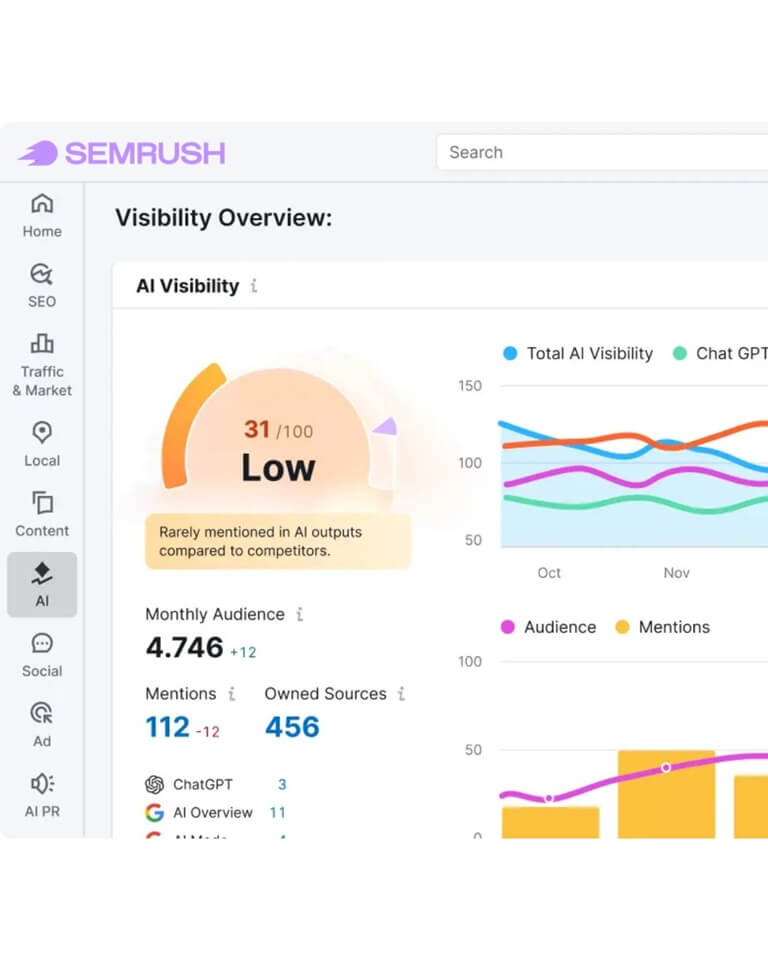
If your audience is already asking AI tools for answers, then your visibility depends on whether you show up in those responses. That is the reality now.
If you want to stay relevant in this shift, it is worth seeing how you can bring real marketing data into AI tools instead of relying on generic answers. You can explore how this works here.
Search is no longer a place people go to. It is a phenomenon that occurs everywhere. Within chat software, within coding applications, and within daily processes. AI is making the decisions, as the users are not even clicking on anything, and it implies that the old concept of being ranked on a search results page is just one of the aspects now.
The greater issue is whether your brand is included in the responses that people are receiving.
This is where Semrush One starts to feel different. It is not just about tracking performance anymore. It is about ensuring your data can live inside the tools people are already using.
At the center of this is something called Semrush MCP. It might sound technical at first, but the idea behind it is simple. It allows AI tools like ChatGPT, Claude, Cursor, and even VS Code to access real Semrush data. So instead of switching tabs or second-guessing what an AI response is based on, you are getting answers grounded in actual keyword data, competitor insights, and traffic information.
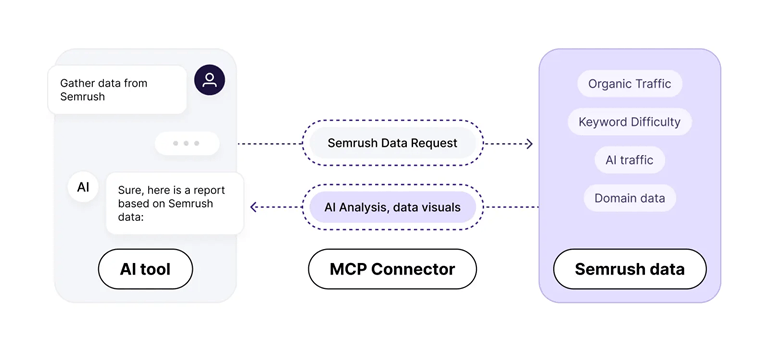
This makes the experience different in a slight yet significant manner. AI ceases to be an arena of crude concepts and begins to be something you can count on to make real choices.
This is not like introducing a new feature to anyone already using AI tools daily, but rather about correcting an omission. The majority of the population has already realized that AI may sound quite convincing in cases when the information is incomplete. The difference between speed and accuracy is where it goes wrong.
That gap begins to bridge by integrating Semrush data into those conversations.
You are able to inquire about the opportunities of keywords and receive answers that are based on the up-to-date data. You are able to search competitors without having to open several dashboards. It is even possible to create reports without pulling it all together. It is all done within the same place where you already work.
Such a workflow is differentiated over time.
You do not have to look at the rankings manually; have an AI agent track any changes and notify you about something significant. When competitors make a move, you can know early when they change their traffic rather than being caught up. Even a process as monthly reporting becomes less of an undertaking and more of an automated process that can be executed in the background.
It is not even a question of working more. It is to take the friction out of the already existing work.
And the fact that access to the Semrush MCP server is already a part of Semrush One, as well as the SEO Toolkit, makes this easier to adopt. No additional add-ons or complicated setup to be concerned with. It is just there in the system that is willing to integrate with the tools that you use.
This is why it is better to consider it as a workflow upgrade, but not a technical feature.
The change that is currently occurring is not merely a matter of tools. It concerns behavior. Individuals are querying AI prior to conducting a search, prior to making comparisons, and even prior to accessing a webpage.
That is, discovery is changing. Visibility must be brought up-to-date.
In case the AI fails to notice your brand, it will not feature it in its responses. And when not included in those answers, you are losing a portion of attention that was once delivered by the traditional search.
This is where having reliable data inside AI conversations becomes important. It is not merely a matter of convenience. It is concerned with ensuring that what you say is correct at the point of making decisions.
To see how this works in practice, here is a quick walkthrough of setting up Semrush MCP with OpenAI tools: Video Tutorial Link
The transition towards AI-driven discovery is already underway at the end of the day. Brands that emerge in AI responses will influence what users view, believe, and select.
Unless your brand is already involved in that conversation, it is time to initiate it.
You can take a closer look at how Semrush One brings real data into your AI workflows here: Semrush One Solution
Since it becomes something that occurs everywhere because search is becoming so, visibility cannot be based on the ability to switch tools. It must go with you, anywhere the work goes on.
Popular on OTW Right Now!




About The Author

Gagan Bhangu
Founder of otechworld.com and managing editor. He is a tech geek, web-developer, and blogger. He holds a master's degree in computer applications and making money online since 2015.