
The Promo Item People Actually Keep: What the Data Says About Notebooks
A lot of promotional merchandise has a short and unhappy life. It gets handed out, glanced at, carried home in a bag, and thrown away within the week, taking whatever budget it cost straight to landfill and delivering almost nothing on the way. Anyone who has organized an event and watched the branded tat pile up in the bins afterward knows the feeling. So the useful question to ask about any promotional item is not how cheap it is or how good it looks on the table, but whether people keep it, and whether keeping it does the giver any good. On both counts, the notebook does unusually well, and there is real data to say so.
Independent research into how promotional products perform has consistently found that usefulness is what determines whether an item survives. It seems like common sense, but people keep spending money on merchandise they don’t use and throw away the ones they don’t. That’s not a difficult task at all for a notebook. Industry research confirms that a big chunk of people keep a promotional notebook because it’s useful, so that’s a far more convincing indicator than an absolute number of impressions—it measures something useful that isn’t tolerated and thrown away. Looking at how printed notebooks improve brand visibility, it is this retention that does most of the work, not a headline number.
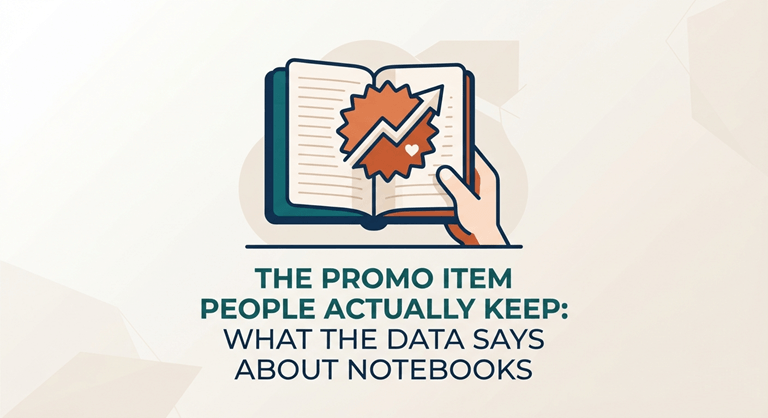
Use specific numbers rather than the business people’s numbers that float around the industry. A notebook may be used on a desk or in a bag; it’s not worn through a crowd, so its lifetime impression count is modest when compared to something like a bag or a pen that is used all day long in a public arena. It would be misleading to start with a large impression figure if it were for a book of notes, and there is a lot of recycled data out there for that purpose. The defensible strength of a notebook isn’t reach: it’s retention and regard. It is stored because it is useful; it is used regularly rather than put away; it is often kept for a good long while, meaning the brand on it is seen by the one person who matters most, the user, over months, not seconds.
The notebook truly becomes a worthwhile tool when it comes to the favourability data. Studies have shown that people have a very positive impression of the companies that provide them with useful promotional products, and even more so if they are in the UK, with the vast majority indicating they have a more positive view of a brand as a result of receiving a useful promotional item and over half of people saying they are more likely to do business with a brand as a result of receiving a useful promotional item. A notebook, which is genuinely useful and is held close, is well placed to capture that effect rather than squander it. The gift isn’t only observed; it’s recognized, and the recognition is what turns a gift into giving.
There is also a European aspect to be considered, since notebooks go against the notion that they are filler items. Notebooks are one of the most coveted promotional products, not grudgingly accepted, but actively received throughout Europe. A desired gift is received differently from one that is merely tolerated. But it must be said that preferences do differ according to country, and that a notebook is not always the top item on everyone’s list – it is always one of the favorites, but not always a runaway favorite. Even if it’s stated boldly, and that’s a bold statement, it’s a good position for a category to be in.
In contrast, all this is set before them, and the case is clear. A low-cost novelty item may be cheaper per item, but if it gets thrown out within a couple of days, its cost per actual impression would be horrid and its impact on your brand’s image—all but nonexistent or worse. A notebook is more expensive, but it is maintained because it is useful, used over an extended period of time, valued by the user, and in high demand throughout Europe. That’s what makes merchandise successful, not just successful, but make it count; that’s what makes the notebook always find its way onto the shortlist for things that pay off; that’s what makes merchandise make sense.
The lesson is generalizable beyond Notebooks, in fact. The cheapest item on the table isn’t the best promotional expenditure; it’s the one that is kept and used, which is the only place where a branded item does any work at all. Notebooks are actually excellent at reaching that state, and that’s the reason that the information on them reads just so well.
Popular on OTW Right Now!



About The Author

Gagan Bhangu
Founder of otechworld.com and managing editor. He is a tech geek, web-developer, and blogger. He holds a master's degree in computer applications and making money online since 2015.